A Kuwaiti store that wants Saudi customers usually starts by asking which plugin to install. The better first question is where the payment will be acquired, because that one answer decides the currency, the cards that work, what Apple Pay does, and who pays the tax when the parcel lands.
This is the order I work through with a store that already sells in Kuwait and wants to take orders from the Kingdom. None of it is legal advice, and the tax side belongs to an adviser. What follows is the build: the decisions that change what the checkout has to do.
The first decision is where the money is acquired
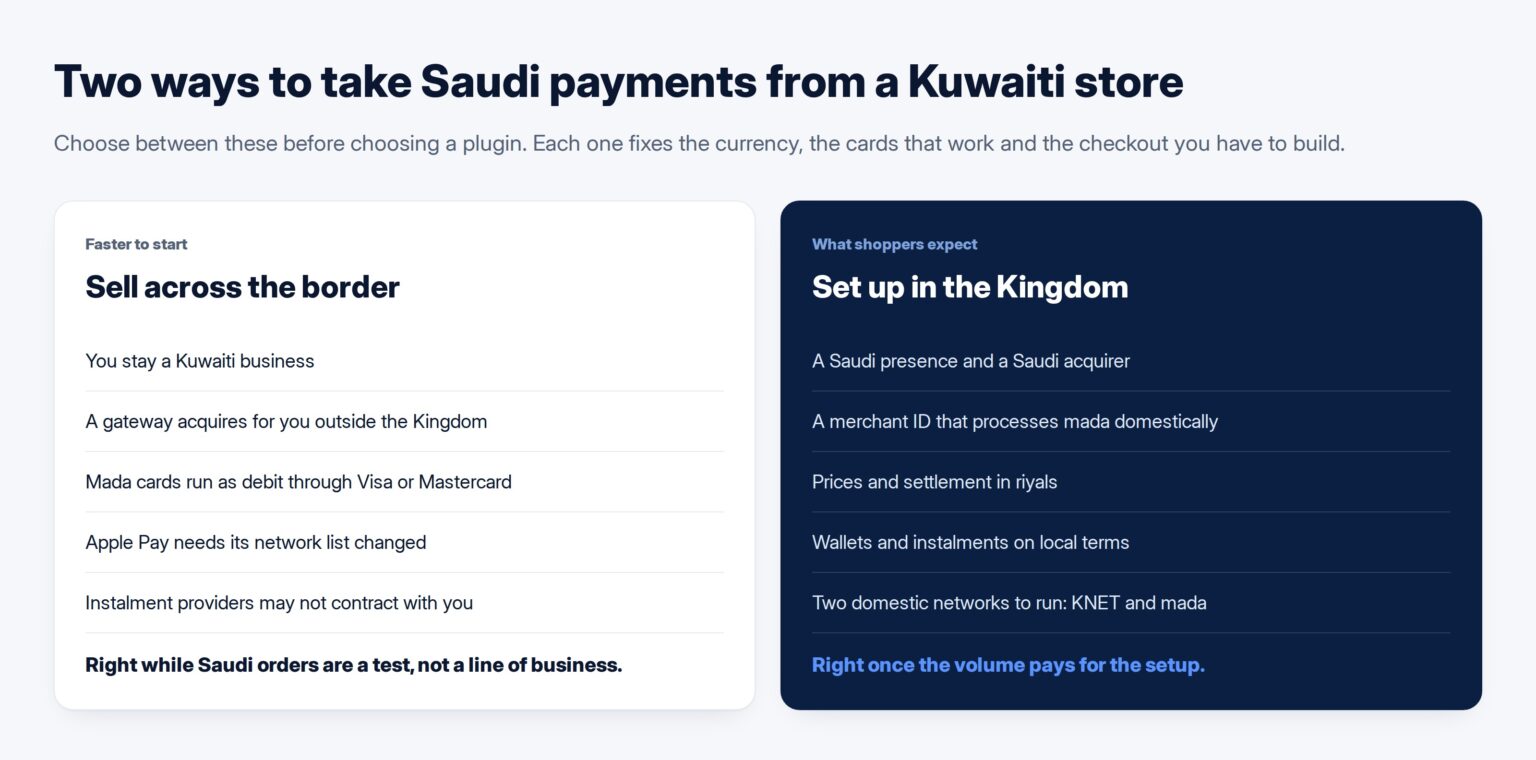
There are two shapes, and most of the confusion comes from treating them as one. In the first, you stay a Kuwaiti business and take Saudi cards through a gateway that acquires for you outside the Kingdom. In the second, you open a Saudi presence and contract with a Saudi acquirer, the way a Kuwaiti store contracts through its bank for KNET.
The first is faster and cheaper to start. The second is what Saudi shoppers actually expect once volumes are real. The mistake is choosing a platform plugin before choosing between them, then discovering that the plugin assumes the other shape.
The honest test is volume. If Saudi orders are a hopeful line in a plan, start cross-border and measure what actually arrives. If they already turn up every week through WhatsApp and Instagram, the domestic route pays for itself sooner than its setup suggests, because every Saudi card that fails at the border is a sale that went to a Saudi competitor.
Mada is the domestic network, and it changes behaviour at the border
Mada is the Kingdom’s own card network, and most cards in Saudi Arabia are debit cards. Many are co-badged with Visa or Mastercard, which is what makes cross-border selling possible at all. Checkout.com’s mada documentation puts the split plainly: processed outside Saudi Arabia, a mada card behaves as an ordinary debit card; processed inside, you first need a merchant ID from a Saudi acquirer.
Currency follows the same line. Tap’s documentation states that mada on its platform supports SAR only. So a store that prices in dinars and hopes to show the mada logo has made two decisions that contradict each other. Price in riyals and you are close to the domestic route; price in dinars and you are relying on the co-badge.
Apple Pay will pick the wrong network unless you tell it not to
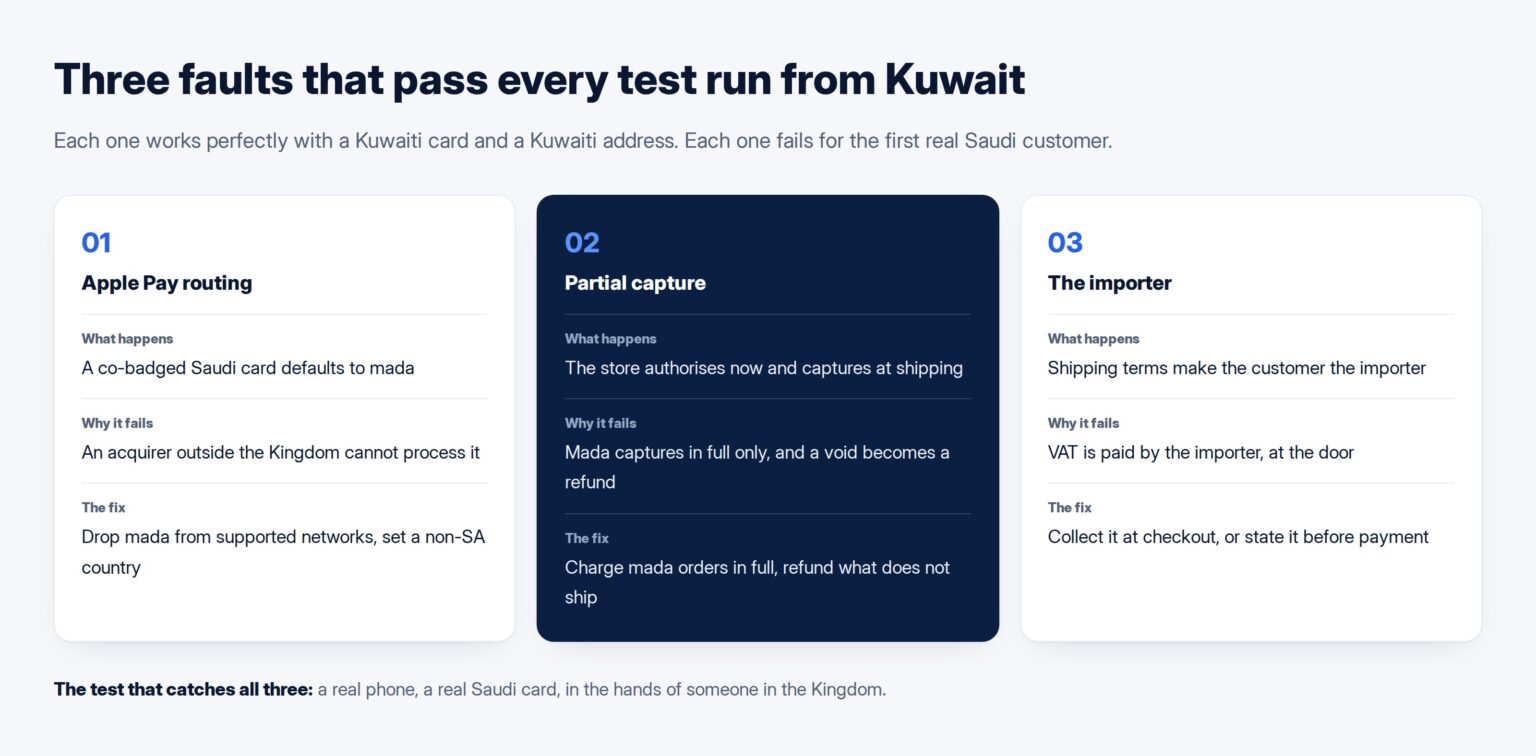
This is the fault I see most often, because it passes every test run from Kuwait. Apple Pay prefers mada for a co-badged Saudi card. If you are acquiring outside the Kingdom, that preference sends the payment somewhere your acquirer cannot process it.
The same Checkout.com page gives the fix: remove mada from the list of supported networks in your Apple Pay code, and set the merchant country to the country you process from, never SA. The card then runs on its Visa or Mastercard side. It is two lines of front-end code, and a store that skips them loses its most convenient payment method for exactly the customers it was built to reach.
Test it on a real phone, with a real Saudi card, in the hands of someone in the Kingdom. A simulator and a Kuwaiti card will both tell you it works.
Full capture only, which quietly breaks the way many stores ship
Many stores authorise at checkout and capture when the order ships, or capture part of an order when one item is out of stock. Mada does not support that. Checkout.com’s note is specific: mada transactions must be captured in full, partial captures and authorisations are not supported, and a void is turned into a refund.
That is an operational decision disguised as a payment setting. If your warehouse routinely ships partial orders, the Saudi flow has to charge in full and refund the difference, and your customer service has to explain a refund on an order they never cancelled. Decide that before launch, not after the first complaint.
The address field is already solved there, so use it
I have written before about the checkout that asks for an address that does not exist. Saudi Arabia is the opposite case. Saudi Post’s National Address gives every registered location a short address of four letters and four numbers, and Saudi Post says it speeds delivery without extra calls.
Most checkouts built for Kuwait have no field for it. Add one, make it optional rather than mandatory, and pass it to the courier. A customer who can type eight characters instead of describing a building is a customer who receives the parcel on the first attempt.
Look at the phone field while you are there. Many Kuwaiti checkouts accept only an eight-digit number, and a Saudi mobile is longer with a different country code, so the form rejects the customer before they ever reach payment. That failure never shows in a payment report, because it never became a payment.
Who imports the parcel decides who gets the surprise
A parcel sent from Kuwait to a Saudi home is an import, and ZATCA’s guideline on imports under VAT is short on this point: in all cases, VAT on goods is paid by the importer. If your shipping terms make the customer the importer, the customer meets a charge at the door that your checkout never showed.
That is where refused deliveries and angry reviews come from. The build choice is between collecting the duties and tax at checkout through a courier that clears on your behalf, or stating the charge clearly before payment. Either is defensible. Saying nothing is not.
Returns cross the same border the other way. Decide before launch whether a Saudi return comes back to Kuwait, goes to a local partner, or is refunded without collection when the item is cheap, because each choice changes the margin you can afford to offer. The regulatory side of selling into the Kingdom is in my note on Saudi compliance; this is the part that lives in your checkout.
Instalments and wallets are contracts, not buttons
Saudi shoppers expect instalments, and they expect wallets. Both arrive with their own rules. Checkout.com lists Tabby with disputes and chargebacks handled by Tabby itself, and with different capture rules depending on the processing model. Its stc pay entry supports automatic capture and refunds, but not authorisations, chargebacks or recurring payments.
So a subscription product cannot rely on stc pay, and a store that holds orders for approval cannot run Tabby on the wrong model. Instalment providers also assess the merchant, not only the shopper, so ask early whether they will contract with a company registered outside the Kingdom. Treat each as a separate agreement with its own onboarding, not as a logo you switch on.
The mada card list changes, and your routing has to follow it
Cards are recognised as mada by their first digits, the BIN. Checkout.com warns that mada updates its approved BIN list frequently and publishes the file with a date on it; the copy I read today was last updated on 2 September 2026. A checkout that decides routing from an old list sends new mada cards down the wrong path, and the customer sees a decline with no explanation.
This is maintenance nobody quotes for. Whoever looks after the store should refresh that list on a schedule and watch declines by card type in the first weeks after launch. A spike in one card range is almost always routing, not fraud.
The order I would do it in
First, decide the acquiring shape: stay in Kuwait and sell across the border, or set up in the Kingdom. Everything else depends on it. Second, choose the currency to match. Third, fix Apple Pay’s network list and country code, and test it with a real Saudi co-badged card, not a Kuwaiti one. Fourth, change fulfilment so mada orders are captured in full. Fifth, add the short-address field. Sixth, decide who imports the parcel and say so before payment. Only then add instalments and wallets, one agreement at a time.
None of these steps is expensive on its own. Together they are the integration line in what a website actually costs in Kuwait, and they are the reason two quotes for “a store that sells to Saudi Arabia” can differ several times over.
If you are still choosing a builder, put this list into the brief so the proposal you get back prices it rather than discovering it. Tothiq builds Shopify stores that sell across the GCC, Saudi checkout included, and it is where I send this work when it is a build rather than a decision. If you want the decision itself checked before anything is built, that is the kind of question I take on as a web consultant.
Frequently asked questions
Do we need a Saudi company to sell to Saudi customers online?
Not to start. A gateway that acquires outside the Kingdom can take co-badged Saudi cards as debit cards. To process mada domestically, in riyals, you need a merchant ID from a Saudi acquirer, which in practice means a Saudi presence. Many stores start cross-border and move once the volume justifies it.
Can we keep one store and one currency for Kuwait and Saudi Arabia?
You can, but pricing in dinars gives up the domestic mada route. A store can show riyal prices to Saudi visitors and still settle elsewhere if the platform and the gateway both support it. Check what your gateway actually charges and settles in before you promise a riyal price at checkout.
Why does Apple Pay work in testing and fail for Saudi customers?
Because you tested with Kuwaiti cards. A co-badged Saudi card defaults to mada in Apple Pay, and an acquirer outside the Kingdom cannot process it. Removing mada from the supported networks and setting a non-Saudi merchant country sends it through Visa or Mastercard instead.
Should the price include Saudi VAT and duties?
That depends on who imports the goods, and the tax question is one for an adviser. The build question is simpler: whatever the customer will pay at the door should be visible before they pay online. Either collect it at checkout or state it plainly.
Is KNET useful for Saudi customers?
No. KNET is Kuwait’s domestic network and Saudi cardholders do not carry it. A store selling to both countries runs two domestic methods side by side, KNET for Kuwait and mada for the Kingdom, plus the international cards both accept.