Most Kuwaiti companies choose a web agency the same way. Three or four proposals arrive, each a mixture of design language and line items, each quoting a different number for what sounds like the same thing. One is a third of the others. Somebody in the meeting says “they all look similar, let us take the middle one”, and that is the decision made.
Three years later the site is being rebuilt, and nobody can point to the moment it went wrong. It went wrong here, in the hour spent reading the proposals.
The difficulty is real. A proposal is written to be persuasive, not comparable. But there are a small number of questions that separate a supplier who has thought about the next three years from one who has thought about the next three months, and none of them requires you to be technical.
The price is not the number you are comparing
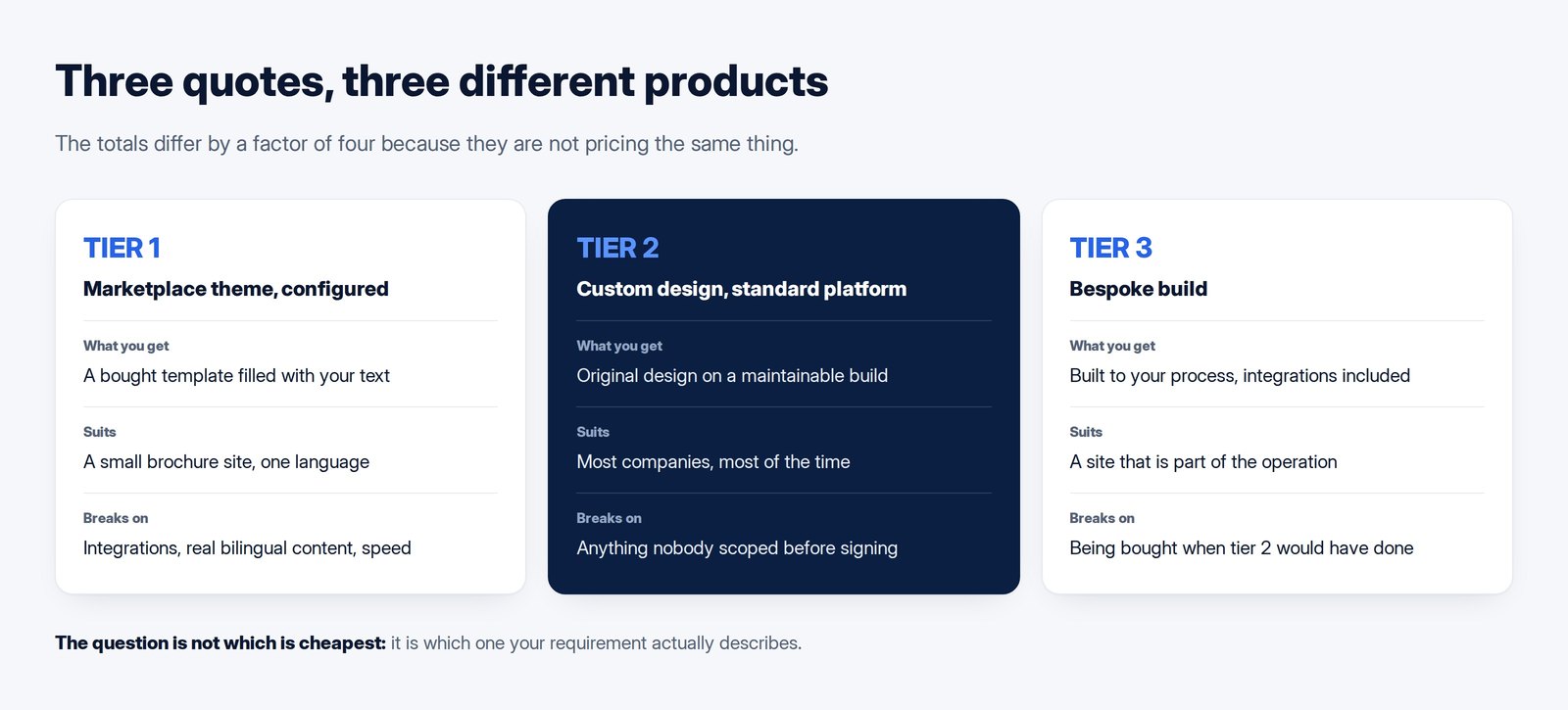
Two quotes for a corporate site can differ by a factor of four and both be honest. They are not pricing the same object.
The cheap one is usually pricing a theme purchased from a marketplace, configured with a page builder, filled with your text. The expensive one may be pricing a design from scratch, a custom build, content structure, and someone available when it breaks. Neither is wrong. What is wrong is comparing the two totals as though they describe the same deliverable.
So the first move is to stop comparing prices and start comparing what is inside them. Ask each supplier to state, in one line each: is the design original or a purchased theme, is the build custom or a page builder, who writes the content, and what happens in month four when something breaks. The answers will differ far more than the prices did.
What the line items usually hide
Four things are routinely absent from a proposal and routinely expensive afterwards.
Content. Almost every quote assumes you will supply the text and the photographs. Almost no company does, on time or at all. Projects in Kuwait stall on content more often than on development, and the delay is invisible in the quote because it was never priced. Ask explicitly who writes, who translates, and who chases.
Arabic. If the site is bilingual, ask whether Arabic is a real second version with its own URLs and its own search behaviour, or a browser translation plugin. The two cost different amounts and produce completely different outcomes, and only one of them can rank — Google’s own guidance on telling it about localized versions assumes separate, indexable URLs per language. A translated layer will look acceptable in a demo and fail quietly for years, which is the argument in how Arabic search actually behaves.
Payments and integrations. If you sell anything, KNET is not a checkbox. Nor is a link to your accounting system, your CRM or your inventory. These are the items most often moved to “phase two”, which is another way of saying they were not priced. Ask which integrations are in scope, by name.
After launch. Ask what happens in month four. Who applies the security updates, who is called when the site is down on a Friday, and at what rate. A proposal that ends at launch has quietly made the next three years your problem.
The ownership question, which almost nobody asks
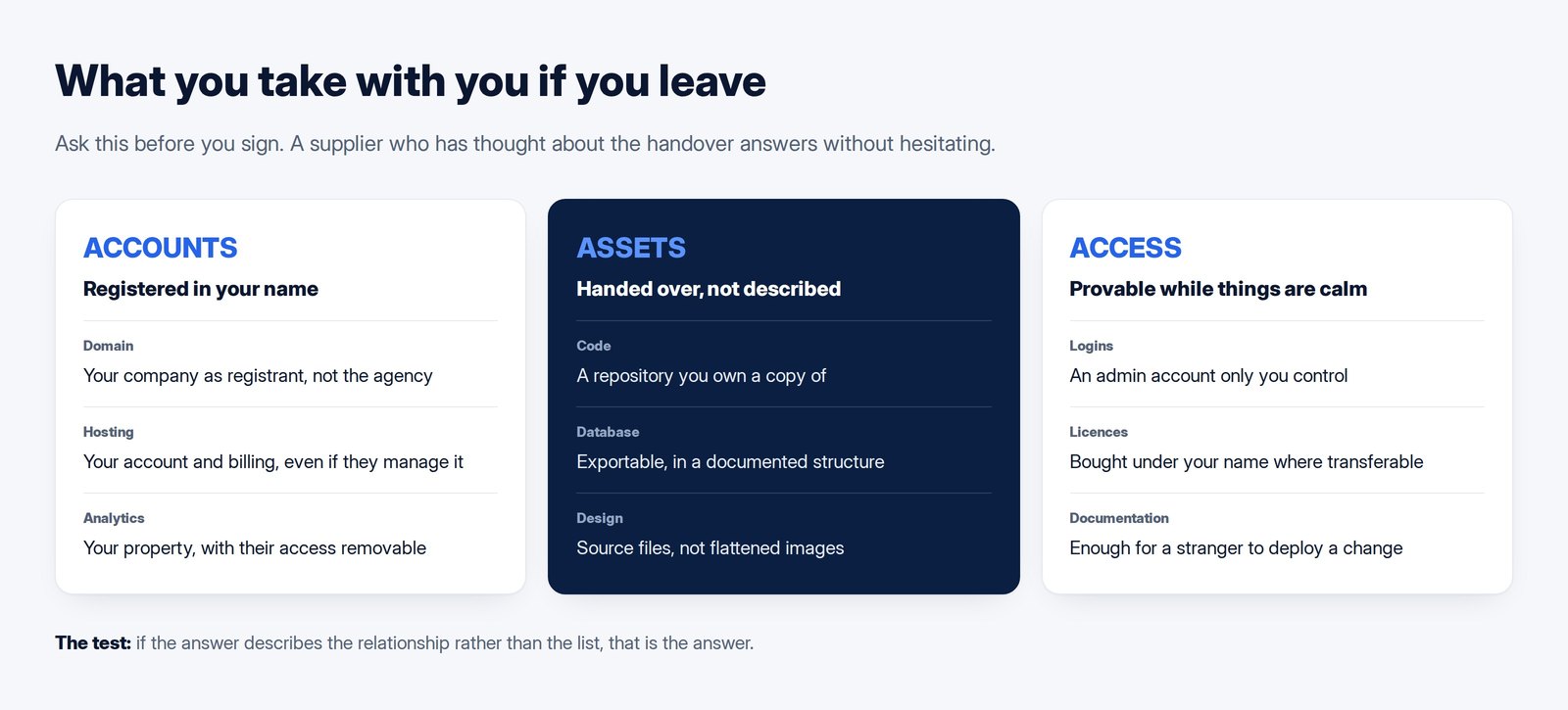
This is the single most valuable question in the whole process, and it takes one sentence: if we want to move to another supplier in two years, what exactly do we take with us?
The answer should be specific and unhesitating. The domain, registered in your company’s name. The hosting account, in your name, not resold through the agency. The code. The database. The design files. The analytics property. The content, in a form that can be exported.
What you are testing for is a common arrangement where the agency owns the hosting, the domain sits in their registrar account, and the site runs on a licensed theme tied to their account. Nothing dishonest has happened. But leaving becomes a negotiation rather than a decision, and the price of that discovery is usually a rebuild — and moving a live system is never the configuration change people expect, as the real cost of a migration sets out.
Ask it before you sign. A supplier who has thought about the handover answers immediately. One who has not will talk about the relationship instead.
Judging the portfolio without being technical
A portfolio is a set of screenshots, and screenshots are the least informative thing about a website. Two checks are worth more than the whole gallery, and you can do both from your phone.
Open three of their live sites and look at how fast they load on mobile data, not office wifi. Then look at whether the sites they built two years ago are still running, still updated, and still with the same client. Agencies show their newest work; the interesting question is what their older work looks like now.
If the site needs to be found as well as seen, ask what they will do about that, and listen for whether the answer is about structure or about promises. Google’s own guidance on how search works and its Core Web Vitals documentation are both public. A supplier who cannot discuss those in plain language is not going to deliver them.
What a good proposal contains
You are not looking for length. Some of the best proposals are three pages.
You are looking for a proposal that names what is being built and what is not, states who supplies the content and by when, lists the integrations by name, says what the site runs on and who else can maintain it, sets out what happens after launch and at what cost, and states plainly what you own at the end.
If those six things are answered, the price becomes meaningful, because you are finally comparing the same object. If they are not answered, the price is a guess dressed as a number.
The questions to ask in the meeting
Five, in order. None of them technical.
Who writes the content, and what happens to the timeline if it is late? Is Arabic a real version of the site or a translation layer? Which integrations are in scope, by name? Who maintains this after launch, and at what rate? And if we leave in two years, what do we take with us?
You will learn more from how they answer than from what they answer. A supplier who has been through this will have opinions and will disagree with you about something. One who agrees with everything is telling you they intend to build exactly what you ask for, which is only reassuring if you already know what to ask for.
Why this matters more in Kuwait than the price does
The market is small enough that supplier depth is a genuine constraint. A site built on an unusual stack by one person is a site you can only maintain through that person, and when they leave the country, the company inherits something nobody local wants to touch. That is a technology-leadership question before it is a web question, which is what fractional CTO work is for.
It is also small enough that reputation is checkable. You can call the last three clients. Almost nobody does, and it is the cheapest diligence available.
The pattern I see repeatedly is not companies buying badly designed websites. It is companies buying websites that were never designed to be handed over, maintained, or extended — and then paying again, from scratch, three years later. That is the subject of how a website should be scoped and built, and the reason what it is built on matters more than how it looks on the day it launches.
When you want the build itself rather than a second opinion on someone else’s quote, that is what my company does: Tothiq builds custom WordPress sites, bilingual from the start.
Frequently asked questions
How much should a business website cost in Kuwait?
There is no useful single figure, because the quotes describe different objects. A configured marketplace theme, a custom design on a standard platform, and a bespoke build with integrations are three different products, and the honest range between them is wide. The productive question is not what it costs but what is inside the price: design origin, build method, content ownership, integrations, and what happens after launch. Once those are specified, comparing numbers becomes meaningful.
Is a cheaper proposal always worse?
No, and treating it that way is its own mistake. A cheaper quote can be entirely appropriate for a small brochure site with no integrations and no bilingual requirement. What matters is whether the cheap price and your actual requirement describe the same thing. The danger is not the low number; it is the low number attached to a scope that quietly omits content, Arabic, integrations and maintenance.
Should the agency host our website?
They can manage it, but the account should be in your company’s name with your billing on it, and the same is true of the domain. Managed hosting bought through an agency is a normal, often sensible arrangement. Hosting you cannot access, on an account you do not own, is not a service arrangement — it is a dependency, and you will discover it at the least convenient moment.
How do I check an agency’s claims about SEO?
Ask what specifically they will do and how it will be measured, then check whether the answer describes structure or outcomes. Anyone promising a position on a keyword is describing something they do not control. A credible answer talks about site structure, URLs and redirects, page speed, structured data and content — and points at public documentation rather than a proprietary method. If URLs are changing, Google’s guidance on site moves with URL changes is the standard to hold them to. If they already run a site of yours, ask to see the Search Console data rather than a report they wrote themselves.
We already signed and it is going badly. What now?
Establish what you own before anything else — domain, hosting, code, content — because that determines every option you have. Then separate what is genuinely broken from what is merely late; the two need different conversations. Most projects in trouble are recoverable without changing supplier, and the ones that are not usually fail on ownership rather than on quality. Getting an independent read before committing to a rebuild is the cheapest step available and the one most often skipped.
The one-line version
You are not choosing a design. You are choosing what it will cost you to change your mind, and every question above is a way of asking that. If you want a second read on a proposal before you sign it, that is a conversation worth having while it is still a proposal.