It is one of the two or three questions I am asked most often, usually in the first meeting, and usually phrased with slight embarrassment, as though there were an obvious answer everybody else already knows. Do we need a Kuwaiti company to build our website?
There is an answer, and it is more useful than yes or no. The question bundles four separate things together, and once they are pulled apart, three of them have nothing to do with where the supplier is registered. The fourth is real and is almost never the one people are worried about.
Four different things get called local
When someone says they want a local supplier, they mean one or more of these, and rarely the same combination twice.
A Kuwaiti legal entity — a company with a commercial registration you could, in principle, take to court.
Physical presence — an office you can visit, people who will come and sit in your meeting room.
Market and language knowledge — Arabic that reads as though a person wrote it, and an understanding of how Kuwaitis actually buy.
Availability — somebody who answers when the site is down on a Friday.
These four correlate loosely at best. A Kuwaiti-registered company can staff your project entirely with contractors in another time zone, and frequently does. A supplier abroad can have a native Arabic team that has shipped for the Gulf for a decade. Judge each of the four on its own, and the postcode stops being the question.
What genuinely requires a Kuwaiti entity, and it is not the builder
Here is the part worth being precise about, because there is a real requirement in the neighbourhood and it attaches to the wrong party in most people’s minds.
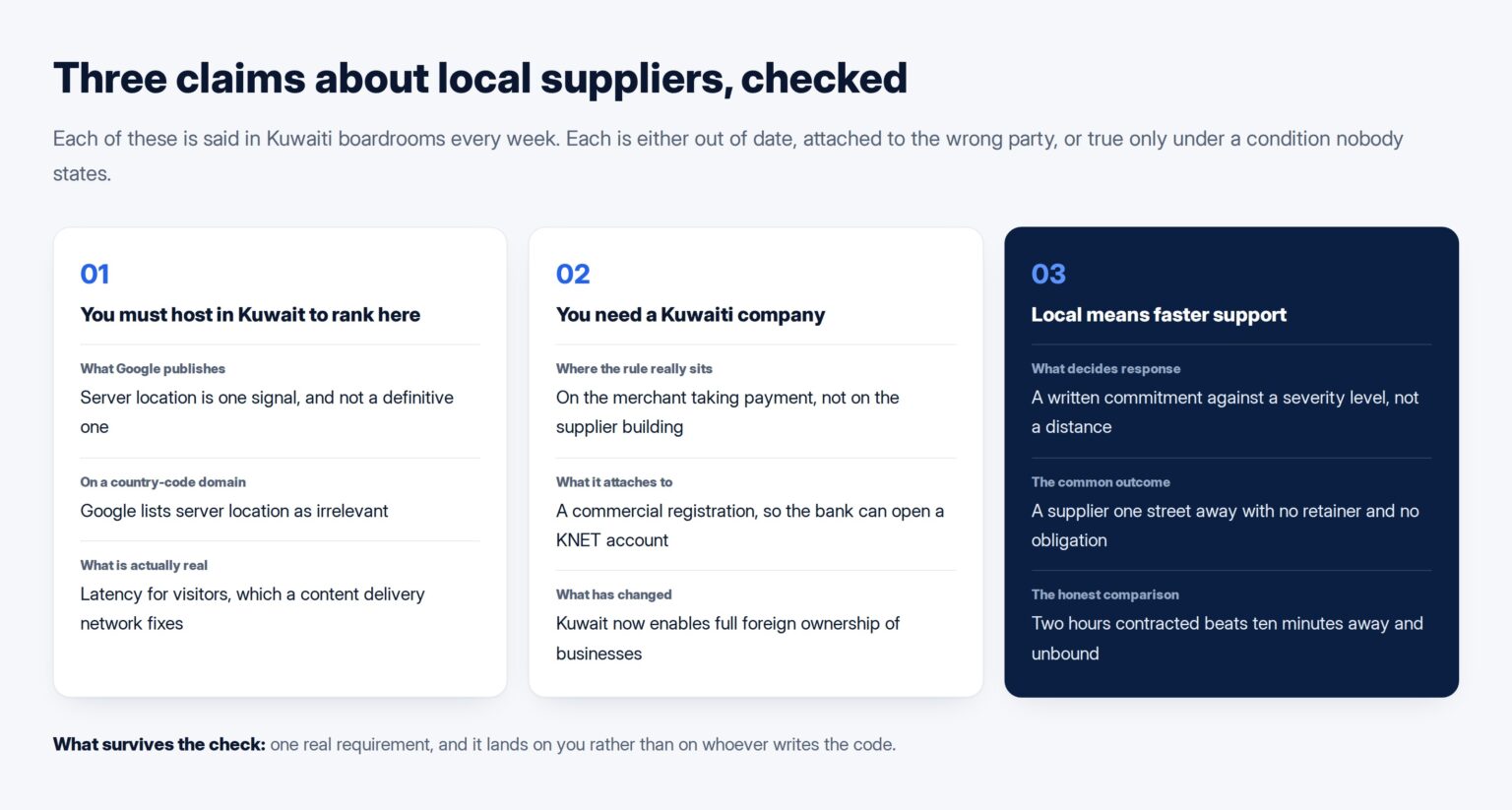
If you are taking payments online, the merchant is the one that needs the local standing. A KNET merchant account is opened by a Kuwaiti bank on behalf of a business with a commercial registration issued by the Ministry of Commerce and Industry. I have set out what KNET actually requires separately, because it decides more about your build than any design choice. But the requirement lands on you, the merchant. It says nothing about who writes the code.
It is also worth knowing that the premise itself has softened. Kuwait’s Direct Investment Promotion Authority exists to enable 100% foreign ownership of businesses here. The idea that a foreign supplier is somehow irregular is a decade out of date.
Two things do follow from the entity question, and they are contractual rather than technical: which country’s courts your agreement points at, and whether an invoice you can put through your own books arrives at the end of it. Both are answered by reading the contract, and neither is improved by proximity if the contract is bad.
The hosting claim, checked against the documentation
The most persistent sales line in this market is that your site must be hosted in Kuwait to rank in Kuwait. It is worth checking against what Google actually publishes.
Google’s guidance on multi-regional sites lists server location as one signal among several, and says plainly that because sites use content delivery networks or are hosted where the infrastructure is better, it is not a definitive signal. For a country-code domain the same page lists server location as simply irrelevant, because the domain already carries the geotargeting. The strong signals it names are the ccTLD and hreflang, neither of which has anything to do with your supplier’s address.
What is real is latency. A visitor in Kuwait waiting on a server several thousand kilometres away pays for it in time to first byte, and that is a genuine user-experience cost. It is also solved by a content delivery network for a few dollars a month, which is why it should not decide who you hire.
Where distance genuinely costs you
Now the part that is real, and that nobody puts in the proposal.
The cost of a distant supplier is not the hourly rate and it is not the quality. It is the number of round trips a decision takes. With four or five hours of overlap in the working day, a question asked in the morning is answered the same afternoon and settled by close. With one hour of overlap, the same question takes three days, because each half of the exchange waits overnight for the other.
Multiply that by the number of small ambiguities in a website project, which is in the hundreds, and the arithmetic is brutal. The project does not fail. It just takes twice as long, and everybody blames the wrong thing.
This is measurable before you sign. Ask how many hours of overlap you will have with the people doing the work, not with the account manager. Ask what happens to a question asked at four in the afternoon.
Where being local is not enough
The reverse error is just as expensive. Being in Kuwait does not mean the Arabic will be any good.
The W3C draws the distinction between internationalization and localization for a reason: the first is engineering that makes a second language possible, and the second is the writing and adaptation that makes it worth reading. A local agency that runs your English through a translation tool has done neither, and I have seen that more often from suppliers in Kuwait than from suppliers outside it, because nobody in the room questions it.
The same applies to the things that genuinely are local. Kuwaiti addresses have no reliable street numbering, which changes how your map pin has to be placed. The weekend is Friday and Saturday. Payment expectations are not the ones the templates assume. These are knowledge, not geography, and they can be bought from anywhere or missed from next door.
The four things that actually decide it
Strip out the postcode and this is what is left, and it is the same list wherever the supplier sits.
Who holds the accounts. The domain, the hosting, the analytics, the payment gateway credentials — registered to your company, with your email as the recovery address. This is the single most common way companies lose control of their own site, and it has nothing to do with distance.
Who answers when it breaks. Not a support address. A named response time against a defined severity, which is what a maintenance retainer is for. A supplier one street away with no retainer is slower than one eight time zones away with a two-hour commitment.
Who owns the output. The code, the content, the design files, in a form you can hand to somebody else. Ask what arrives when the relationship ends.
Whether the brief is any good. The largest single determinant of how a website project turns out is the clarity of what was asked for, and that is your side of the table. Knowing which half of the work you are buying and which pages you actually need settles more than the supplier’s location does. Distance amplifies a vague brief. It does not create one.
The arrangement most companies end up with
In practice the split that works is local for the things that need judgement in the room, and wherever-is-best for the things that need craft.
Someone here who understands the business, writes or approves the Arabic, holds the accounts and can sit in the meeting when the decision is contested. Build capacity wherever the right people are, working to a brief that has already been settled. That is the shape of most of the good work I have seen in Kuwait, and it is close to how I work myself.
What fails is the opposite arrangement: the judgement outsourced and the typing done locally.
What I would ask, wherever they are
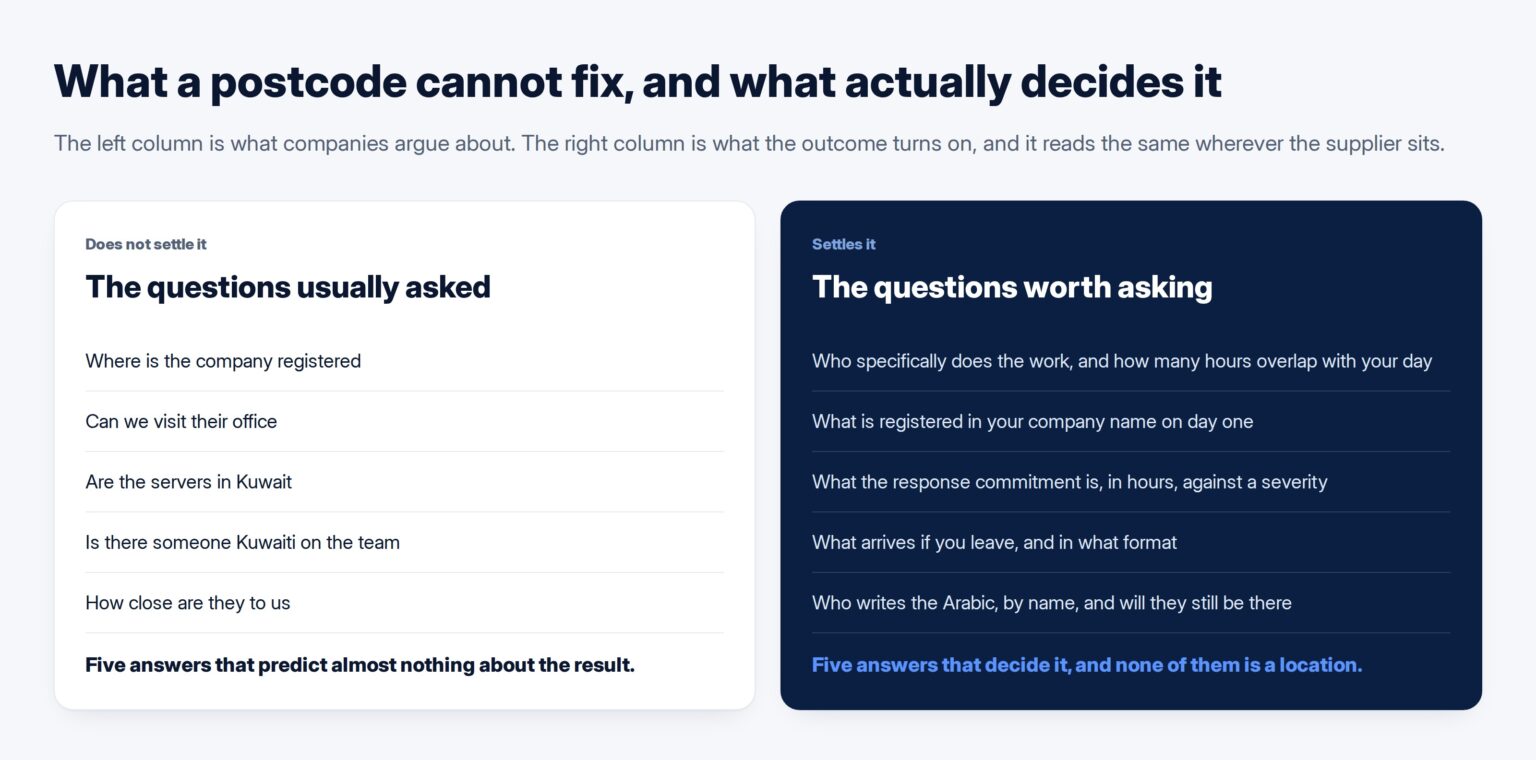
Five questions, and the answers matter more than the address on the invoice. Who specifically will do the work, and how many hours of your day overlap with theirs. What is registered in your company’s name on day one. What the response commitment is when the site is down. What arrives if you leave. And who is writing the Arabic, by name.
A supplier in Kuwait City who cannot answer those is the more expensive choice. That is really the whole argument, and it is also the work I am usually brought in to do — reading the arrangement before it is signed rather than after it has gone wrong.
Frequently asked questions
Does hosting in Kuwait help our search rankings at all?
Marginally at best, and Google says so itself: server location is one signal among several and, because sites commonly sit behind content delivery networks, not a definitive one. On a country-code domain it is listed as irrelevant. What it does affect is speed for visitors here, and a CDN solves that for a few dollars a month without constraining who you hire. If a supplier presents local hosting as a ranking requirement rather than a performance choice, that tells you something about the rest of the proposal.
What if there is a dispute and the supplier is abroad?
This is the one legitimate advantage of a local entity, and it is smaller than it feels. Pursuing a supplier through the courts over a website is rarely proportionate wherever they are registered. The practical protections are commercial, not legal: pay in stages against delivered work, keep the domain and hosting in your own name so you can walk away with the asset, and take a copy of the code and content at each milestone. Do those three and your exposure is a month of fees, local supplier or not.
Our board wants a company they can visit. Is that unreasonable?
It is not unreasonable, but it is worth naming what it buys. An office you can visit is a signal of permanence and it makes escalation easier, which are real. It is not evidence of capability, and it is not a substitute for a response commitment in writing. If the board wants it, the sensible compromise is the split arrangement: a local party accountable in the room, with build capacity wherever the right people are.
How do we check the Arabic before we commit?
Ask for a sample written for your business, not a portfolio page, and have somebody in your own company read it aloud. Machine translation and translated-from-English writing are both obvious within two paragraphs to a native reader: the sentences run in English order and the idioms are wrong. Also ask who specifically writes it, by name, and whether the same person will still be there in six months. This is worth more scrutiny than any other single element, because it is the part clients most often accept without checking.
Is a local supplier more expensive?
Usually yes on the rate, and not always on the total. A distant supplier that needs three days per decision can consume the saving in elapsed time and in your own team’s attention, which nobody prices. The comparison that means something is not the day rate but the cost of a completed decision, and that depends on overlap hours and on how clear the brief was. Quotes that differ by a factor of three almost always differ in scope rather than in geography.