Ask three suppliers in Kuwait to quote for the same website and you will get three numbers that do not look like they describe the same job. One will be a few hundred dinars, one a few thousand, one considerably more. Nobody is lying. They are quoting for different work, and nothing in any of the three documents tells you which.
Nobody publishes a price for this, which is itself informative. I have read the top-ranking Kuwaiti agency sites and not one of them will say what a website costs, or even what makes it cost more. So here is the honest version: not a price list, because a price list without a brief is fiction, but the six things that actually move the number, and how to tell which of them apply to you.
The number is decided before anyone opens a design tool
A website quote is mostly a bet on how many decisions are still open. When everything is settled — what the site is for, what pages exist, what the words say, what it has to connect to — the build is a known quantity and the price is tight. When those are open, the supplier is pricing uncertainty, and uncertainty is expensive whether or not it materialises.
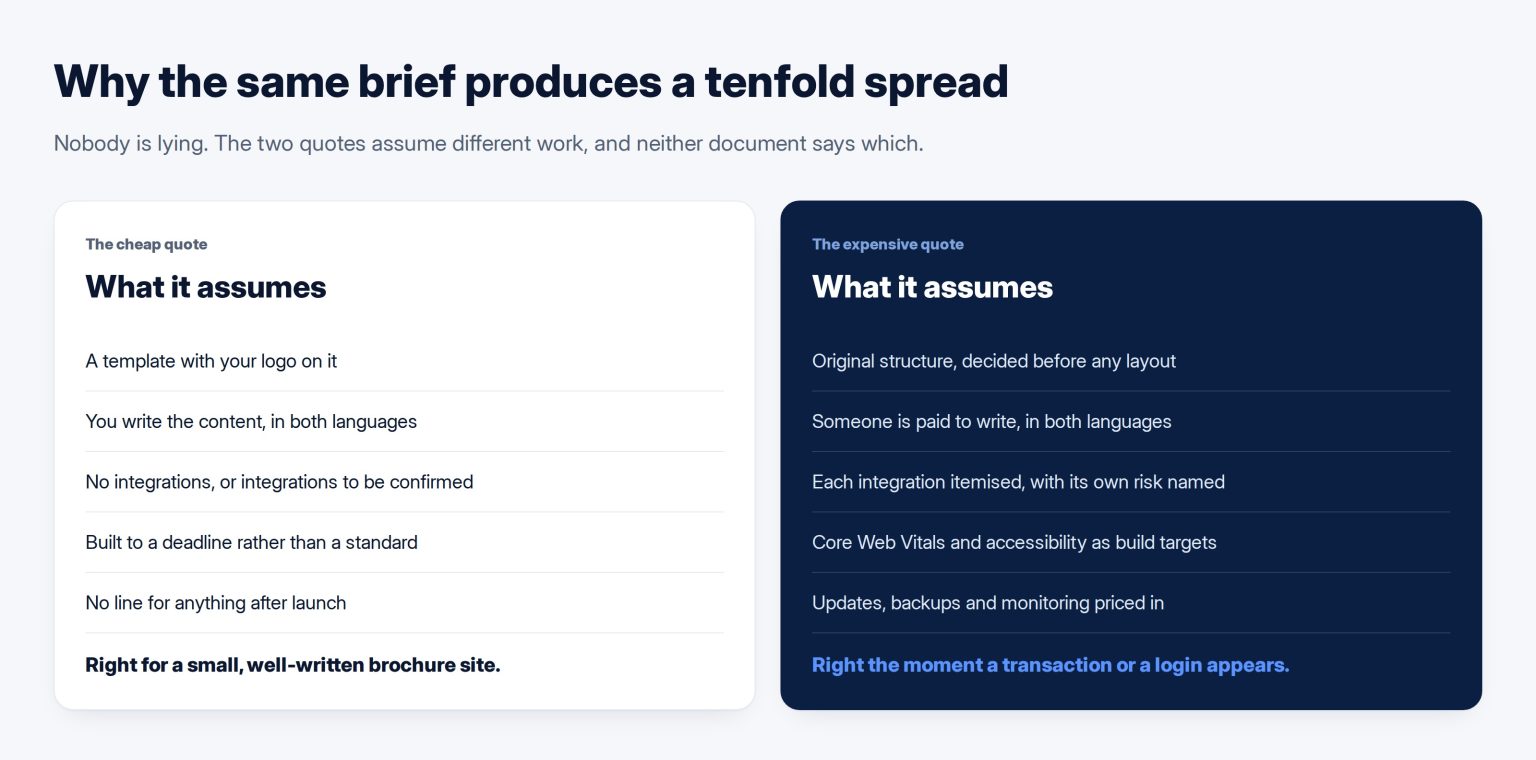
That is why the same brief produces a tenfold spread. The cheap quote assumes a template, your content, and no integrations. The expensive one assumes original structure, someone writing the copy, and two systems that have to talk to each other. Both are legitimate answers to questions nobody asked out loud.
1. Which of the three shapes you are actually buying
This is the single biggest factor and it is usually not discussed.
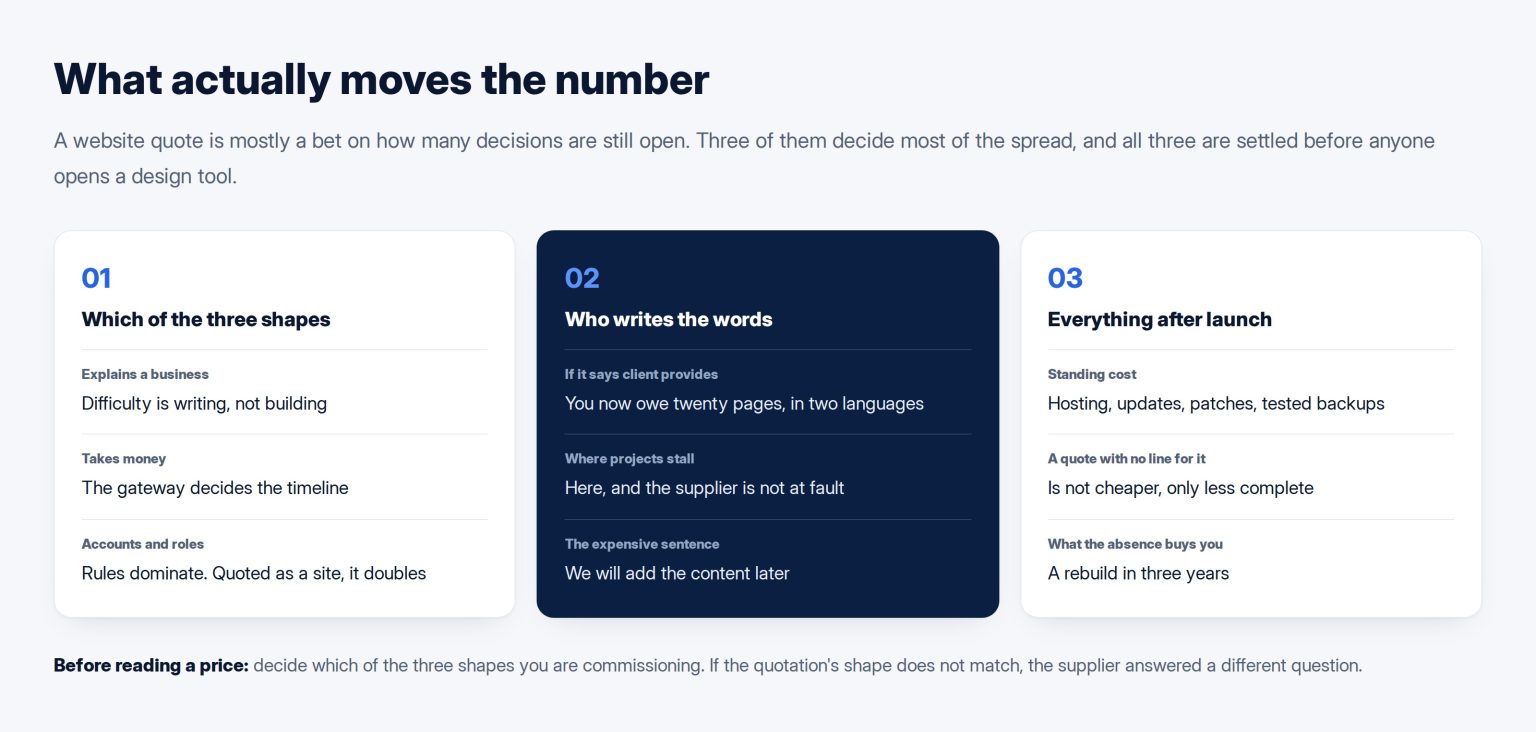
A site that explains a business. Twenty pages, a contact form, no transactions. Well-trodden work. Most of the difficulty is writing, not building.
A site that takes money or bookings. The moment a transaction appears, the cost changes character: payments, stock, refunds, failure states, receipts, and the bank’s own requirements before you can go live. In Kuwait the gateway is what decides the timeline, and it is a requirements problem long before it is a coding one — the reason I wrote out what KNET actually requires before your store can take a payment.
An application with accounts and roles. Anywhere users log in and see different things. Rules dominate: who sees what, what happens to data, what the system does when two people edit one record. Quoted as a website, this is how a project doubles.
Decide which of the three you are commissioning before you read a single price. If the quotation’s shape does not match, the supplier answered a different question — the distinction I set out in what you are actually paying for in design against development.
2. Who writes the words
The cheapest line in most quotes, and the one that most often blows the timeline.
If the answer is “client provides content”, the price you are reading assumes work you have not scheduled. Someone in your company now owes twenty pages of finished copy, in two languages, on top of their actual job. That is where projects sit for months, and the supplier is not at fault when they do.
Copywriting is real money and it is worth paying for, but the choice has to be made deliberately. A layout designed around invented text collapses when the real sentences arrive, which is why “we will add the content later” is the most expensive sentence in the project.
3. How many languages, and how honestly
Arabic is not a checkbox. A bilingual site is not one site with a translation layer; it is a site whose layout mirrors, whose dates and numbers behave differently, whose line lengths change, and whose forms, error messages, confirmation screens and notification emails all have to work twice.
Budget for Arabic as its own scope, not as a percentage uplift. The version that gets treated as an uplift is the version that reads as machine-translated, and the reader can tell within a sentence.
4. What it has to connect to
Every integration is a separate project wearing the costume of a feature. A payment gateway, a booking system, an accounting package, a delivery provider, a CRM — each one has its own requirements, its own approval process, and its own way of failing.
Integrations are also the least predictable part of any estimate, which is why an honest supplier will price them separately and say which one worries them. One who says every part of the estimate is equally certain has not built one.
The reason they are unpredictable is not the code. It is that each one belongs to somebody else — their approval process, their release schedule, their idea of what an error means. MDN’s performance documentation makes the related point about third-party resources: everything you embed becomes part of your page’s behaviour, including its slow days. You are not buying a feature, you are adopting a dependency.
5. What standard it is built to
Two sites can look identical and cost very differently, because one was built to a standard and one was built to a deadline.
Performance is measurable, not a matter of taste: Google’s Core Web Vitals set specific thresholds — largest contentful paint within 2.5 seconds, interaction to next paint under 200 milliseconds, layout shift at or under 0.1, judged on real visits. Accessibility is the same: W3C guidance on involving users is clear that this is a design activity rather than a final inspection, and retrofitting costs several times what building to it costs.
You do not have to buy the highest standard. You do have to know which one you are buying, because the gap shows up later as a rebuild rather than as a discount now.
6. What happens after launch
The launch price is not the cost of the website. The cost of the website is the launch price plus what it takes to keep it alive.
Hosting, the domain, certificates, third-party services, updates to the platform and its plugins, security patches, backups that someone actually tests, and the small changes you will want every month. WordPress’s own requirements page is a reminder that the platform underneath moves whether or not you do — PHP and database versions age out, and something has to keep pace.
A quote with no line for any of this is not cheaper. It has moved a cost you will definitely incur off the page you are comparing, and that absence is exactly why Kuwaiti companies end up rebuilding every three years instead of maintaining what they have.
What I would ask for instead of a price
Do not ask three suppliers for a number. Ask all three for the same five lines, and the numbers become comparable for the first time.
- Discovery and structure — what the site is for, what pages exist, what each one has to do.
- Content — who writes it, in which languages, by when. Named, with a date.
- Design — how many layouts, at how many widths, with how many rounds of revision.
- Build — by capability, with every integration itemised rather than folded into a total.
- After launch — updates, backups, monitoring, and who is called when it breaks at nine at night.
A supplier who will not produce that has not planned the work, which is the same test applied to the whole document in how to read a website proposal in Kuwait.
Why cheap is sometimes exactly right
None of this is an argument for spending more. A small company that needs a credible presence, a contact form and pages that load quickly should buy exactly that, and a template build with good writing will serve it for years. Nielsen Norman’s long-running argument for discount usability makes the same point from the research side: most of the available benefit comes from a small, cheap fraction of the possible effort.
The mistake is not spending too little. It is spending on the wrong half — an elegant design over a fragile transaction, or a sophisticated build under text nobody has written. Spend where the risk is in your project, not evenly out of fairness.
That judgement is most of what I am asked for, whether the engagement is website design and build, WordPress development, or simply reading three quotes with someone before they sign one.
For a number rather than a range, my company quotes the build directly: Tothiq, website design and development.
Frequently asked questions
So what does a website cost in Kuwait?
For a business-explaining site with original structure and professionally written bilingual copy, expect the writing to be a meaningful share of the total and the build to be the predictable part. For anything taking payments, expect the gateway and its requirements to dominate the timeline and a significant part of the cost. Anyone giving you a firm number before knowing which of the three shapes you need is guessing, and the guess protects them rather than you.
Why is the cheapest quote sometimes the most expensive?
Because of what it excludes rather than what it includes. Content you have to write, integrations quoted as “to be confirmed”, no maintenance line, and no statement of what you own at the end. Each of those becomes a conversation later, and later conversations happen with no competing quote on the table.
Should we pay a fixed price or by the day?
Fixed price for work that is genuinely defined — a known set of pages, a known design, content ready. By the day for work that is still being discovered, which usually means anything involving integrations or an application. A fixed price on an undefined brief is not certainty; it is a supplier pricing in their worst case, and you paying for it whether or not it happens.
How much should we set aside per year after launch?
Enough to cover hosting and services, platform and plugin updates, backups that get tested, and a small monthly allowance for changes. Treat it as a standing cost rather than an occasional expense. The companies that skip it do not save the money — they spend it in a lump three years later, on a rebuild they describe as necessary.
Does a template mean we save on design?
It removes the drawing, not the deciding. You still choose what the site is for, what each page must do and what the words say, and a template constrains those choices rather than making them. Templates suit the first of the three shapes well and rarely survive contact with a transaction.