Most conversations about website design in Kuwait start in the wrong place. Someone shows you a competitor’s site, someone else mentions a colour, and within ten minutes the discussion is about taste. Taste is the least consequential thing about a website. The decisions that determine whether a site earns enquiries are made before anyone opens a design tool, and they are rarely the ones being argued about in the meeting.
This is a practical guide to commissioning and judging a website design for a Kuwaiti business: what actually matters, what to ignore, how to handle Arabic and English properly, and how to hold a designer to a standard you can verify yourself without being technical.
What “website design” means in 2026
A page is now read three ways, by three very different readers, and only one of them cares what it looks like.
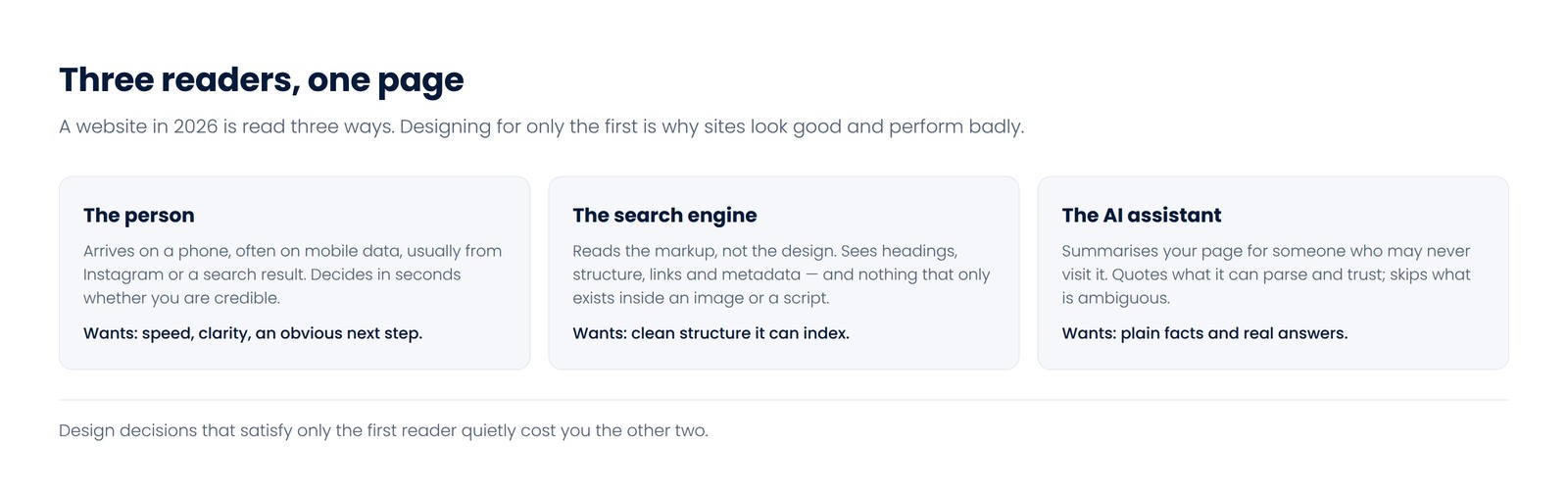
The person arrives on a phone, usually from Instagram or a search result, often on mobile data rather than wifi, and decides in a few seconds whether you look credible. The search engine never sees the design at all — it reads markup, so a heading that is merely large blue text is not a heading to it. The third reader is new and changes the brief: an AI assistant summarising your business for someone who may never visit your site, quoting what it can parse and trusting what is unambiguous.
That third reader is why a beautiful site can be commercially invisible. If your services, your location and your answers exist only inside images, sliders or scripts, the assistant has nothing to quote and will describe a competitor instead. I have written about that shift in detail in the guide to SEO, AEO and GEO for Kuwait, but the design consequence is simple: content that matters has to exist as real text, in real structure, on the page — and, where it helps, described with the structured-data formats in Google’s documentation so a machine can read it without guessing.
Five decisions that outrank the visual design
Settle these before the first mockup. Each of them is cheap to decide now and expensive to reverse after launch.
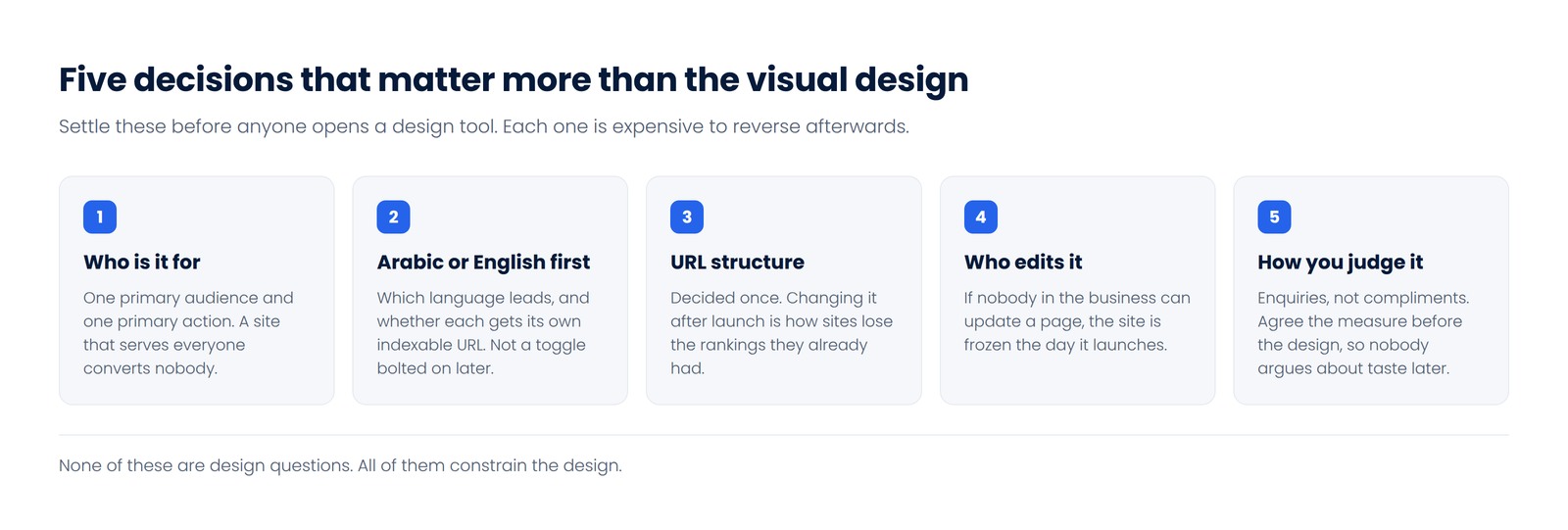
Who it is for, and what you want them to do. One primary audience, one primary action. A site built to satisfy every stakeholder in the company converts nobody, because every page ends up carrying five competing calls to action and the visitor chooses none of them.
Which language leads. In Kuwait this is a commercial decision, not a technical one, and it should be made deliberately rather than defaulting to English because the agency finds it easier.
URL structure. Decide it once. Changing URLs after launch without one-to-one redirects is the single most common way a Kuwaiti business loses rankings it already had, and the damage stays invisible for weeks.
Who edits it afterwards. If nobody inside the business can publish a page, the site is frozen the day it launches and every small change becomes an invoice. That is a design constraint, because it dictates how the templates are built.
How you will judge it. Agree the measure before the design exists — enquiries, bookings, qualified calls — so that sign-off is not a debate about personal preference. Compliments are not a metric.
Arabic and English, properly
This is where most bilingual sites in Kuwait quietly lose their Arabic audience, and it is almost never because of the writing. It is structural. Both languages need their own indexable URLs, correct hreflang, and a layout built with CSS logical properties so direction is a property of the document rather than a pile of right-to-left overrides added at the end. The W3C guidance on dir and bidirectional text is the authoritative reference, and it explains most of the bugs designers discover late.
Typography matters more than people expect. Arabic set in a font that was designed for Latin letterforms and stretched to fit looks wrong to an Arabic reader in a way that is hard to articulate but easy to feel — and it undermines credibility before a single word is read. Choose a family with genuine Arabic design, such as those in the Google Fonts Arabic subset, and check line height separately for each script.
Finally, Arabic copy should be written, not translated. A translated caption reads as a translated caption, and Kuwaiti customers notice immediately. The fuller treatment is in the guide to Arabic UX in the GCC.
Mobile-first is a constraint, not a layout
Everyone says mobile-first. Very few designs are tested that way. The site is reviewed on a large monitor in an air-conditioned office on fast wifi, signed off, and then meets its actual audience: someone standing outside on mobile data with one hand free.
Treating mobile as a constraint changes real decisions. Hero images stop being decorative and start being a performance cost. Long menus become a liability. The contact action moves to where a thumb can reach it. Fonts get tested at the size people actually read them, not the size they look good in a presentation. And speed becomes a design consideration rather than something handed to a developer afterwards — measured against Core Web Vitals on a real device, not a desktop score.
One test settles most arguments: open the site on your own phone, outside the office, and try to complete the main action. If it is slow, or you have to hunt for the button, no amount of visual polish will fix the number of enquiries you get.
How to judge a design without being technical
You do not need to read code to hold a designer to a standard. Ten checks cover most of what goes wrong, and every one of them can be verified by the person paying for the site.
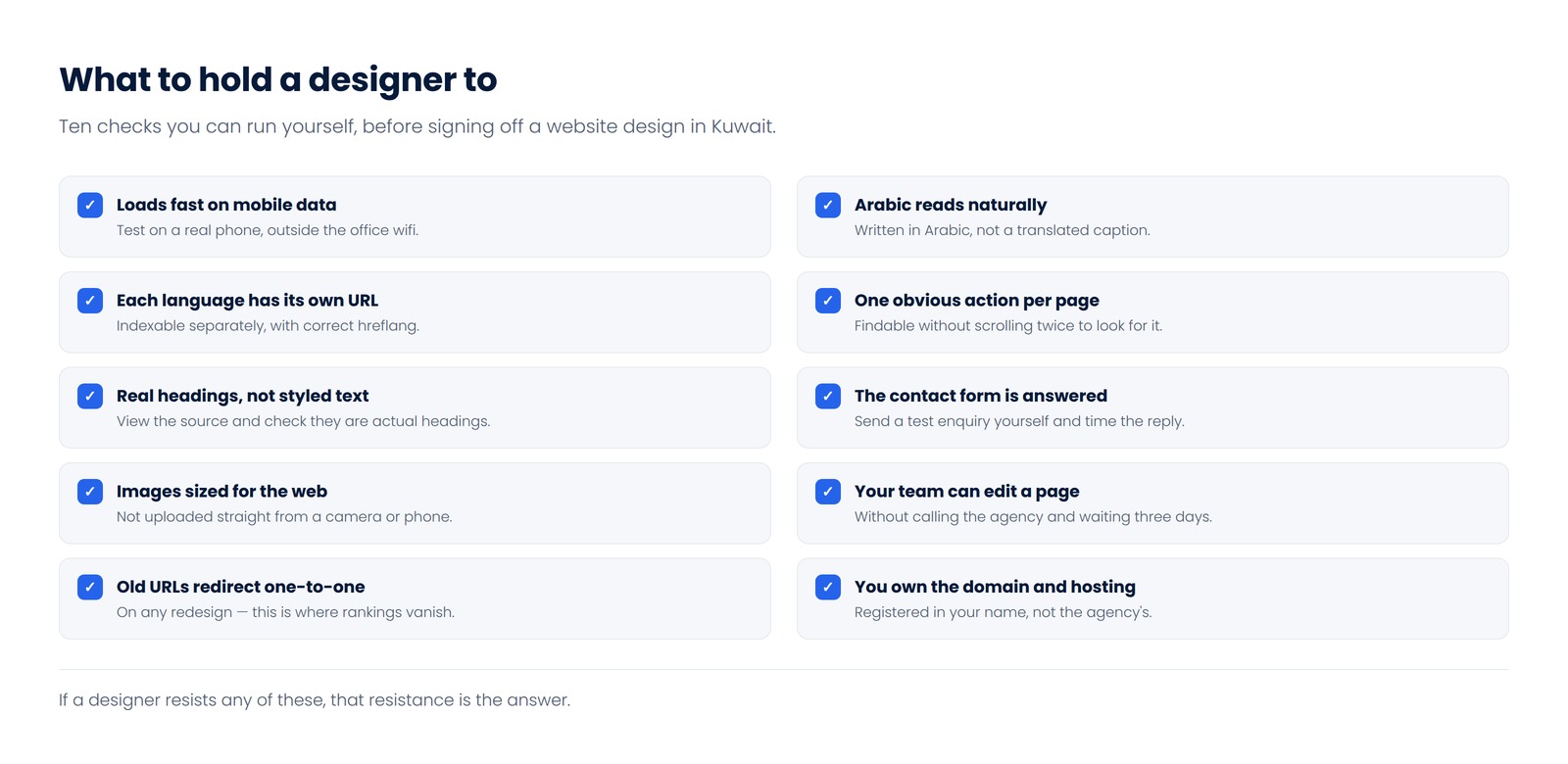
Two of them deserve emphasis. Send a test enquiry through your own contact form and see whether it arrives and how long the reply takes — a startling number of Kuwaiti sites have a form that silently fails, and nobody notices for months. Accessibility is worth adding as an eleventh check: the WCAG guidelines are the baseline, they are widely ignored on Kuwaiti sites, and meeting them tends to improve the design for everyone rather than only for people using assistive technology. And check that the domain and hosting are registered in your company’s name, not the agency’s. That single detail decides whether a relationship that goes wrong is an inconvenience or a hostage situation.
Where website design projects in Kuwait go wrong
Design by committee. Every department adds a requirement, the homepage becomes a compromise, and the site launches saying nothing clearly. One accountable decision-maker beats consensus every time.
The redesign that loses the traffic. A new site launches, URLs change, redirects are forgotten, and three months of rankings evaporate. Nobody connects the two events until an audit finds it. If you are redesigning rather than starting fresh, the migration plan matters more than the visual direction.
Choosing a platform before defining the problem. WordPress, Webflow and a custom build all suit different situations, and the honest comparison is worth having early — the WordPress development page and the Webflow assessment set out where each one earns its place.
Treating launch as the finish line. A site that nobody updates decays. Search engines notice, and so do customers. Budget for the year after launch, not only for the build.
Payment is a design decision, not a plugin
If the site will ever take money, the payment question belongs in the first conversation, not the last sprint. In Kuwait that means KNET, and KNET behaves differently from the card checkouts most templates are built around.
The practical difference is that KNET takes the customer off your site to authorise, then returns them. Every polished single-page checkout mockup you have been shown quietly assumes that does not happen. Discovering it late means redesigning the checkout, re-testing the whole flow on mobile, and explaining to the client why the thing in the pitch deck is not the thing being built.
You have two routes. Direct KNET through a bank, which is cheaper per transaction and slower to arrange. Or an aggregator — MyFatoorah, Tap, UPayments and others — which is faster to launch, adds a per-transaction margin, and hands you a dashboard your finance person can actually use. Neither is the right answer in the abstract. The volume you expect in year one decides it.
Three things this decision reaches that people do not expect: where the site is hosted, because some gateways are sensitive to it; what data you end up storing, which is a compliance question rather than a technical one; and how refunds are handled, which is where most of the support burden lives once you are live.
Ask any agency quoting you how they intend to handle the KNET redirect and what happens when a customer closes the tab mid-payment. The answer tells you quickly whether they have shipped a Kuwaiti store before or are about to learn on your budget.
If you are selling online, that is a different product
A brochure site and a store share a design language and almost nothing else. The store adds catalogue structure, stock, delivery zones, returns, order states, and a customer who now has a reason to come back and be disappointed. Each of those is a decision, and none of them is visual.
The most useful thing I can say to most Kuwaiti businesses asking for a store: you may not need one yet. If you are currently selling through Instagram and WhatsApp and it is working, a full store can reduce your sales in the short term by adding friction your customers have not asked for. The honest sequence is often a good catalogue with clear pricing and one obvious way to order, then a real store once the volume justifies the operational weight.
When a store is right, the platform question follows the business rather than the other way round. A small, stable catalogue with strong content and search visibility is well served by WordPress and WooCommerce. A fast-moving catalogue where operations matter more than content is usually happier on Shopify, accepting the per-transaction cost and the limits on customisation. What decides it is who updates the site, how often, and whether search traffic or repeat customers pay the bills.
Whichever way it goes, budget for the second month. Launch is the cheap part. The expensive part is the first time stock, delivery and accounting disagree with each other and someone has to be responsible for reconciling them.
Choosing who builds it
Ask three questions and listen to the shape of the answers. What happens to my existing URLs? How will Arabic be handled? Who owns the site when we stop working together? A designer who answers those clearly and without deflecting to a portfolio is worth paying. One who reaches for a demo instead is selling you a screenshot.
Be equally sceptical of the cheapest quote. A site assembled from a marketplace theme and a dozen plugins is cheap to buy and expensive to own, and the cost surfaces later as slow pages, licence renewals and a rebuild in eighteen months. It is worth asking what the site costs to run, not only what it costs to make.
If you want this done rather than explained, it is the work described on the web consulting page. And if the underlying question is which technology decisions the business should be making at all — build versus buy, in-house versus agency, what to do first — that is a Fractional CTO conversation rather than a design one.
Frequently asked questions
How much does website design cost in Kuwait?
The range is wide enough that any number quoted without knowing your requirements is meaningless. What is more useful is knowing what drives it: the number of unique page templates, whether the site is bilingual, whether it sells online, and how much content has to be written rather than supplied. Ask any quote to separate the one-off build from the annual running cost — hosting, licences, maintenance and content — because the second number is the one that decides whether the site is still working in two years.
How long does a website take to design and build?
For a straightforward business site, weeks rather than months — but the timeline is usually decided by content and decisions on your side, not by the design work. Projects stall waiting for copy, Arabic translation, product photography and sign-off, not waiting for a developer. The fastest projects I have run are the ones where the client had the content ready and one person authorised to approve.
Will a redesign hurt my Google rankings?
It can, and it usually does when the migration is careless. The risk comes from URLs changing without one-to-one redirects, titles and meta descriptions being lost, pages quietly dropped, or content that used to answer a question being cut for visual reasons. Done deliberately, a redesign is neutral to positive. Done as an afterthought in the last week of a project, it is the most expensive mistake in the whole exercise.
Should my website be in Arabic, English, or both?
For most Kuwaiti businesses, both — but as two properly built versions, not one page with a language switcher. Each language needs its own indexable URL, its own metadata, and copy written natively rather than translated. If the budget only stretches to doing one language well, do the one your customers actually search in well, and add the second when you can do it properly.
Do I own my website if an agency builds it?
Only if the contract and the registrations say so. Check that the domain is registered in your company’s name, that the hosting account is yours, and that you have administrator access rather than an editor login. Ownership of the design files and any custom code should be written into the agreement rather than assumed. This is worth settling at the start — it is a straightforward conversation before a project and a painful one afterwards.
Can a good design alone bring me more customers?
No, and anyone promising that is overselling. Design removes friction and builds credibility; it does not generate demand on its own. A well-designed site that nobody can find, or that answers no real question, will sit quietly doing nothing. The visibility side — search, answers and AI assistants — is a separate discipline that has to run alongside the design rather than after it.