A great deal of Kuwaiti retail never touches a website. The order arrives in an Instagram message or a WhatsApp chat, somebody replies with a KNET payment link, and the customer pays on their phone. It works, it is cheap to start, and for a while it is the right answer. The question is where it stops being the right answer, and what it quietly costs before you notice.
This is how I look at it when a business that sells this way asks whether it needs a store. Usually the answer is “not yet”, and the useful part is knowing which signal will change it.
What a payment link actually is
A payment link is an invoice with a checkout page attached. You type an amount and a customer name into a gateway’s dashboard or app, and it gives you a URL. The customer opens it, chooses KNET or a credit card, and pays on the gateway’s page, not yours. KNET’s own payment gateway accepts every debit card issued by banks in Kuwait and verifies the cardholder with a one-time password, and that is the same step your customer goes through after tapping the link.
Every provider in the Kuwaiti market sells this now. Tap’s billing product sends branded links “through WhatsApp, SMS, Instagram, email” and says plainly that no website or developer is needed. UPayments, MyFatoorah and the others offer the same thing under different names. The product is mature, and the choice between providers matters less than how you run it.
The important thing it does is keep card data away from you. Nothing sensitive passes through your phone or your accounts, which is the same reason a proper store sends the customer to the gateway rather than taking card numbers itself.
You still need the merchant account first
A link does not remove the application. The provider is acting as your acquirer or aggregator, which means the same questions a KNET application for a full online store asks: who the business is, what licence it holds, which bank account the money settles to, and what you sell. The difference is that aggregators are built to onboard small businesses quickly, so it is usually a shorter process than a direct contract with a bank.
Apply in the name of the business that will actually sell, with the bank account that business owns. A link that settles into a personal account is how the accounting becomes impossible to untangle a year later, and it is the first thing any provider’s compliance team will stop.
What links do well
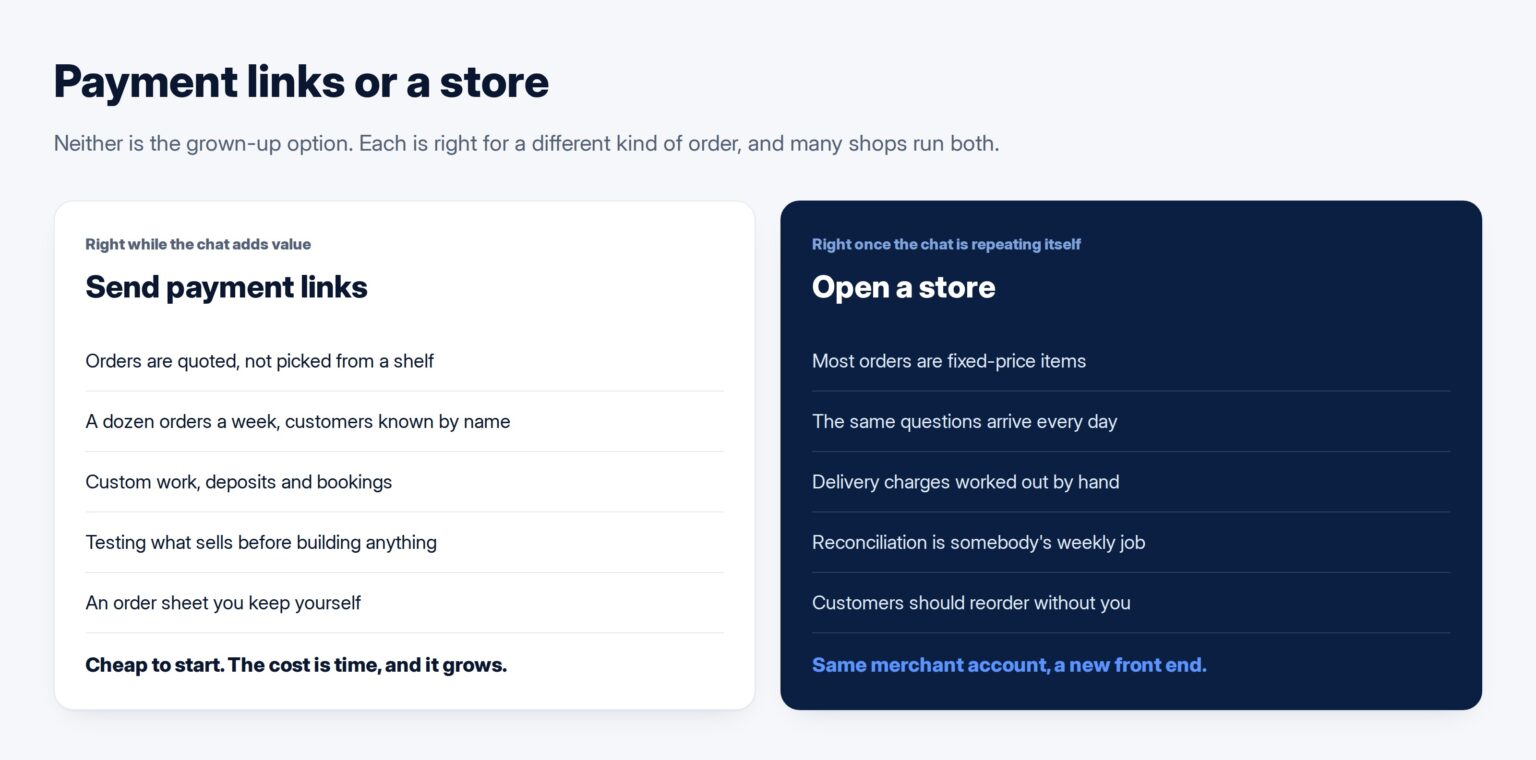
They are right for anything that is quoted rather than picked from a shelf. A cake decorated to order, a tailored abaya, a deposit on an event booking, a repair priced after inspection. The price is only known once you have talked to the customer, so a cart would add nothing and a conversation followed by a link is the natural shape.
They are right for low volume. If you take a dozen orders a week and know most customers by name, a store is a monthly cost and a maintenance job that buys you nothing yet.
And they are right for testing whether anyone will pay. Before building anything, including deciding which pages a site would even need, sending links for a month tells you what sells, at what price, and to whom. That is market research you are paid for, which is the best kind.
The order record is the thing a link does not give you
A link knows an amount and a name. It does not know that the customer ordered two of the blue and one of the green, that delivery is to Salmiya on Thursday, or that they asked for gift wrapping. That lives in a chat thread, and a chat thread is not a record.
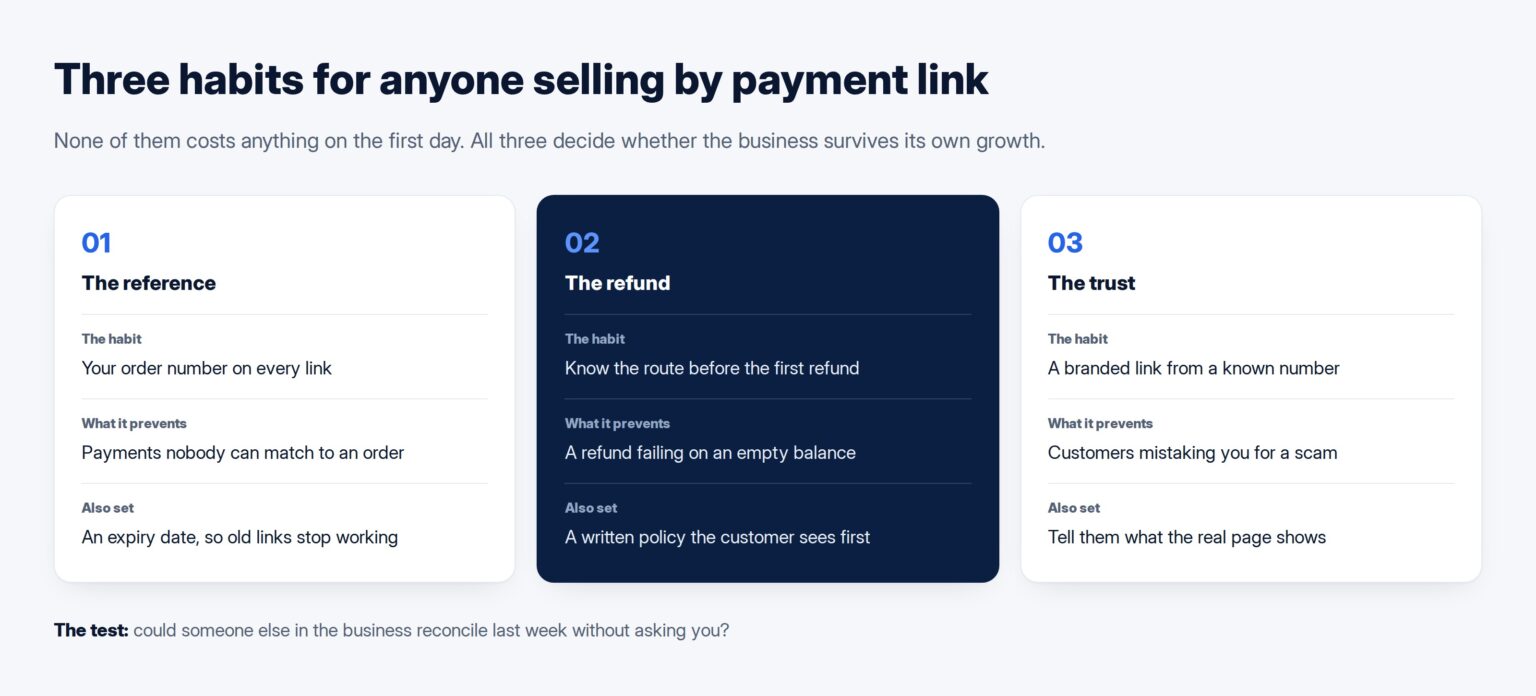
So the first job, before volume forces it on you, is a simple order sheet: one row per order, with the link’s reference, what was ordered, the delivery details and the status. Most gateways let you attach your own reference to a link. MyFatoorah’s invoice link documentation, for instance, lets you set a customer reference and an expiry date on every link and returns a payment ID once it is paid. Put your order number in the reference field every time. That single habit is what makes the next three sections possible.
Matching money to orders
The dashboard will show you forty payments this week. Your chats will show you forty-three orders. Somebody has to find the three that did not pay, the one that paid twice, and the one that paid the wrong amount because they were sent an old link.
Done by scrolling, this takes an hour a week at small volume and a full day at moderate volume, and it is the job that nobody owns until a customer complains that they paid and never received anything. With a reference on every link it becomes a sort and a comparison: payments against the order sheet, gaps highlighted, done in minutes.
Set links to expire. A link that stays payable forever will eventually be paid by someone scrolling back through an old chat for an item you no longer have at a price you no longer charge.
Refunds are not instant, and not free
Refunds go back to the card that paid, and on most aggregators they come out of your balance with the provider, not your bank account. MyFatoorah’s refund documentation is explicit that you need a sufficient available refund balance, and that without automatic refunds the request goes to their finance team to execute rather than straight to the customer.
Two consequences follow. A refund on a busy week can fail simply because the week’s money has already been transferred out. And the customer waits while it is processed, which in a business built on personal trust is the moment the relationship is tested. Decide your refund policy before your first refund, state it in your bio or your first message, and know how long your provider actually takes.
Your customers are being taught to distrust links
This is the risk nobody mentions when they recommend payment links. Fraud in Kuwait runs on fake links. Banks and the Central Bank run the “Let’s Be Aware” campaigns precisely because, as The Times Kuwait reported in June, messages with malicious links that lead to fake banking pages are a growing problem. Every customer who has heard that warning hesitates at your link, and some of them are right to.
Make yours recognisable. Use the provider’s branded link on your business name rather than a shortened URL, send it from the number or account the customer already talked to, and tell them in the message what the page will show: your business name, the amount, and the KNET page. Never ask anyone to pay a link that arrived from a number they do not know, and say so in your bio. The shops that do this lose fewer orders at the last step, because the customer knows what a real one looks like.
The signals that it is time for a store
Not revenue, and not follower count. The signals are about where the time goes.
The same questions arrive every day. What sizes do you have, is it in stock, how much is delivery to Jahra. When most messages are questions a product page would answer, the conversation has stopped adding value and started costing it.
Most orders are for things with a fixed price. Once the typical order is picked rather than quoted, a cart does the work the chat is doing, at any hour, without anyone typing.
Reconciliation has become a weekly job with a name attached. When somebody spends a morning matching payments to orders, you are already paying for a store; you are just paying in staff time.
And you want customers to come back without you messaging them. A store has an account, an order history and a reorder button. A chat has a scroll.
Moving to a store without starting again
The good news is that the merchant account you already have usually carries over. The same providers that issue links also have plugins for Shopify and WooCommerce, so moving to a store is a new front end on an account that is already approved, not a new application. Check that before you pick a platform. The checkout mistakes Kuwaiti customers hit most are worth reading at the same time, because a store that asks for a postcode loses the orders the chat used to catch.
Keep links for what they are good at. Custom orders, deposits and anything quoted still belong in a conversation, and a store with a “request a quote” route that ends in a link is a perfectly good design. What you are moving is the routine, not the relationship. How much the store itself costs depends on how much has to be built rather than configured, and why two quotes for the same store differ so much is covered separately.
If you are weighing the build yourself, how I approach website design in Kuwait sets out what I take on. Where you want the store built on Shopify with KNET already connected, that is exactly what Tothiq sets up for Kuwaiti sellers, including moving the products you have been selling by message.
Frequently asked questions
Can I get KNET payment links without a commercial licence?
You need a licensed business behind the merchant account, because the provider has to know who is being paid. What counts depends on the provider and the licence type, including licences for home-based businesses, so ask the provider directly before applying. Settling into a personal account is not the workaround it looks like.
Is a payment link safe for the customer?
A genuine one is. The customer pays on the gateway’s page and verifies with a one-time password from their bank, and you never see their card. The risk is fake links, so make yours recognisable and tell customers what the real page shows.
Do customers pay more when they use a link?
They should not. The fees are the merchant’s, charged by the provider on each transaction, and the KNET merchant agreement prohibits charging the cardholder for using a payment method. If the cost needs recovering, it belongs in the price.
How many orders a week before I need a store?
There is no number. A business selling five custom pieces a week may never need one, and one selling thirty fixed-price items a week already does. Watch how many messages are questions a product page would answer.
Will I have to change payment provider when I open a store?
Usually not. Most providers that issue links also connect to Shopify and WooCommerce, so the approved account carries over. Confirm that your provider supports the platform you choose before you commit to either.