The proposal arrives with a sitemap on page four. Home, About, Services, and then Services split into six, plus News, Careers, Testimonials, Partners, FAQ, Gallery, Privacy, Terms, and Contact. Twenty-two pages. It looks thorough, and thoroughness is what you are being sold.
Most of those pages will never be read by anyone who was going to buy from you. Some of them will cost you money every year for as long as the site exists, because a page is not a one-time purchase — it is something that has to stay true. This is which pages actually do work, which ones exist only to make the quotation look substantial, and how to decide it for your own company rather than from a list.
Start from the honest base rate
Publishing a page does not create demand for it. Ahrefs, which maintains its own index of the web, ran the numbers across roughly fourteen billion pages and found that 96.55 per cent of them receive no traffic at all from Google. That is not a warning about quality. It is the base rate. A page you add is, by default, a page nobody arrives at.
One thing that is often claimed here and is not true at your scale: extra pages are not eating your crawl budget. Google’s own documentation is specific that crawl budget is a concern for sites with more than a million pages, or ten thousand pages changing daily. A twenty-two page site has no crawl problem. The cost of the extra pages is not technical. It is that each one is a promise to keep current, and the ones nobody reads are the ones nobody notices going stale.
The pages that do the work
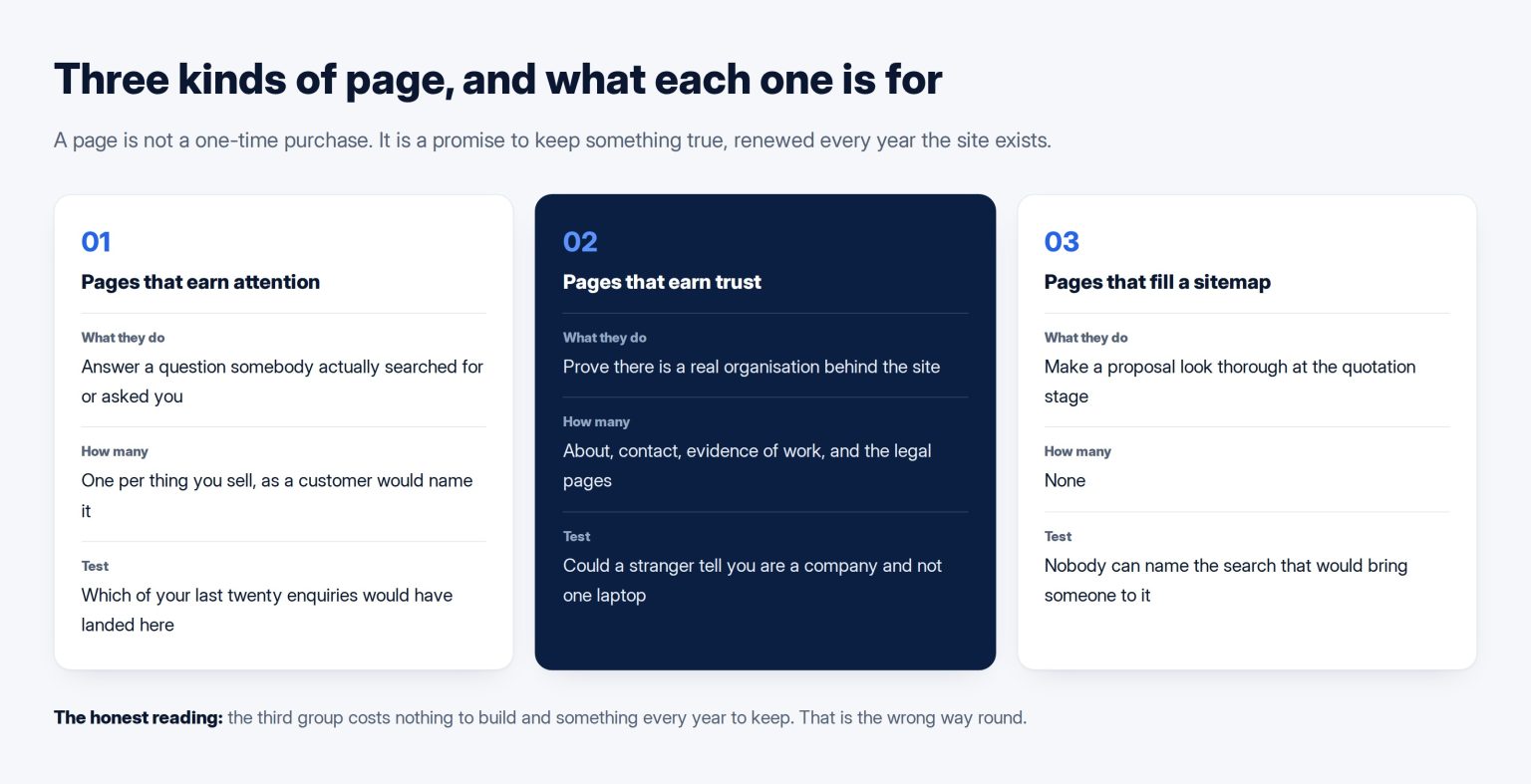
For a company selling a considered service or product to other businesses or to walk-in customers, five pages carry almost everything.
Home, whose only job is to say what you do, for whom, and where — in the first screen, without scrolling. Most Kuwaiti company homepages spend that space on a slideshow.
One page per thing you sell, and this is where the count is actually decided. Not one page per service line in your internal org chart: one page per thing a customer would name when describing what they need. If two of your six services would be described by a buyer in the same sentence, they are one page.
About, which in this market does more work than anywhere else, for reasons below.
Contact, which is a transaction rather than a page: how to reach a person, and what happens after you do.
Evidence — work you have done, in whatever form you can actually show it. Named clients, a project, numbers, photographs of finished work. One page, or one page per project if you have real ones.
That is five to nine pages depending on your service count, and it is a complete site. Everything after it has to justify itself individually. If the difference between two of those pages is not obvious to you, it will not be obvious to a buyer either, and the gap between what design covers and what development covers is where that confusion usually starts.
Why About carries more weight here than the textbooks say
Visitors go to About to work out whether the organisation is real and whether it does the specific thing they need. Stanford’s long-running credibility research reaches the same place from the trust direction, and its second guideline is blunt about the mechanism — show that there is a real organisation behind the site, and the easiest way is a physical address.
In Kuwait that page does extra work, because a large share of buying decisions run through a question the site is never asked directly: is this a company, or is this one person with a template and a bank transfer request. An About page that names people, shows a real address, and states how long the business has been operating answers that. A page of stock photography and the word “passionate” does not.
The pages that exist for trust rather than traffic
Privacy and terms are not marketing pages and should not be judged as such. They exist because the payment provider, the app store, or the customer’s procurement process will ask for them, and because a site collecting enquiries is collecting personal data. Write them once, keep them accurate, and stop thinking about them.
Careers is the page most often added by companies that are not hiring. If you hire twice a year, a line on About with an email address does the job. An empty Careers page tells a visitor the company is smaller than it wants to look, which is the opposite of what it was added for.
Testimonials as a separate page is usually a mistake, not because testimonials do not work but because they work where the doubt is. A quotation from a client belongs on the service page that client bought, next to the claim it supports. Collected onto their own page, they are read by nobody except the person who wrote them.
The two pages worth adding that nobody proposes
A pricing or “how we work” page, even without numbers. Most Kuwaiti company sites answer neither what it costs nor what the process is, and both are the questions a serious buyer has before they contact you. If you cannot publish prices, publish the shape: what a typical engagement contains, how long it takes, what you need from the client. This is the page that removes the enquiries you did not want, which is worth more than the ones it adds.
And a location page, if you have a physical place customers visit. Not because of search alone but because the panel, the map and the site have to agree with each other — the argument in why your Google Business Profile decides more than your homepage, and the reason the address on the site has to match the profile character for character.
Deciding it for your company rather than from this list
Two exercises, neither of which needs a consultant.
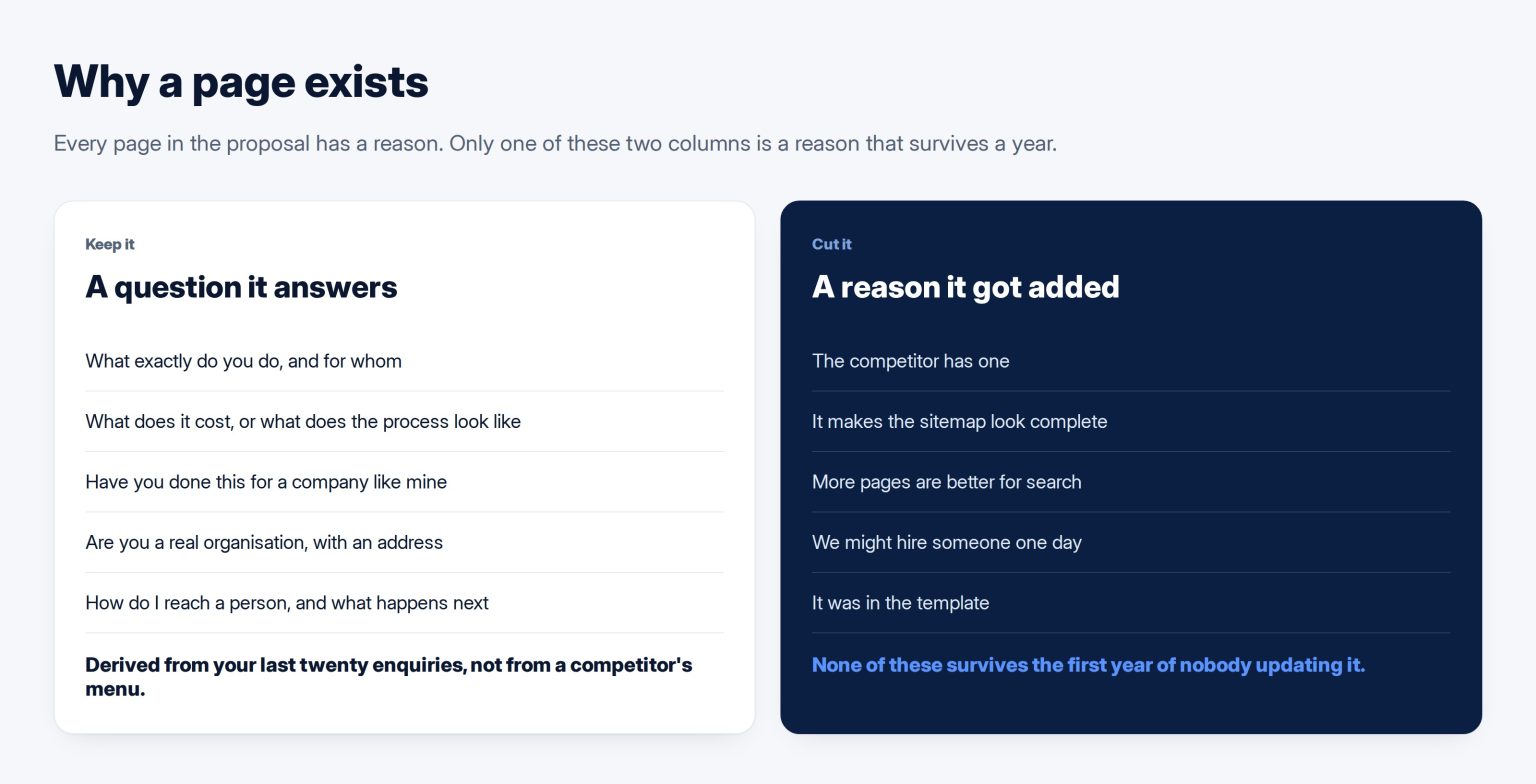
First, write down the last twenty enquiries you received and what each person asked about before they bought. That list is your page inventory, ordered by frequency, derived from evidence rather than from what a competitor’s site happens to contain. The UK government’s service manual makes the point in one line that is worth pinning up: treat any opinion or suggestion that does not come from users as an assumption that has to be proven.
Second, if you genuinely cannot decide how to group your services, run a card sort. Write each service on a card, give the pile to people who buy this kind of thing, and ask them to group the cards and name the groups themselves. I use about fifteen people, which is a week of asking rather than a research budget, and the grouping they produce is almost never the one on the org chart. That gap is the finding.
What to do about pages you already have
Do not delete in bulk. A page with no traffic is costing you nothing directly; the cost is maintenance and dilution, and both are fixed by consolidation rather than deletion. Merge the four thin service pages into one good one and redirect the old URLs to it. Anything that ranked keeps its value, and the surviving page is now worth reading.
Judge what survives by the test Google publishes for its own systems: who made it, how it was made, and why it exists — and specifically whether it was made primarily to attract search traffic. A page that fails that question was never going to earn anything, however many of them there are. And since seventy-nine per cent of users scan rather than read, a merged page that is twice as long is only better if it is twice as scannable.
If you are commissioning the site now rather than fixing one, the page count belongs in the brief before anyone quotes, because it is the single number that moves a quotation most — which is why two quotations for the same site differ tenfold, and what a proposal is really telling you when it opens with a sitemap.
Deciding the page list is the easy half. Building it is the other, and my company does that: website design and development at Tothiq.
Frequently asked questions
Will a smaller site rank worse than a bigger one?
Not by page count. Ranking happens per page against a query, so a site of eight strong pages competes fine against a site of forty thin ones for the queries its eight pages actually answer. What a bigger site buys you is more chances to match something, which only helps if each page genuinely answers a question someone asks. Forty pages saying the same thing in different words compete with each other, not with your competitors.
Our competitor has a page for every service and every city. Should we?
Look at whether those pages are different from each other before copying the pattern. A service page repeated with the city name swapped is the oldest thin-content pattern there is, and it is a pattern search engines have specifically targeted for years. If your competitor ranks, check whether they rank because of those pages or despite them. Usually one real page and a genuine local profile beats thirty generated ones.
Do we need a blog?
Only if someone will write it, indefinitely, and has something to say that a buyer cannot get elsewhere. A blog with four posts from two years ago is worse than no blog, because it dates the whole site — a visitor reads it as evidence the company stopped. If nobody has committed the time, leave it out and revisit it when someone has. It is much easier to add later than to explain later.
What about a page in Arabic for each English page?
That is a separate decision from the page count and should be taken separately. Doubling every page doubles the maintenance for ever, and most companies find that only some pages need both languages — the ones a customer reads before deciding, rather than the ones read after. Decide which pages exist in Arabic deliberately, and make sure the ones that do are written rather than translated.
The supplier says more pages are better for SEO. Are they wrong?
They are describing something that was partly true a decade ago. What is true now is that more pages give you more surface, and surface only earns anything when each page answers a real question well. Ask them a specific question instead of arguing the principle: for each proposed page, which search would bring someone to it, and what would that person do next. A supplier who can answer that for twenty-two pages has earned them.