A company in Kuwait spends four months and several thousand dinars on a new website. It launches. Enquiries do not move. When we look at where the searches for their own service actually go, most of those people never reach the site at all: they see a panel beside the results, or three boxes on a map, and they tap the phone number.
That panel is the Google Business Profile. Nobody designed it, nobody approved it, and in most companies nobody owns it. For a business that sells to people in a place, it is doing more of the selling than the homepage is.
This is not an argument against having a good website. It is an argument about sequence. If the profile is wrong, the site never gets the chance.
What the panel actually decides
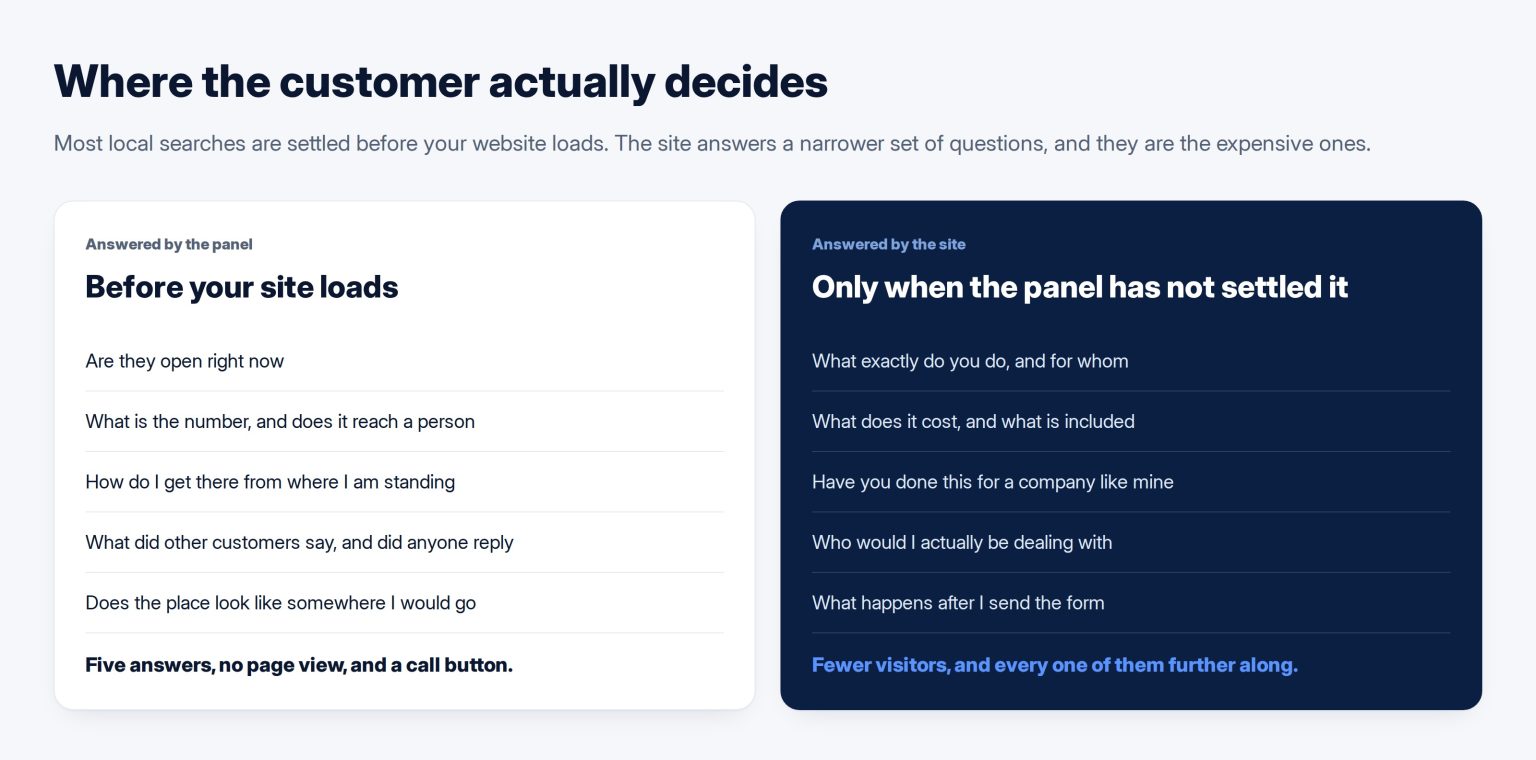
Look at what a customer can do from the profile without visiting anything: call you, get directions, see whether you are open right now, read what other people said, look at photographs of the place, and in some categories message you or book. The website link is one option among eight.
Every one is a conversion, and every one happens against information you may not have checked in two years. A wrong closing time is a customer standing outside your door. A number that rings a former agency is a customer you never hear about.
The website’s job in that moment is narrower than people expect: it is where somebody goes when the panel has not settled the question. That is a real job, and it is why the site still has to be good. It is just not the first thing the buyer sees.
The three inputs, in Google’s own words
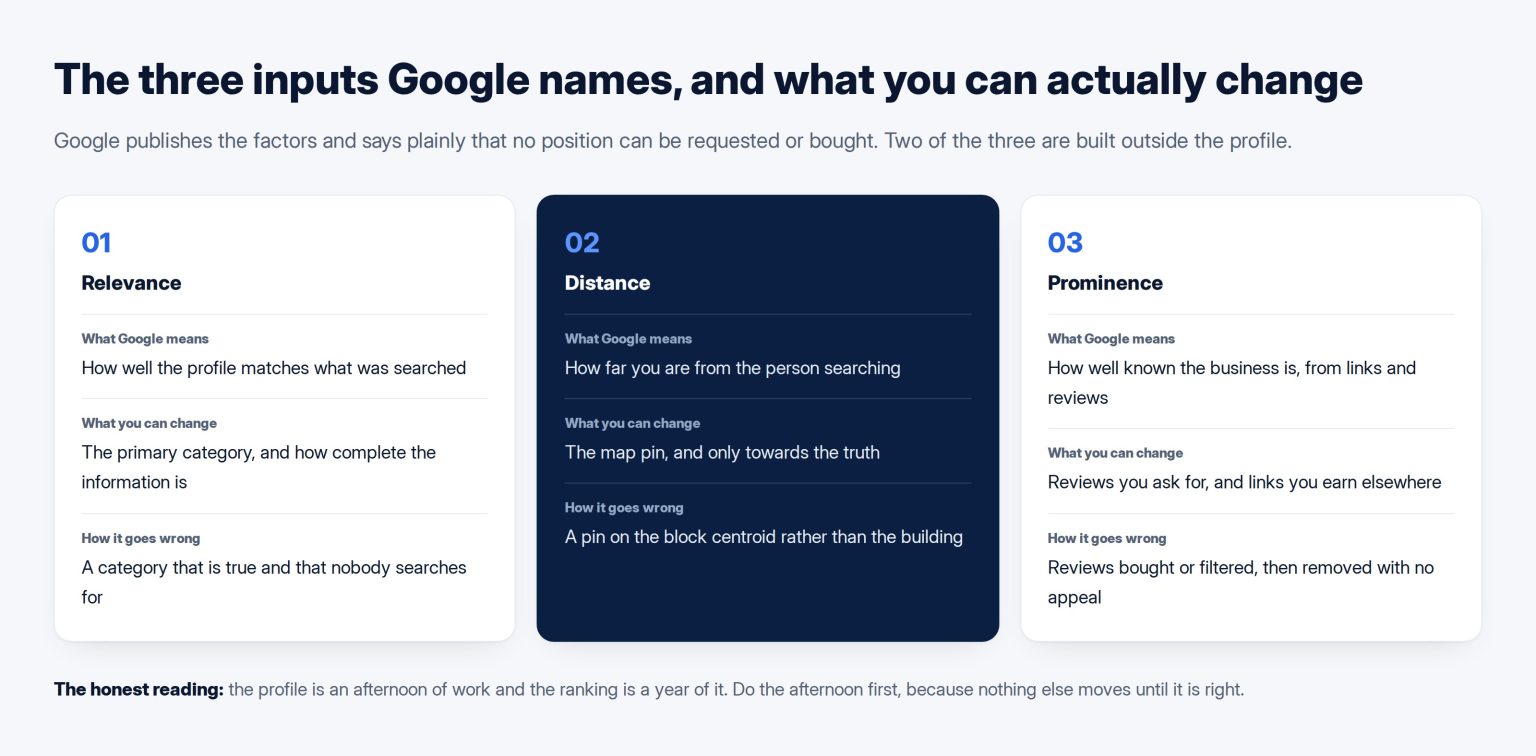
Google is unusually direct about this. Its own guidance on local ranking names three factors and says plainly that there is no way to request or pay for a better position.
- Relevance — how well the profile matches what was searched. This is the one you control most and neglect most, and it is mostly the category and the completeness of the information.
- Distance — how far you are from the person searching. You cannot change this. It is why a competitor in a different area outranks you for a customer standing near them, and why that is not a failure on your part.
- Prominence — how well known the business is, which Google says draws on links to your business and on your reviews.
Two of the three are worked on outside the profile. Prominence in particular is the slow one, and it is the same asset that everything else in search rests on, which is the argument I made in the piece on what changed in search and what nobody can sell you.
The category is the field that decides the most
If you change one thing after reading this, change the primary category, and change it carefully.
Google’s rule for choosing is a good sentence: pick categories that complete “this business is a”, not “this business has a”. A restaurant that also does deliveries is a restaurant. A trading company with a small showroom is not a shop.
The failure I see most often here is the opposite of stuffing: a category that is technically true and commercially useless. “Corporate office” is true of almost everybody and searched by nobody. The primary category is the closest thing the profile has to a keyword, and it is chosen once and forgotten for years.
Add the fewest secondary categories that are genuinely accurate. Google says it already infers the broader ones, so a long list adds noise rather than reach.
The rules that get profiles suspended
The guidelines for representing your business are short, and almost every problem I am asked to fix is in them.
- The name is the name. Not the name plus the service, not the name plus the area. The rule is that it should match the real-world name as used on the storefront, the site and the stationery. Adding “best” or a district to the name is the most common self-inflicted suspension.
- The phone number has to be under the direct control of the business. A number that forwards to an agency’s call tracking is a rule you are relying on nobody enforcing.
- The website field wants the real page for that location, not a campaign landing page built to capture the click.
- Service-area businesses hide the address. If customers do not come to you, you set a service area instead, and Google’s guidance says a virtual office does not qualify unless it is staffed during business hours. This affects a great many Kuwaiti consultancies and contractors that list a licensed address nobody visits.
The address problem that is specific to here
Kuwaiti addresses are block, street and building, and street numbering is not always what the map expects. Google’s own address guidance covers this directly: where the address has no street number or cannot be found, you place the pin manually on the map.
That pin matters more than the text. Distance is measured to the pin. A profile whose pin sits on the wrong side of a ring road, or on the block centroid rather than the building, is quietly losing every search where the customer is nearby but the map thinks otherwise.
Check it the way a customer would: open directions from a point a few minutes away and see where they land. Two minutes, and almost never done.
Hours are an operational field, not a marketing one
Regular hours are the easy part. The ones that cost money are the exceptions.
Ramadan hours, Eid closures, National and Liberation Day, and the afternoon break that many Kuwaiti offices keep are all special hours, and a profile that does not carry them tells customers you are open when you are not. Google shows a warning on profiles whose holiday hours are unconfirmed, and the customer sees that warning too.
This is not an SEO task. It is somebody in the office updating four or five dates a year, and it belongs on a calendar with an owner’s name against it, the same way maintenance that has no owner is the reason sites get rebuilt every three years.
Reviews, and what you are allowed to do about them
Reviews feed prominence, and they are also the first thing a human reads. Two things are worth knowing precisely.
The first is that you may ask. Requesting reviews from real customers is permitted; what is not permitted is incentivising them, filtering who you ask by how happy they are, or posting them yourself. Google’s content policy is explicit about fake engagement and conflicts of interest, and removals are not appealable in any useful sense.
The second is that replying has the best return and the least effort, and Google recommends it directly. A calm, specific reply to a bad review is read by every future customer who scrolls past it. It is the cheapest reputation work a small company has.
What the website still has to carry
None of this replaces the site. Three things on the site feed the profile and are frequently missing.
- The same name, address and phone number as the profile, in text rather than inside an image, on a page a crawler can read.
- LocalBusiness structured data that agrees with the profile. Where the two disagree, you have told Google two things and it will believe neither confidently.
- A page for the thing you actually sell, so that the click from the profile lands somewhere that answers the question rather than on a homepage carousel.
That last one is where the money in a website usually is, and it is a different discipline from the visual work — the split I set out in what you are actually paying for in design and development.
The order I would fix it in
- Claim it, and find the duplicates. Search your own name and your address. Old profiles created by a former agency, a previous branch or a staff member are common, and duplicates split your reviews.
- Fix the primary category, then remove the secondary ones that are aspirational.
- Move the pin and test directions from a nearby point.
- Correct the name to the real one, even if it costs you a keyword. A suspension costs more.
- Put the phone number back under your control and point the website field at a real page.
- Load the special hours for the next twelve months in one sitting.
- Then start asking for reviews, and reply to all of them.
Steps one to five take an afternoon and cost nothing. They are the highest return per hour available in local search, and they are almost always skipped in favour of the part that has an invoice attached, which is a pattern worth recognising when you are reading what a website actually costs. Getting this right is the least glamorous half of what I do as an SEO consultant, and it is the half that moves first.
Keeping the profile and the site pulling in the same direction month after month is work my company takes on: AI search visibility at Tothiq.
Frequently asked questions
We work from an office nobody visits. Should we hide the address?
If customers do not come to you, yes. Google treats that as a service-area business, and the guidance says a virtual office does not qualify unless it is staffed during business hours. Hiding the address and setting a service area is the honest configuration and it does not hurt you: distance is still measured from your location, so nothing is lost by removing a public address that would only bring people to a door you do not want them at.
A competitor has our old business name on their profile. What can we do?
Use the suggest-an-edit route on their profile and, if that fails, the redressal form, with evidence: a trade licence, a photograph of their signage, a screenshot of their own website. Evidence is what moves these; an assertion is not. Expect it to take weeks and to need more than one attempt, and do not respond by putting keywords in your own name, which converts their problem into your suspension.
Do posts and photos on the profile actually do anything?
Photographs do, because a human is choosing between three results and yours is the one with an interior shot taken this year. Posts are weaker and expire, so treat them as a place to put something time-bound like changed hours rather than as a content channel. If a supplier is selling you a monthly posting retainer as local SEO, ask them what it is meant to move and how it will be measured.
How long after fixing the profile should we expect anything?
Address and hours changes usually appear within minutes but can take up to thirty days. A category change is normally reflected in what you rank for within a couple of weeks. Reviews and prominence are the slow part and move over months. If nothing at all has changed after six weeks, the problem is usually distance or a duplicate profile still holding the history, not the edits you made.
Should we run this ourselves or give it to an agency?
Own the account yourselves whatever you decide. The single most expensive thing in this article is a profile whose owner is a person or company you no longer work with, because recovering it is slow and sometimes impossible. Give an agency manager access if you want the work done; do not give them primary ownership, and do not let the verification go to an email address nobody in the company controls.