A client sent me two screenshots last month. The first was his homepage: five gold stars, a 4.9 average, “based on 87 reviews”. The second was his listing in Google’s results, with no stars anywhere. He wanted to know what was broken.
Nothing was broken. The plugin worked exactly as built, the markup validated, and the stars were never going to appear. What he had bought was a rule nobody had told him about — worth understanding properly, because review widgets are a real line in a lot of website budgets here and almost none of that money buys what the buyer thinks it buys.
The rule, and it is not ambiguous
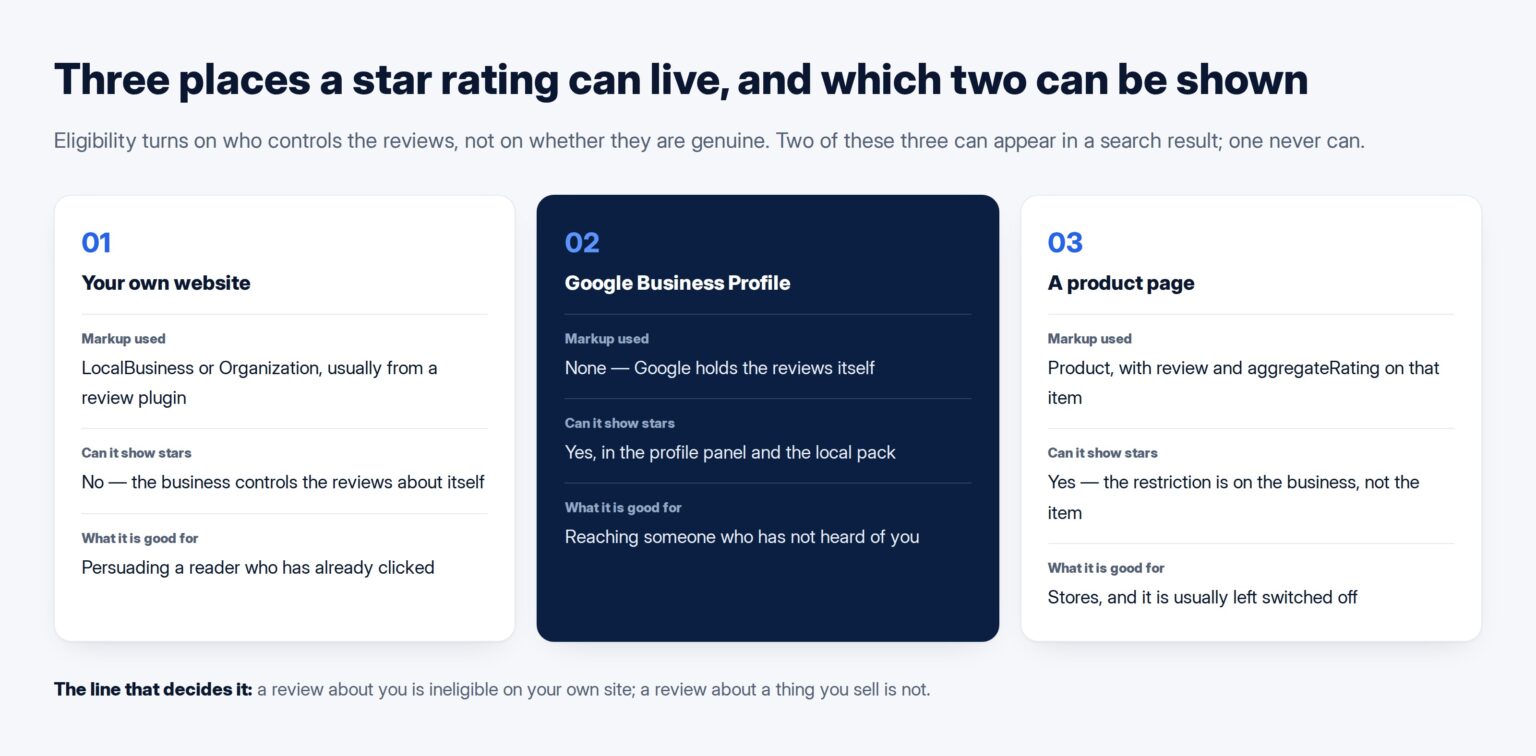
Google’s review snippet documentation lists which types of thing can carry a star rating in results. Two entries arrive with a condition: local business and organisation reviews are supported only for sites that capture reviews about other businesses.
Further down the condition is stated plainly. Where the entity being reviewed controls the reviews about itself, its pages carrying LocalBusiness or any Organization structured data are not eligible for the star feature. The example given is a review about a company placed on that company’s own website.
That is your homepage, your services page, and the testimonials page every Kuwaiti company site has carried since 2015. None can show stars, and no amount of correct markup changes it: the ineligibility is a policy decision, not a technical failure.
Why the rule exists, which is the part worth knowing
Google explained the change when it made it, and the reasoning is easy to sympathise with. A rating a business awards itself is not evidence: it costs nothing to publish, cannot be audited by a reader, and every business that publishes one publishes a good one. Nobody has ever launched a testimonials page at 2.8.
The star in a result is a shortcut a reader uses to choose between two blue links in about a second, and a shortcut is only useful while it carries information. A signal every participant can set to five carries none, so the feature was restricted to cases where somebody other than the subject collected the rating. Read that way it stops being an obstacle and becomes a description of the problem you actually have: you need a rating somebody else is holding. It is the same distinction that separates ranking from being quoted — what you assert about yourself is worth less than what can be checked.
The embedded widget does not get around it
This is where most of the money goes. A plugin pulls your Google or Facebook reviews onto your own page with an aggregate score, and the sales copy implies stars in search. The documentation names this case specifically, whether the review is written directly into the structured data or brought in through an embedded third-party widget — Google Business and Facebook widgets are the two examples it gives.
The reviews are genuine and the rating is honest. The page is still ineligible, because eligibility turns on who controls what appears, not on who wrote it. A widget you install, configure and can switch off is under your control by definition.
A second line beside it catches a different practice: ratings must come directly from users, and human editors must not create, curate or compile them for local businesses. A staff member transcribing the nice things customers said on WhatsApp into a reviews section is exactly that, and it is the most common version I find here.
Where self-collected ratings are still eligible
The restriction is on LocalBusiness and Organization. It is not on Product. If you sell things, reviews your own customers leave against an individual product on that product’s page are ordinary product structured data and can carry a rating into the results.
The distinction is between reviewing you and reviewing a thing you sell. “Excellent company, very professional” attached to your organisation is ineligible. “This bag held up for two years” attached to that bag is not. For a store that is the whole opportunity, usually sitting unused in a platform that already supports it.
It comes with obligations: the rating sits on the page a shopper actually lands on, the count is real, and a product page with three reviews says three. If you are already trading online here, this is part of the store build — what KNET requires before your store can take its first payment is the other half of it.
The markup mistake that turns ineligible into penalised
Ineligible is neutral: nothing shows, nothing is lost. The failure that costs you something is different, and I find it on about one site in five.
Google’s structured data policies require marked-up content to be visible to the reader, prohibit markup that is irrelevant or misleading, and state that ratings not from real users can attract a manual action. Three lines, and one badly configured plugin can cross all three.
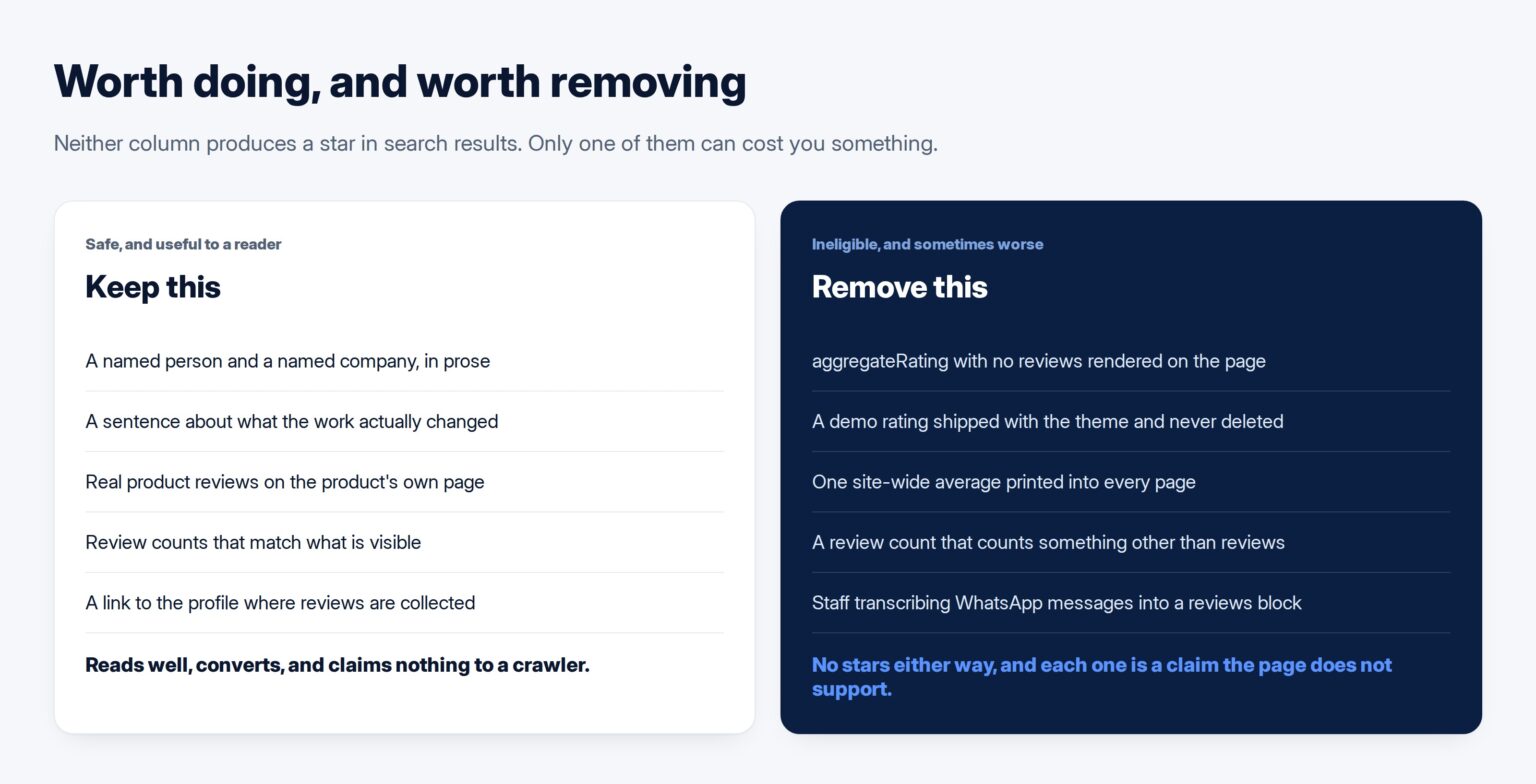
In practice: an aggregate rating in the markup with no reviews rendered on the page; a theme shipping a demo aggregateRating nobody removed; a site-wide average printed into every page including ones it has nothing to do with; a review count counting something other than reviews. None produce stars. All are assertions the page does not support.
What the stars on your own page are actually for
Here is the part lost in the disappointment. The testimonials block was never going to move your rankings, and it was never useless either. It works on a human rather than on a crawler.
Someone who has reached your services page has already chosen to consider you, and is now looking for a reason to stop worrying. A specific quote from a named company in a recognisable industry does that work, after the click rather than before it. Judge it as conversion material and stop asking a crawler to admire it.
So the honest split is this. Stars before the click live on your Google Business Profile, where Google collects them and where the rules on asking, incentivising and replying are a separate subject I have covered there. Evidence after the click lives on your site, in prose, with names attached.
Buying a review platform: what to check first
Some third-party review services do produce eligible stars, because they hold the reviews rather than you. Many sold in this market do not, and the sales page will not tell you which you are buying. Four checks settle it.
Ask where the review is published. If the answer is “on your own site, through our widget”, you are buying conversion material, which may be fine — but you are not buying search stars and should not be paying for them.
Ask for a live URL of a customer in a similar business and run it through the Rich Results Test yourself. A minute, and the only evidence that counts.
Ask what happens if you stop paying. Reviews collected on a platform you rent are not yours in any practical sense, and nobody asks this until the renewal.
Ask whether the reviews are about the business or about products. If you sell things, a platform doing only business-level reviews is solving the ineligible half of the problem.
What I would do, in order
First, run the Rich Results Test on your homepage and your main service page and read what is actually being declared. Most owners have never seen it, and it takes two minutes.
Second, remove any aggregateRating or Review markup attached to your organisation. It cannot help, and depending on configuration it may be making a claim the page does not back up.
Third, put the effort into the profile instead — that is the only place a star rating reaches somebody who has not heard of you yet, and it is search work rather than website work.
Fourth, if you sell products, put real reviews on product pages with correct markup. That is the one place where collecting reviews yourself earns a result in search.
Fifth, keep the testimonials and write them properly — a named person, a named company, and a sentence about what the work changed. That is worth more than an average score, and it is the only part a competitor cannot copy in an afternoon.
Where the question widens from markup on one site to how the business is found and quoted at all, it belongs with search visibility work rather than a plugin. Tothiq does that as a service — its AI search visibility practice covers the same ground across the GCC.
Frequently asked questions
We have had star markup on our site for two years and nothing bad has happened. Is it really a problem?
Probably not, if the ratings are real and the reviews are visible on the page. Ineligible is not the same as penalised, and most of these installations simply sit there doing nothing. The cases worth acting on are the ones where the number in the markup does not match anything a reader can see, or where a site-wide average has been printed onto pages that have nothing to do with it. Run the Rich Results Test and you will know which you have inside two minutes.
Our competitor’s site shows stars in Google. How are they doing it?
Three possibilities, and it is worth finding out which. They may be selling products and carrying product reviews, which is allowed. The stars you are seeing may be on their Google Business Profile panel rather than on their website result, which people frequently conflate. Or the markup predates the rule and has not been caught yet, in which case copying it buys you a problem with a delay on it. Search their brand name and look carefully at which result the stars are attached to.
Does this apply to Arabic pages differently?
No. The eligibility rule is about the type of entity being reviewed and who controls the reviews, not about the language of the page. What does differ in practice is collection: customers here leave reviews in dialect, often as voice notes or WhatsApp messages, and almost never on a form. That affects how you gather them, not whether they can appear as stars.
Can we put the reviews on a separate domain we own and mark them up there?
No, and it is worth being clear about why. The rule is about control, not about which server the page sits on. A review site you own, about your own business, is the same entity reviewing itself with an extra domain registration in front of it. It would also be a site with one subject and no other purpose, which is not a durable thing to build.
Is it worth collecting reviews at all if they will not show as stars?
Yes, for two reasons that have nothing to do with markup. Reviews on your profile feed how prominent Google considers your business to be locally, which is a ranking input rather than a display one. And written evidence on the site is read by the people already considering you, which is the expensive audience. The mistake is not collecting reviews. It is expecting the collection itself to produce a search result.