Most monthly SEO reports I am shown in Kuwait run to twenty or thirty pages: charts of keyword counts, a list of links built, an authority score, a traffic graph for the whole site. Almost none of them answers the one question the business is paying to have answered, which is whether the work brought in more enquiries than it cost.
This is how I read one, and the short version I would ask any supplier, including myself, to send instead.
Why the reports are long
A long report is proof of activity, and activity is easy to show. Rankings move every day for reasons nobody controls, so there is always a chart going up somewhere. Tools produce hundreds of metrics at the press of a button. And a client who receives thirty pages rarely reads past the fifth, which suits a supplier who would rather not be asked what changed.
None of this needs bad faith. It is simply what happens when the report is designed around what can be measured instead of what the client needs to decide. The decision a business faces every month is small: keep paying, change the work, or stop. A report should make that decision easy.
The only question the report has to answer
Did more of the right people find the business through search, and did any of them get in touch? Everything in the report should serve one half of that sentence. If a chart does not, it is decoration.
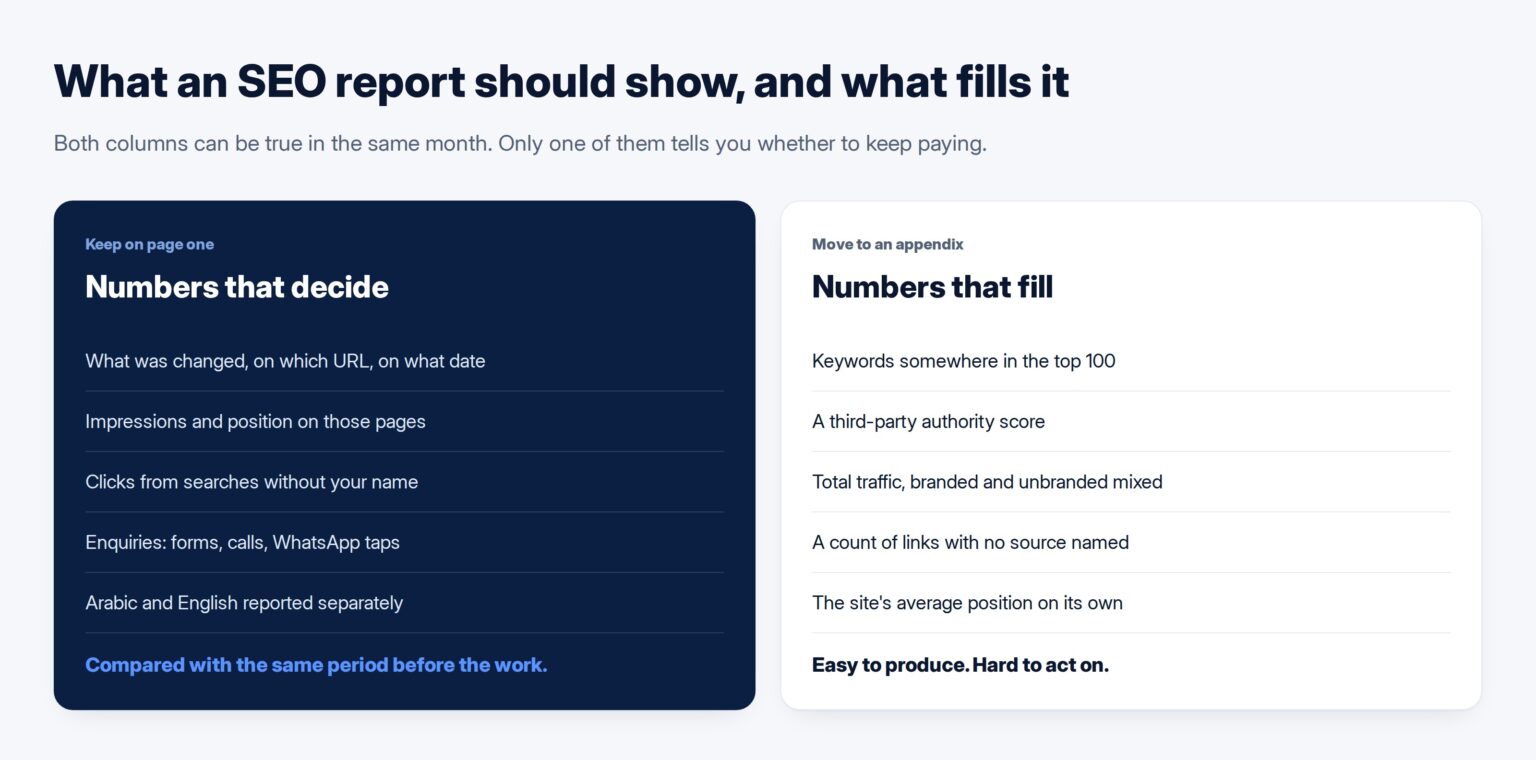
That means four things, in this order: what was done, what search visibility changed on the pages that were worked on, what visits followed, and what enquiries followed those. Anything else is appendix.
Impressions and position, read together
Search Console’s performance report is the source that matters, because it is Google’s own data rather than a third-party estimate. Its definitions are worth knowing. An impression is how often someone saw a link to your site. Average position is the topmost position your site held, averaged across every search where it appeared.
That second definition catches people out. When a page starts ranking for fifty new searches at position 70, the site’s average position gets worse, even though the site is now visible for more things than last month. A supplier can present that as a problem to fix, or ignore it; either way, reading position without impressions beside it tells you nothing. Ask for both, for each page worked on, compared with the same period before the work.
Take your own name out of the traffic
For many Kuwaiti businesses, a large share of search visits come from people typing the company’s name. Those visitors already knew you. They would have found you if the site had no SEO at all, and they rise and fall with your advertising, your shop traffic and the season, not with anything done to the site.
So the report should separate branded searches, which contain your name or your product names, from everything else. Search Console lets you filter queries that do or do not contain a word. The non-branded line is the one the SEO work is responsible for. A site whose total traffic is up twenty percent because of a busy month in the shops, with non-branded traffic flat, has not been helped by its SEO, and a total traffic chart will hide that every time.
Count enquiries, not visits
A visit is not a customer. The report has to reach the step where someone did something a business can act on: sent a form, clicked to call, tapped the WhatsApp button, requested a quote. In Google Analytics these are marked as key events, and if nobody has set them up, that is the first job, before any content is written.
For most businesses here, WhatsApp is where enquiries actually happen, and a click on the WhatsApp link is the closest measurable thing to a lead. Count it. Calls from your Google Business Profile are reported inside the profile rather than in Analytics, and belong in the same line. The number will be small. It is still the only one that pays the invoice.
The work log is the part most reports leave out
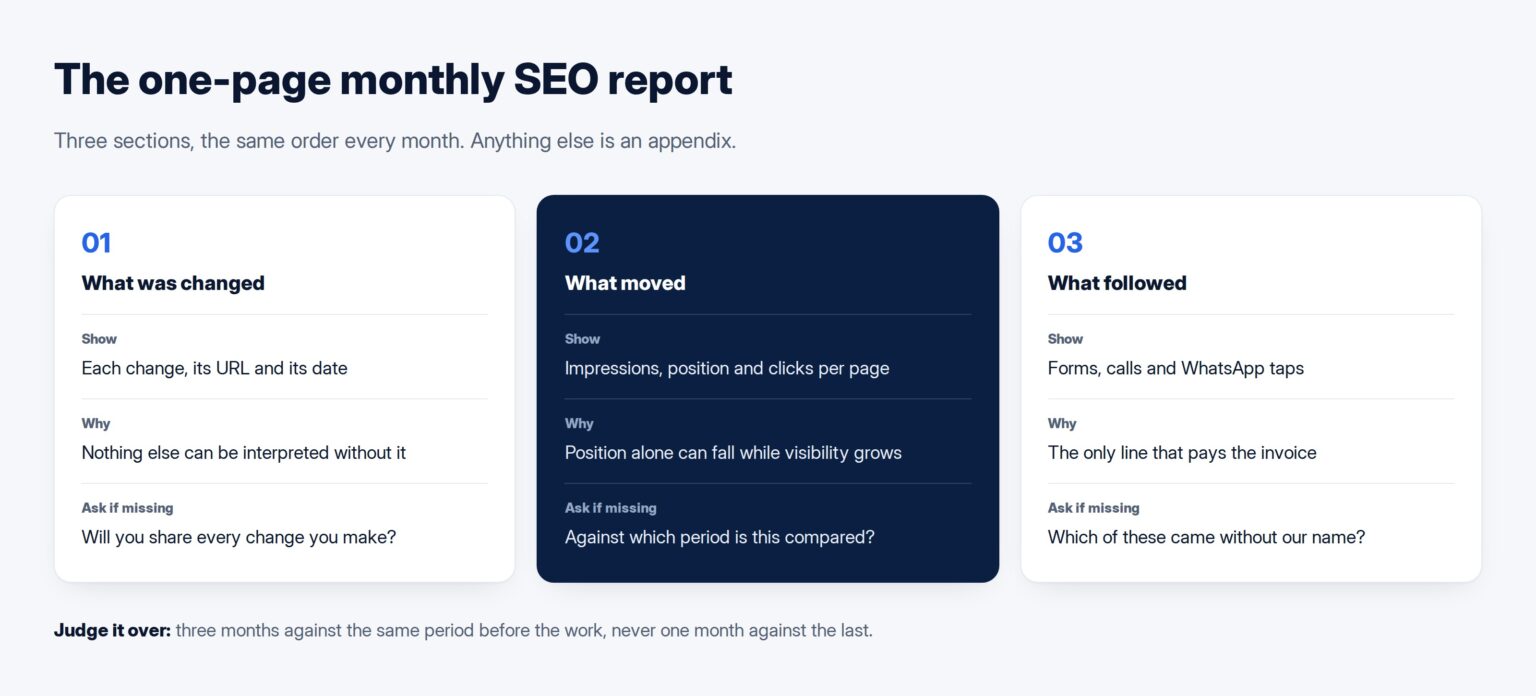
Google’s own guidance on whether you need an SEO lists questions to ask before hiring one, and one of them is whether they will share every change they make to your site. The monthly report is where that happens: a dated list of what was changed, on which URL, and why.
Without it, nothing else in the report can be interpreted. A page that climbed may have climbed because of the work, or because a competitor’s site went down. With a log, you can line up each change against what happened to that page afterwards, and after three or four months a pattern appears: the kind of work that moves your site, and the kind that does not. That is the most valuable thing an SEO engagement produces, and it only exists if someone writes it down.
Numbers that are mostly there to fill the page
Keyword counts, “keywords in the top 100”, are the commonest. A site can gain a hundred such keywords at position 90 without a single extra visit. Authority scores come from commercial tools, and Google says plainly that third-party tools do not have access to its internal ranking data. They are that tool’s estimate, useful for comparing sites against each other and not much else.
Link counts deserve suspicion rather than applause. Links that were bought, exchanged or placed for the purpose of ranking are named as link spam in Google’s spam policies, and a report celebrating forty new links a month from sites you have never heard of is describing risk. Ask where each one came from. If the answer is vague, stop that part of the work.
Arabic and English are two reports
A bilingual site in Kuwait competes in two different result pages with different competitors, different questions and different volumes. Merge them and the English numbers, usually larger, hide whatever is happening in Arabic. Ask for the two languages reported separately, which Search Console makes simple when the Arabic pages live under their own path, such as /ar/.
The Arabic line often moves differently, and it is frequently where the easier gains are, because fewer local competitors write properly in Arabic. The questions Arabic-speaking buyers actually ask can be found without a keyword tool, and a report that shows which of them the site now answers is worth more than any authority score.
One more figure belongs on the page if you advertise: whether the paid campaigns changed that month. A new Google Ads campaign lifts branded searches and sometimes steals clicks from organic results for the same words. If the report does not say what the advertising did, the organic numbers cannot be read fairly in either direction.
What to ask for instead
One page. Three sections, in the same order every month: what was changed, with dates and URLs; what moved on those pages, as impressions, position and clicks against the period before; and what enquiries followed, from key events, WhatsApp clicks and profile calls, non-branded separated from branded. Judge it over three months, not one, because a first read after four weeks is noise more often than signal.
Put the format in the contract, not in a kick-off email. A reporting clause that names the three sections, the comparison period and the date each report arrives costs nothing to agree at the start and is very hard to negotiate later, once the first thirty-page report has become the standard. It also protects a good supplier, whose work is finally visible on a page the client actually reads.
Where a supplier cannot produce that page, it usually means the tracking was never set up, which is fixable, or that there is nothing on it to show, which is information. Either way you have learned more than thirty pages would tell you. How I scope this kind of work, and what I will not do, is on my SEO consulting page, and what changed in search with AI answers explains why visibility now needs reporting beyond Google’s ten links.
Where you want the work and the reporting handled together, including visibility in AI answers, Tothiq’s search visibility service reports on exactly this one-page basis.
Frequently asked questions
How long before an SEO report should show results?
Work on existing pages can show in impressions within a few weeks; new content and anything competitive take months. Judge the trend over three months against the same period before the work started, not one month against the last.
Our average position got worse but the supplier says it is good news. Can that be true?
Yes. Average position is averaged across every search where the site appears, so ranking for many new searches low down pulls the average down. Check impressions: if they rose on the pages worked on, the site is visible for more, which is progress.
Is domain authority a Google metric?
No. Authority scores are calculated by commercial SEO tools, and Google says third-party tools do not have access to its internal ranking data. Treat them as one tool’s estimate, not as a measure of how Google sees your site.
Should the report include ChatGPT and other AI answers?
Increasingly, yes, but as a separate check rather than a score. A monthly test of whether the assistants name your business for your main questions is more useful than any single visibility index, and it can sit on the same page.
What if the supplier will not share what they changed?
Then you cannot tell what you are paying for, and Google’s own advice is to ask for exactly this before hiring. Ask once in writing. If the answer is still no, that is the answer.