A client sent me a screenshot last month. Two lines on one chart: average position, flat as a ruler for eight months; sessions, sloping down the whole way. His question was reasonable and slightly panicked — what did we break?
Nothing. He had not been penalised and his rankings had not moved. What changed was the page those rankings appear on: a result that used to be ten links now often opens with a generated answer, and a reader who gets what they came for at the top has no reason to scroll. The ranking still exists; the click behind it does not.
This is where the acronyms arrive: SEO, AEO, GEO, and a wave of packages sold on the premise that the new surfaces need new machinery. Most of that premise is false, and it is falsifiable against public documentation — which is what the rest of this post does.
What the three letters actually mean
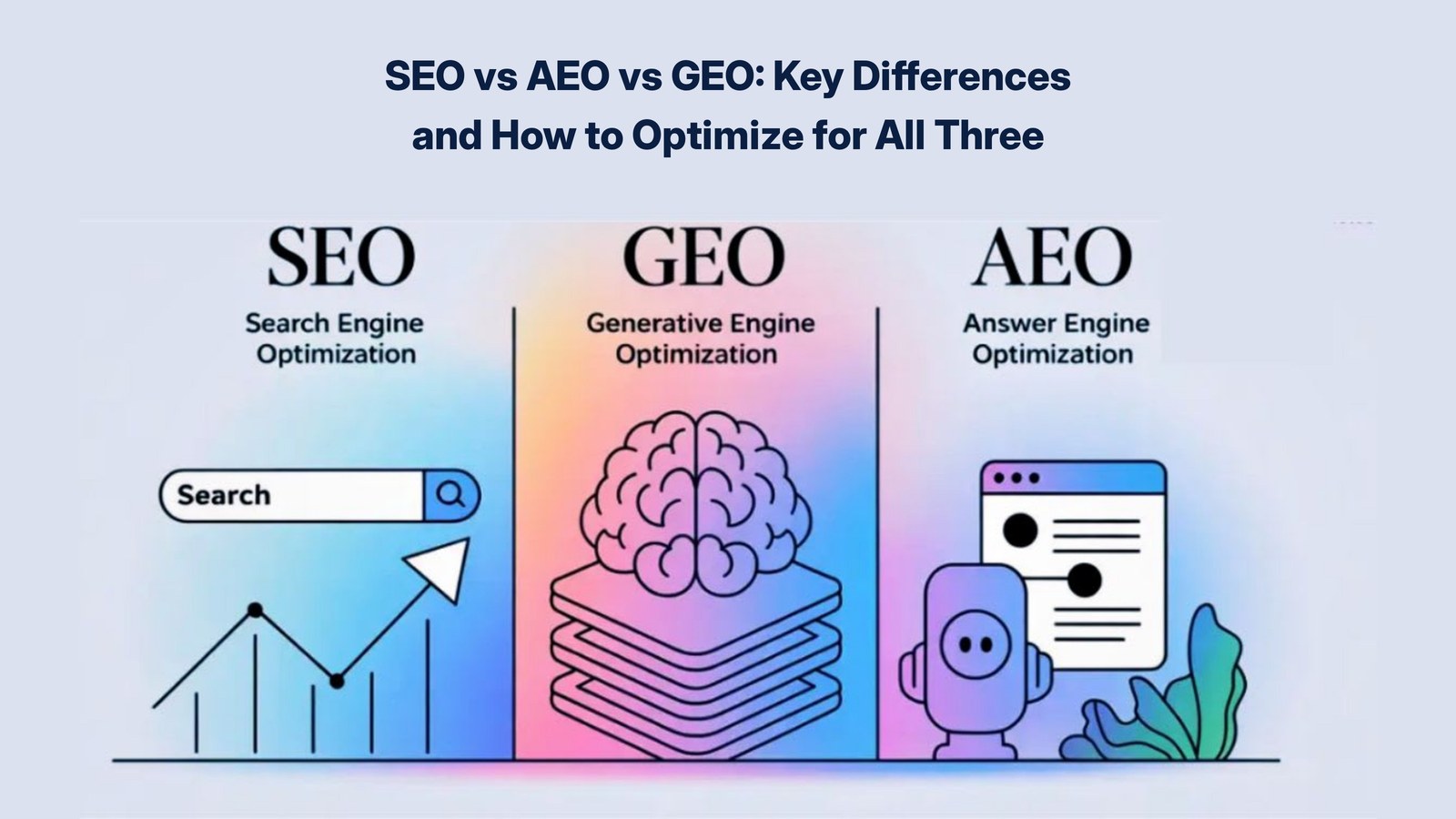
SEO is optimising to be found in a list of results — the ranked links that have existed since the beginning. AEO, answer engine optimisation, is about being the direct answer rather than one of the options: the featured snippet, the People Also Ask box, the reply a voice assistant reads out. GEO, generative engine optimisation, is about being cited inside an AI-generated answer — Google’s AI Overviews and AI Mode, or ChatGPT and Perplexity.
Three names, three surfaces, one page. That is what the acronyms obscure: they describe where your content can appear, not three disciplines with three budgets. The same page must work as a ranked link, a lifted answer and a citable source — and largely the same work makes it good at all three.
What Google says you have to do differently
Nothing. That is not my opinion but Google’s own documentation on AI features in Search, which states there are no additional requirements to appear in AI Overviews or AI Mode and no other special optimisations necessary — and adds, in as many words, that there is no special schema.org structured data you need to add.
The one condition it names is unglamorous: a page must be indexed and eligible to be shown with a snippet. If you have blocked snippets with nosnippet, capped them with max-snippet or applied noindex, you have opted out — and those are the same controls that have governed ordinary snippets for years. Nothing new was introduced.
To be exact: that is Google’s position on Google’s surfaces. It does not describe how ChatGPT or Perplexity choose sources, and none of them publishes a comparable specification. But Google is the surface that matters most to a business in Kuwait, and the only one making a public commitment. A proposal that contradicts the one specification available is worth noticing.
So what is being sold?
I have read a stack of AEO and GEO proposals sent to businesses in Kuwait and the wider Gulf, and they rhyme. Set the pitch beside the documentation and the gap is not subtle:
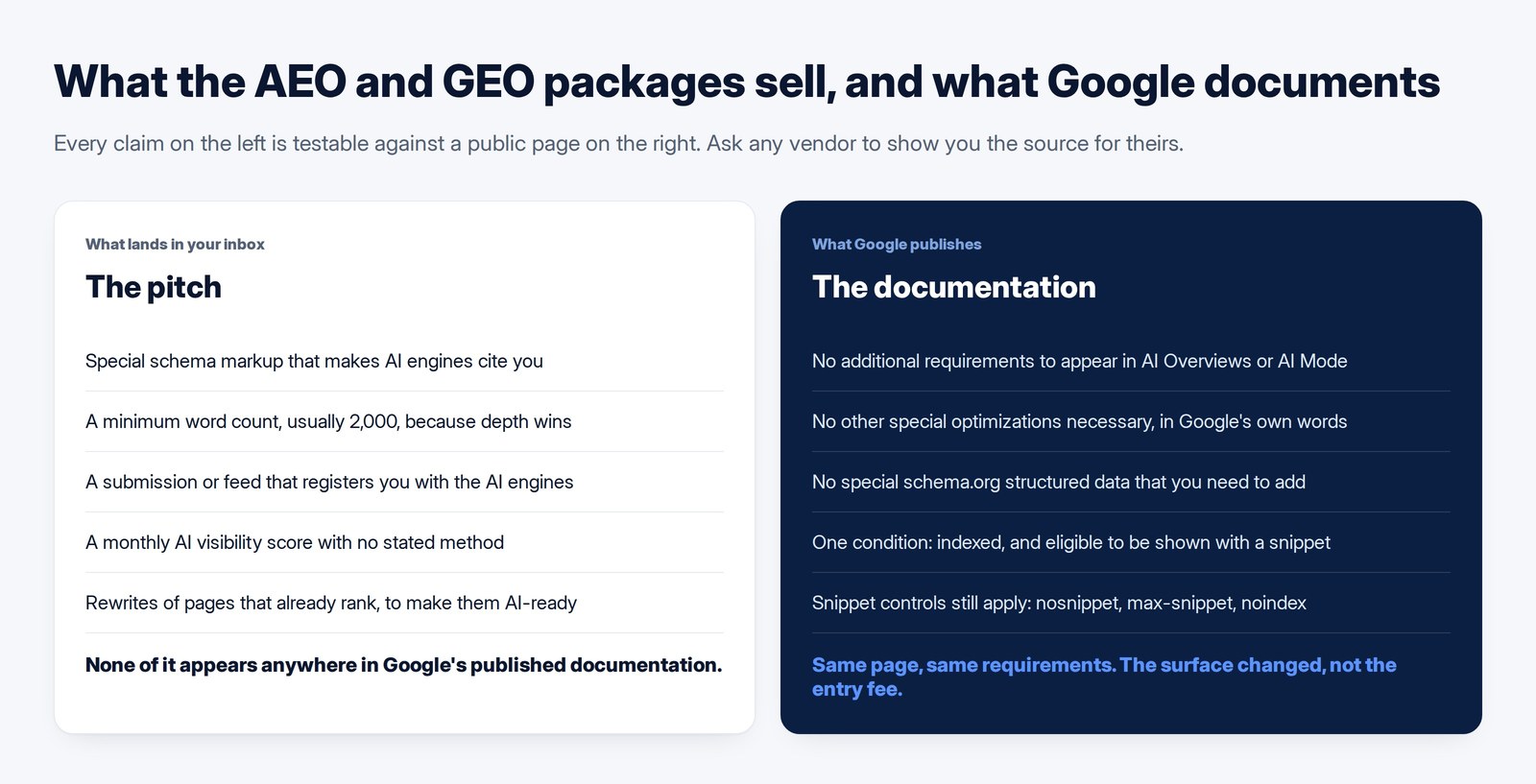
Two deserve naming directly, because an earlier version of this post repeated them and I would rather correct that in public than quietly delete it. The first: structured data does not make AI engines cite you. It earns rich results — review stars, FAQ accordions, product cards — a real outcome, and a different one. Mark up your pages; just do not buy it as an AI ranking factor.
The second is the word count. No published threshold turns a page citable, and a 2,000-word article that buries its answer under a preamble is less quotable than four tight sentences that resolve the question. Length is a consequence of having enough to say, never an input.
The number behind the feeling
My client’s chart is not unusual, and there is now measurement behind it. SparkToro’s analysis of Similarweb clickstream data found that in the first four months of 2026, 68.01% of Google searches ended without a click, up from 60.45% in 2024. Where an AI Overview is present, clickthrough falls by roughly 60%.
Read it with the caveat the authors state: United States data, from a panel excluding the Google mobile app. It is not a Kuwait figure and I have not seen one. Treat it as direction and magnitude, not as your number — and note the exclusion means the true share is likelier higher than lower.
The consequence is simple and uncomfortable. If a large share of searches now resolve on the results page, impressions and clicks have stopped telling the same story — and a business measuring only clicks will read an interface change as a marketing failure.
What Search Console will and will not tell you
In June 2026 Google introduced generative AI performance reports in Search Console, covering impressions from AI Overviews and AI Mode. It is useful and free, and if you have not opened it, do that first.
Know its edges first. You get impressions by page, country, device and date — not queries, clicks, clickthrough rate, position, or which passage supported the answer. So it tells you that you appeared, not whether appearing was worth anything. Any dashboard claiming a precise AI visibility score is either running a proprietary crawl it should describe, or estimating. Ask which.
What actually makes a passage quotable
Strip away the machinery that does not exist and real work remains. It is editorial rather than technical, which is why it is harder to sell in a package. A generated answer is assembled from passages, so the unit of optimisation is the passage, not the page.
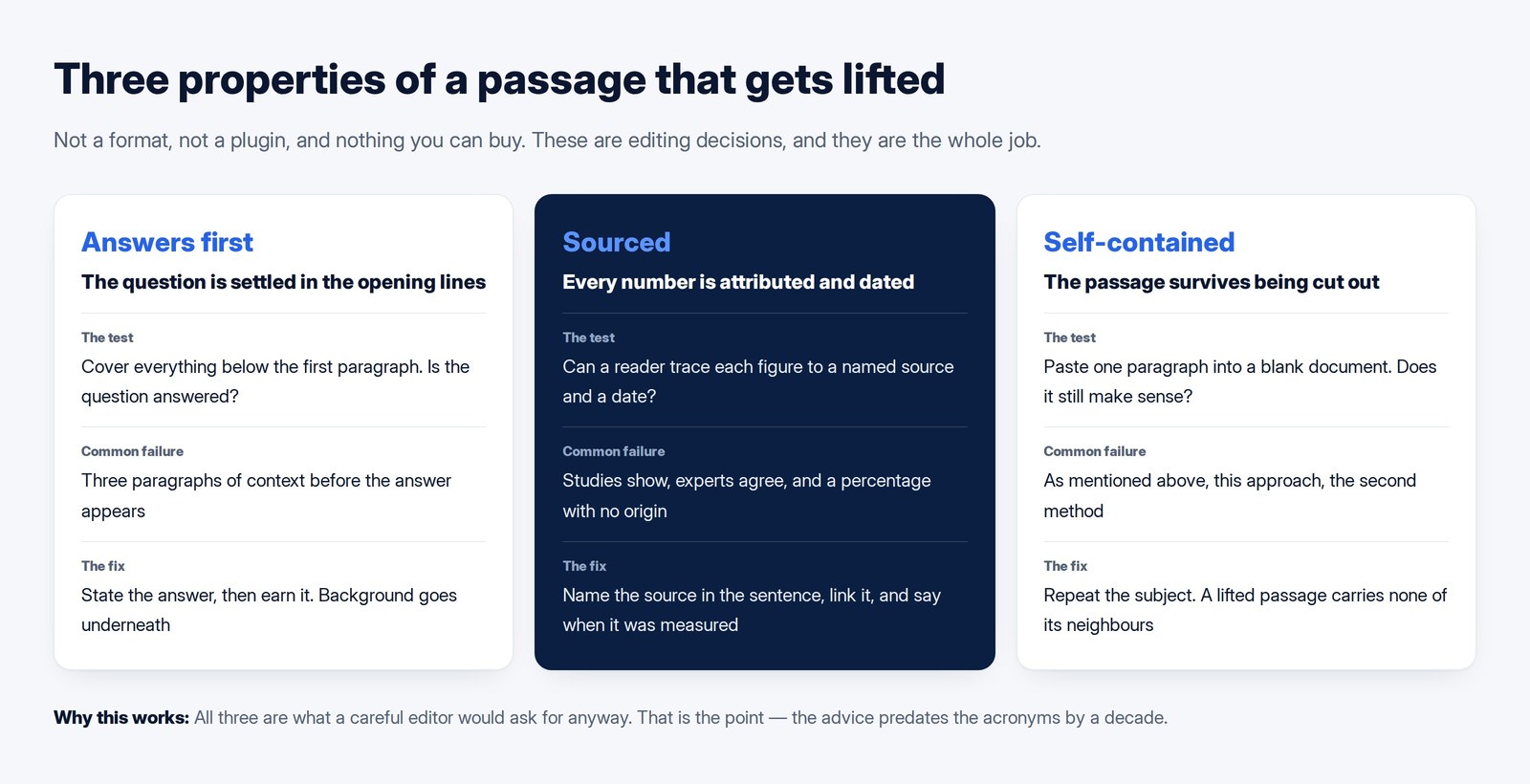
The third test catches good writers. We are trained to build an argument across paragraphs, each leaning on the last. A machine takes one paragraph and discards its neighbours, so a paragraph opening with “as we saw above” reaches the reader meaning nothing. Repeating the subject reads as slightly redundant; it is what makes the passage portable.
And none of it is new. Compare those three tests with Google’s guidance on creating helpful content, published for years: original information, a substantial and complete description, a reader who has learned enough to achieve their goal, sources cited. Those questions predate AI Overviews entirely and describe the same page the new surfaces reward — which is the strongest evidence available that GEO is not a new discipline, and the same holds for the newer labels arriving behind it.
The Arabic argument, which is the strongest one you have
Now the part specific to a business here, which almost nobody acts on. Measured on 22 August 2026, W3Techs puts English at 49.5% of websites whose content language is known and Arabic at 0.6%, eighteenth place.
Turn that around. For an English query on almost anything, an answer engine chooses between millions of competent sources and your odds of being cited are dismal. For an Arabic query about e-invoicing obligations in Kuwait, the field of good sources is thin to the point of embarrassment. The cheapest citation available to a Kuwaiti business is a properly written Arabic page on something it actually knows — part of how generative AI is reshaping the economics here.
“Properly written” is doing real work there. Machine-translated English does not qualify, nor does Arabic laid over an interface designed for English and mirrored afterwards — see what Arabic requires beyond mirroring the layout. Same for how people ask: questions arriving through voice and assistant interfaces come in dialect.
What I would stop doing
Three things. Stop paying for AI submission or registration with answer engines — there is nothing to submit to. Stop padding pages to a word count, which makes them worse at the exact thing you are padding for. And stop rewriting pages that already rank to make them AI-ready: the documented requirement is the eligibility you already have.
What I would measure instead
Four numbers, baselined this week so the comparison means something later. Impressions and clicks as two separate lines, not one ratio. Generative impressions per page. Branded search volume, where being cited without being clicked eventually surfaces. And enquiries that mention something only your site says — the crudest measure and often the most honest, because it counts the reader who found your answer inside someone else’s interface and came anyway.
Steady rankings and falling traffic is now the normal pattern, not evidence of a fault. What answers it is editorial: fewer pages, answered earlier, sourced properly, written in the language your customer searches in. That is the substance of what I do as an SEO consultant in Kuwait. If you want a second opinion on a proposal in front of you, send it over — reading someone else’s scope of work takes an hour and has saved clients a great deal more.
Frequently asked questions
Is GEO a real thing, or just marketing?
The problem is real; the discipline is mostly invented. Generated answers genuinely change how people find businesses, but the adaptation is editorial — answer earlier, source your figures, write passages that survive being lifted out of context. Google’s documentation states plainly that there are no additional requirements and no special structured data for its AI surfaces. Take the shift seriously; treat a separate technical GEO package with suspicion until someone shows you its source.
Should we still use schema markup?
Yes, and keep it accurate — but for the right reason. Structured data is how you become eligible for rich results: review stars, FAQ accordions, product and event listings, breadcrumbs. Those are visible, measurable and worth having. What it does not do is make an AI engine cite you, and Google says so directly.
How do I know if AI answers are costing us traffic?
Compare impressions against clicks over the same period in Search Console. Impressions holding or rising while clicks fall is the signature: the interface changed, your visibility did not. Then open the generative AI performance report for the pages that dropped — remembering it shows impressions only, so it tells you where you appeared, not what that was worth.
Does publishing in Arabic really help us get cited?
It is the largest structural advantage available to a Gulf business. Arabic is 0.6% of websites against English at 49.5%, so competition to be the best source on a Kuwait-specific question in Arabic is a fraction of the English equivalent. The condition: written in Arabic rather than translated into it, on something you genuinely know. Start with the questions customers ask you by phone.
How long before any of this shows up?
Indexing changes within days to weeks; the commercial effect takes a quarter or more and will not arrive as a clean line on a traffic chart. Expect it in the shape of the enquiries instead — better-informed people arriving already knowing your position on something, which is what a citation without a click produces.
Updated 23 August 2026. First published in May 2025 and rewritten since: two claims in the original — that structured data drives AI citation, and that a 2,000-word minimum helps — were wrong, and are corrected above against Google’s published documentation. Every figure here is attributed and dated so you can check it.