“I need someone to audit and fix the SEO on my Arabic website in Kuwait. Who do I hire?” That question, almost word for word, is one people type into Google. It deserves a straighter answer than most audits give, because an Arabic site fails in places an English checklist never looks.
This is the order I work in when a Kuwaiti company asks me to audit a site that runs in Arabic, or in Arabic and English, and what the result should look like when it lands on your desk.
Start with access, not with a tool
An audit built from the outside is guesswork. A crawler can tell you what a page looks like; only your own accounts can tell you what Google does with it. Before anything else the auditor needs read access to Search Console for the property, your analytics, and the website’s admin, plus a name to ask about the hosting.
If nobody in the company can grant Search Console access, that is the first finding, and it is a common one. The account often belongs to a previous agency, or to an employee who has left. Recovering it comes before any other work, because every later check depends on it.
Read the Arabic pages as a site of their own
In Search Console, filter the performance report to pages whose address contains /ar/, or whatever marks your Arabic section, and look at it separately from the English. On most bilingual Kuwaiti sites I open, the English side carries nearly all the impressions and the Arabic side almost none. That is rarely because nobody searches in Arabic. It usually means Google is not treating the Arabic pages as pages worth showing.
Then compare the queries. The Arabic queries that do appear tell you what Arabic searchers expected to find, and they are often more specific and more commercial than the English ones. The same separation should run through every monthly report afterwards, as I set out in what a monthly SEO report should prove.
Is Google keeping the Arabic pages at all?
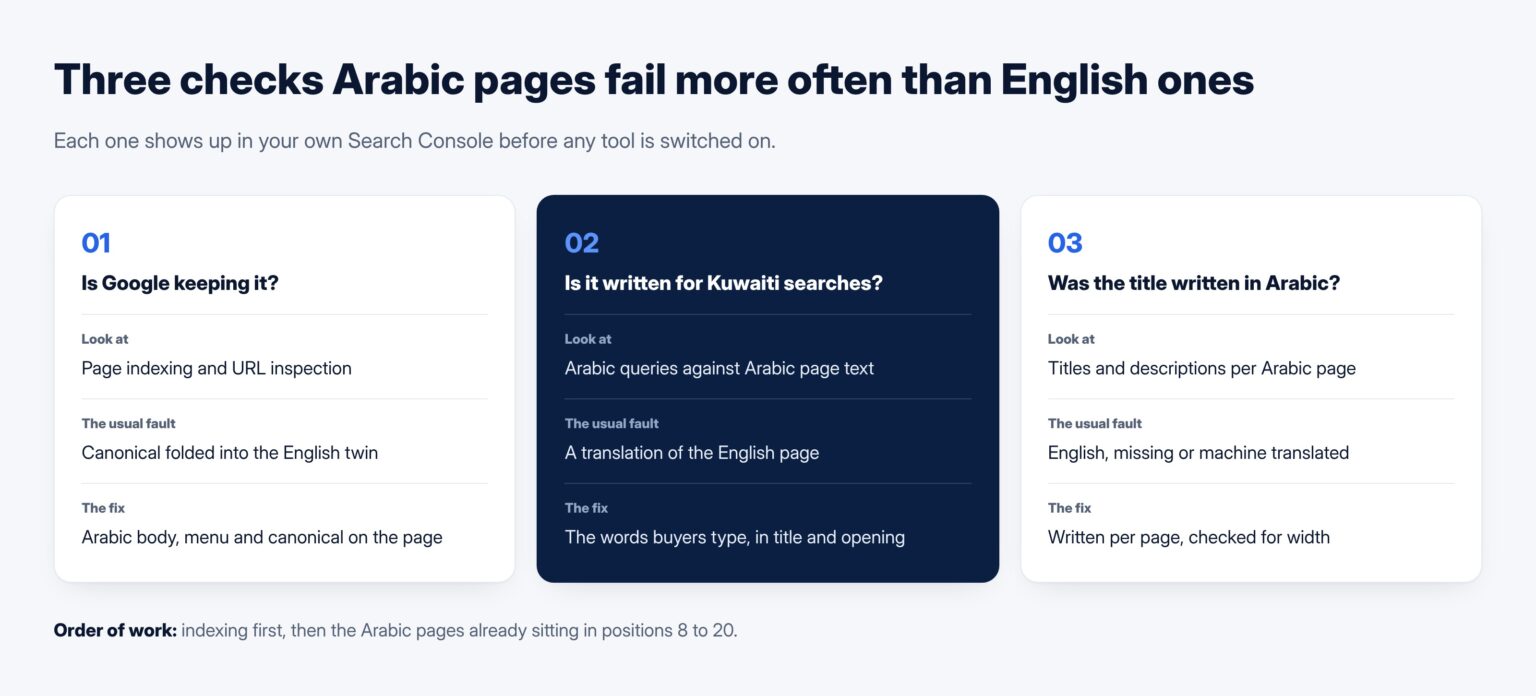
Open the page indexing report and look for Arabic addresses among the pages Google has chosen not to index. Then run a few Arabic service pages through the URL inspection tool, one at a time, and read which page Google selected as the canonical.
The fault I find most often is an Arabic page that Google has folded into its English twin. Google’s own guidance on localized versions says translated pages are only treated as duplicates when the main content is left untranslated. So when it happens, the Arabic page usually still carries English in its main body, its navigation, or its template, or the theme points its canonical tag at the English address.
Check the simpler blocks while you are there. Arabic sections are often added late, through a staging copy, and they sometimes carry a leftover noindex instruction or a robots rule that was meant to be temporary. One inspection of one Arabic page shows it, and it is the cheapest finding an audit can make.
Google also says it decides a page’s language from what is visible on it, not from the code, and it advises one language per page for content and navigation. A page with an Arabic body, an English menu and an English footer is sending mixed signals, whatever its language attribute says.
The words Kuwaiti buyers actually type
An Arabic page written as a translation of the English one answers the English searcher’s question in Arabic. That is not the same as answering the Arabic searcher. Kuwaiti buyers search in a mix of Modern Standard Arabic, Gulf usage and English terms written in Arabic letters, and the page has to contain the words they use.
The audit checks this directly: the Arabic queries in Search Console against the words on the Arabic pages. Where buyers type a phrase the page never uses, that page will not be shown for it, however well it is built. Finding those phrases does not need a paid tool; it is the method in finding the questions your buyers ask, applied to the Arabic side.
Titles and descriptions that were never written in Arabic
On sites built in English first, the Arabic page title shown in search is often the English one, a machine translation of it, or the page heading with the site name appended. The meta description is frequently missing altogether, so Google writes its own from whatever text it finds first, which on an Arabic page can be a menu label.
Google’s documentation on title links explains that it may rewrite a title that is too long, repetitive or unhelpful. An Arabic title also takes a different width on screen from its English twin, so a length that fits in English can be cut off in Arabic. The audit lists every Arabic page whose title or description is missing, English, or duplicated, because each one is a fix that takes minutes.
Images, numbers and the details nobody translates
The smaller parts of an Arabic page are where translation stops. Image alternative text is set once, usually in English, and stays English on the Arabic page. File names are English. Prices and phone numbers appear in one format on the English page and another on the Arabic one, or as images that cannot be read at all. Opening hours, the company name and the area name are written differently on the site and on the Google Business Profile.
None of these alone decides a ranking. Together they tell Google, and the reader, that the Arabic page is a copy rather than a page written for them. The audit lists them because they are cheap to fix and they are fixed once, in the template or the media library, not page by page.
Links, sitemaps and the plumbing between the languages
The technical layer has its own well-known faults: language versions that do not point at each other, internal links that pass through redirects, and a sitemap that stopped telling the truth. Tothiq has written up five technical mistakes that hide Arabic pages with a fifteen-minute check, and an audit should run all of it.
What I add from my own sites is one check people skip: open the Arabic pages on a phone and use the language switcher. If switching from an Arabic service page lands on the English home page rather than the English service page, the two were never linked as a pair, and search engines can see that as clearly as a visitor can.
What the audit should hand you
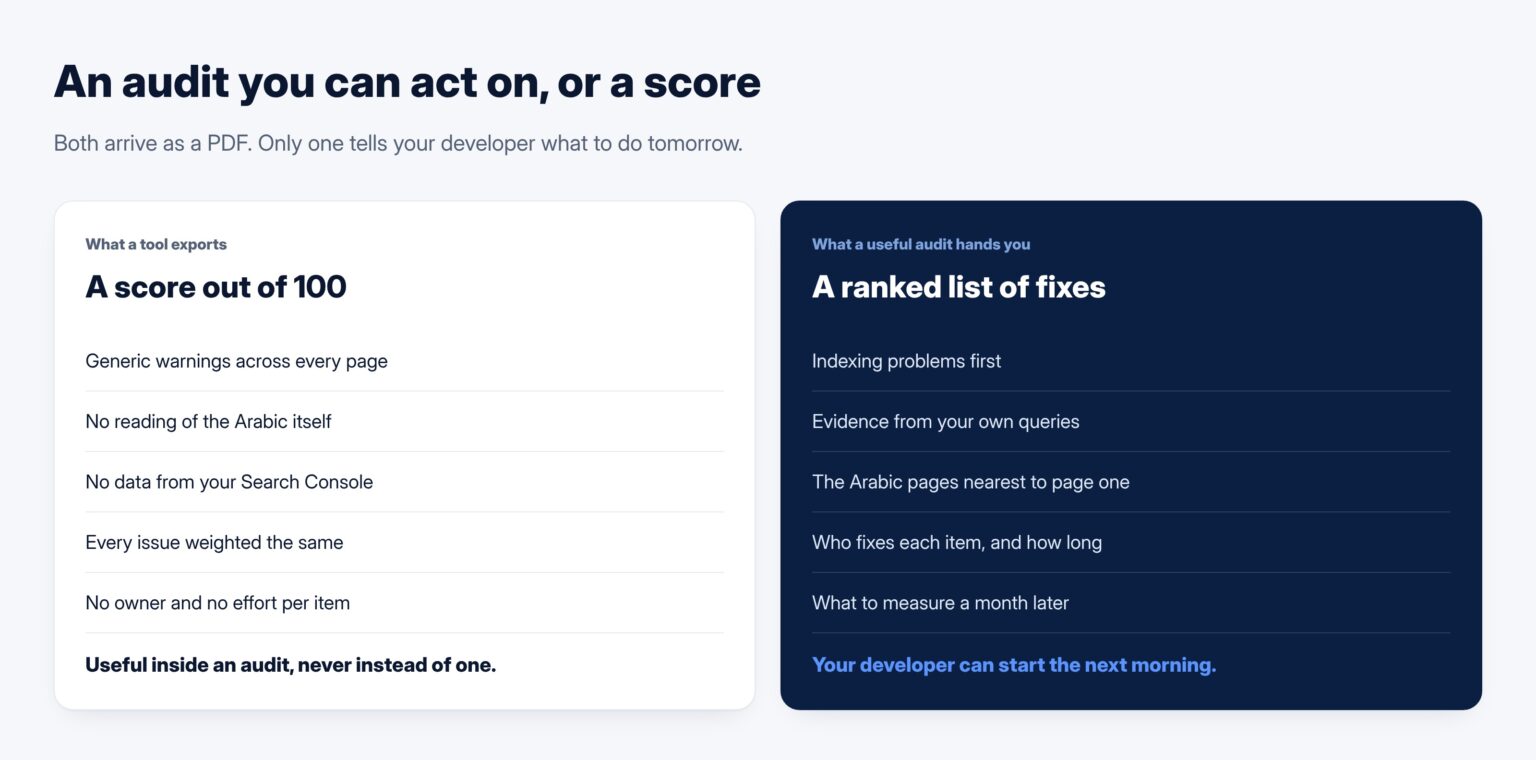
Not a score. A score out of a hundred from a crawler measures what the crawler can measure, and on an Arabic site that leaves out most of what matters. A useful audit is a ranked list. Each finding says what is wrong, on which pages, the evidence from your own Search Console, what fixing it involves, who should do it, and roughly how long it takes.
The order matters more than the length. Indexing problems come first, because nothing else counts on a page Google is not keeping. Then the pages closest to earning: Arabic pages already appearing in positions eight to twenty, where better titles and the right words move them most. Then the rest.
Who to hire for it
Two skills have to sit in the same person, or in two people who actually work together: reading Arabic as a native reader, and reading the page source. An English-speaking SEO specialist with a translator misses the language problems. An Arabic copywriter misses the canonical tags. Most audits of Arabic sites in Kuwait fail for one of those two reasons.
Ask any candidate three things. Which Arabic queries in our Search Console would you work on first, and why? What does Google currently think the canonical of our main Arabic service page is? What will you hand us, and could our developer act on it without you? If they cannot answer the first two after looking at your data, they are selling a tool’s output.
Be wary of three things in a proposal: a guaranteed position, a package of links bought from other sites, and an audit price quoted before anyone has seen your data. The first cannot be promised, the second puts the site at risk, and the third means the audit is a template with your name on it.
That is the work I do as an SEO consultant in Kuwait, and where the fixes need building rather than advising, Tothiq’s search visibility service does the implementation in both languages. If the audit turns up old pages worth saving, bringing an old post back covers how to do it without losing what they already earn.
Frequently asked questions
How long does an SEO audit of an Arabic website take?
For a company site of a few dozen pages in two languages, a few working days once access is granted. Much of the time goes on reading the Arabic pages against the Arabic queries, which no tool does for you.
How long does SEO take to work in Kuwait after the fixes?
Indexing and title fixes can show within weeks, once Google recrawls the pages. Ranking for new Arabic phrases usually takes a few months. Measure it in Search Console on the Arabic pages alone, not on the site total.
Can an SEO tool do the audit instead?
A tool is useful for the technical crawl. It cannot judge whether the Arabic reads like Kuwaiti search language, and it cannot see your Search Console data unless you connect it. Use one inside an audit, not instead of it.
Should our Arabic pages target Kuwaiti dialect or Modern Standard Arabic?
Write in clear Modern Standard Arabic and include the Gulf and English-derived terms buyers actually type, especially in titles and headings. Your own Search Console queries show which ones those are.
Can our own developer make the fixes?
Usually, yes, if the audit is specific enough: page, problem, evidence, fix. The Arabic titles, descriptions and wording need a native Arabic writer, which is not always the developer.