A Kuwaiti store that already sells to Saudi Arabia and Bahrain usually assumes Qatar is the easy one. Same Gulf, similar buyers, a currency pegged to the dollar. It is easier in some ways. But the card most Qataris carry in their wallet may never reach your checkout, and that one fact changes how a Qatar launch should be planned.
This is the third post in a series on selling into each GCC country from a store in Kuwait. Saudi Arabia was about where the money is acquired; Bahrain was about the wallet. Qatar is about the debit card that stays at home, and two things Kuwaiti stores rarely have to think about: a market with no VAT, and an address written as three numbers on a blue plate.
The Qatari debit card is built for Qatari checkouts
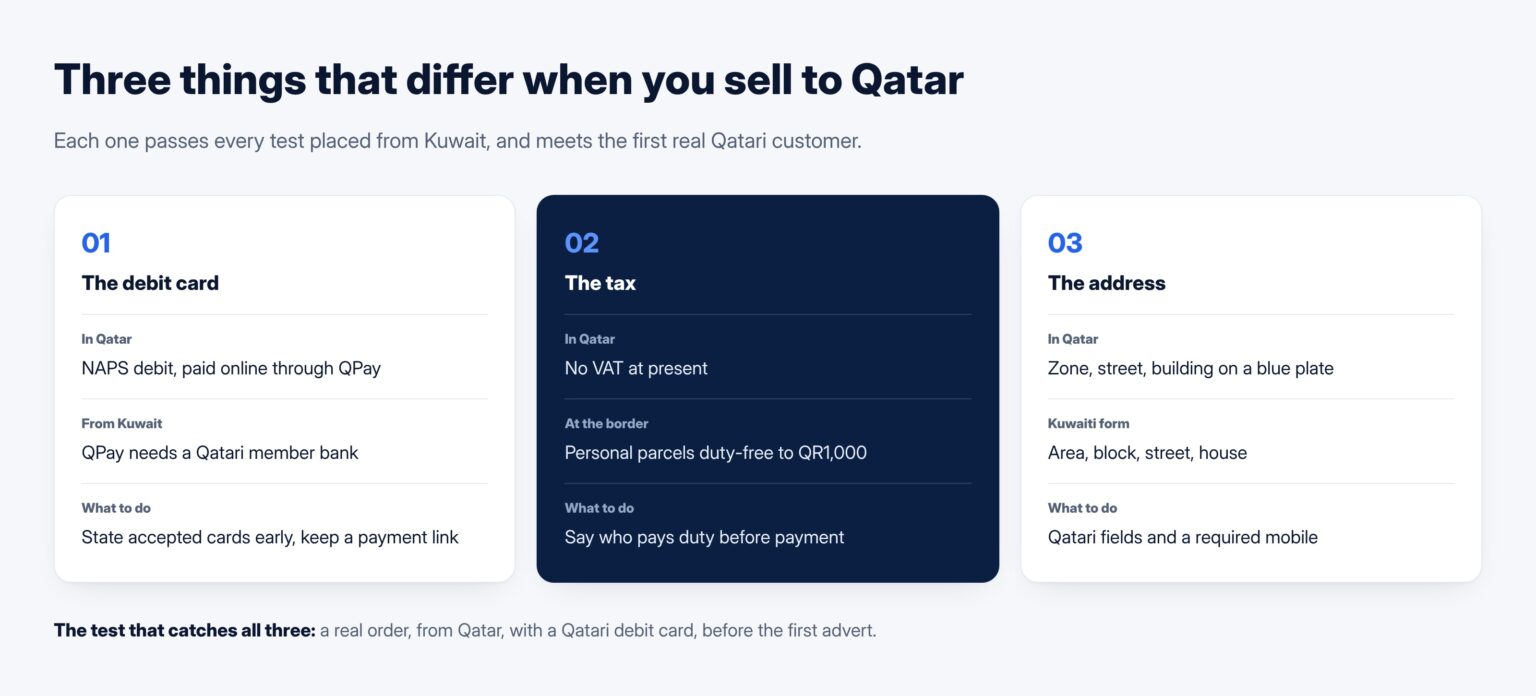
Qatar’s banks issue debit cards on NAPS, the national payment network. Online, those cards are paid through QPay, the gateway the Qatar Central Bank built for them. Checkout.com describes QPay as the only gateway designed specifically for Qatari debit cards, processing in Qatari riyals, and lists it as needing a direct contract with a local provider.
The Mastercard Gateway’s QPay documentation is more specific: the merchant needs an account with a QPay member bank and a QPay merchant ID. In practice that means a Qatari acquiring relationship, which a Kuwaiti company selling from Kuwait does not have.
Qatar’s newer national card, Himyan, launched by the central bank in 2024, also runs domestic payments over NAPS, and its online use is described as local platforms. So the question for your checkout is not whether Qatari customers have cards. It is whether the card they reach for first carries an international brand your gateway accepts.
What that means at your checkout
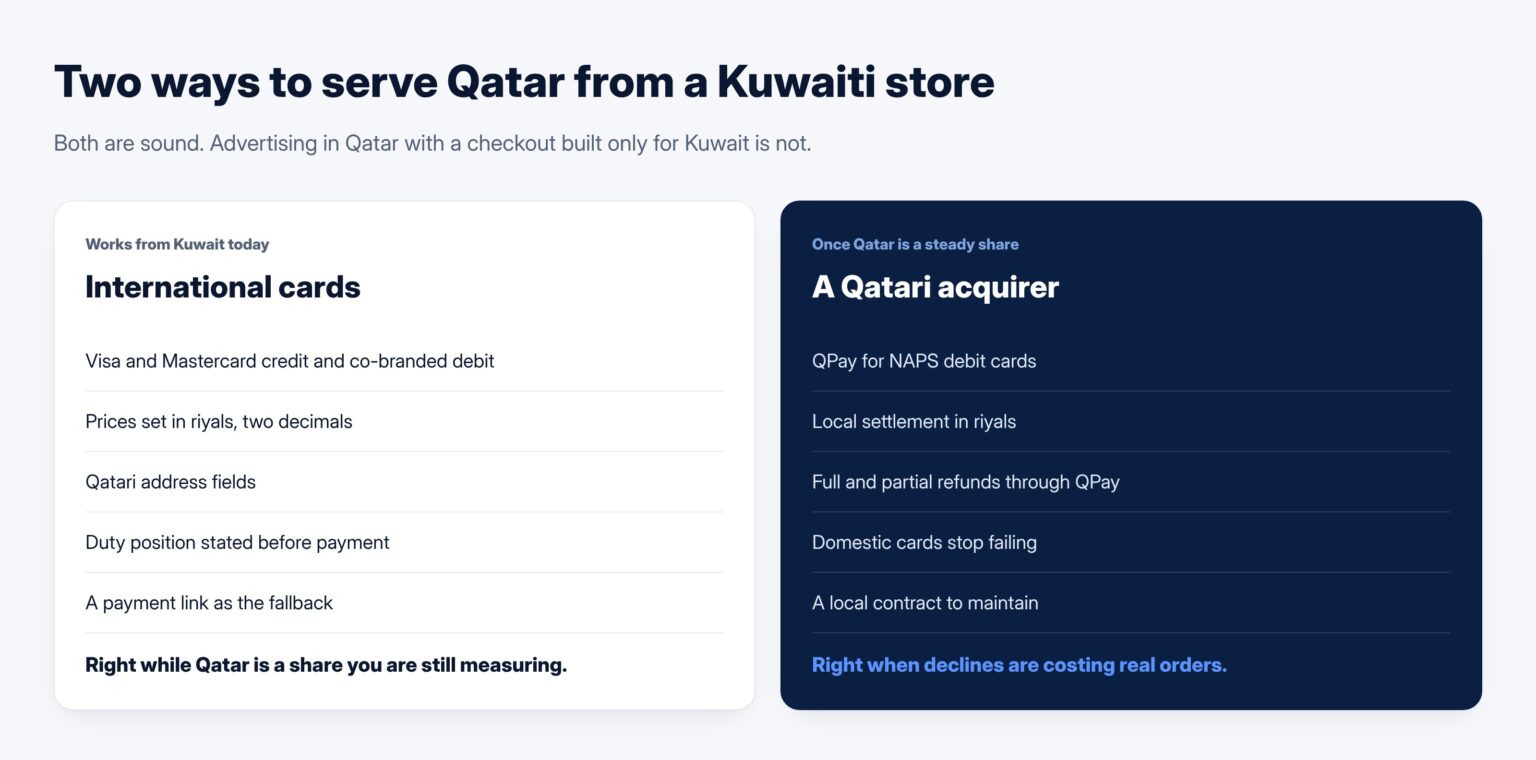
Credit cards and debit cards co-branded with Visa or Mastercard will work through a normal international gateway, exactly as they do for any foreign buyer. Apple Pay works where the card inside it is one your gateway accepts. A customer whose only card is a domestic debit card will reach your payment page and find nothing that takes it.
You cannot fix that from Kuwait without a Qatari acquirer. You can stop it costing you the order. State the accepted cards on the product page, not only at the last step. Keep a payment link as a fallback, sent by WhatsApp, for the customer whose card failed. And watch the payment failures by country in your gateway’s reports for the first month: if Qatari declines are high, that is the debit card, not your site.
Apple Pay deserves its own test. Himyan cards have been available in Apple Pay since 2025, and a customer will reasonably expect the wallet to work everywhere it appears. Whether a given Qatari card inside the wallet is accepted depends on the network behind it, not on the Apple Pay button. Test it with a Qatari customer before you rely on it, and keep the card form visible as an alternative.
Two decimals, not three
The Kuwaiti and Bahraini dinars use three decimal places. The Qatari riyal uses two. If your store converts prices automatically, a price that ends neatly in fils in Kuwait can end in an awkward fraction of a dirham in Qatar, and different parts of the system can round it differently.
Set Qatari prices yourself rather than converting them on the fly, and round them the way Qatari shops do. Then place a test order and check that the product page, the basket, the payment page and the receipt all show the same total. A difference of a few dirhams between the basket and the charge is the kind of thing that turns into a complaint and a dispute.
There is no VAT, and that is not the whole story
Qatar has not introduced VAT. PwC’s Qatar tax summary, reviewed in September 2026, states there is no VAT or sales tax, while noting it is expected under the GCC framework without a date. Excise tax applies to a short list of goods, and customs duty is generally 5 percent on goods from outside the GCC.
For a Kuwaiti store this is simpler than Saudi Arabia, where who imports the parcel decides who pays the tax. It is not a reason to ignore the border. Goods arriving in Qatar still pass customs, and the paperwork has to describe them properly. Design the checkout so that a future VAT could be added as a line, not as a rebuild, because “expected without a date” can become a date.
The parcel threshold shapes the basket
Qatar’s customs authority exempts personal parcels from duty up to a value of 1,000 riyals, provided the goods are not restricted and are imported in the individual’s own name, as The Peninsula reported from the General Authority of Customs. Above that, duty and clearance come into play.
That number belongs in your shipping decisions. A store whose typical Qatari order sits just above it should state clearly, beside the price, who pays any duty and roughly how much, rather than letting the customer discover it at the door. Whatever you choose, say it before payment. The surprise is what produces the refused parcel, not the duty itself.
The address is three numbers on a blue plate
Qatar Post’s postal standards describe the national address system: every building carries a blue plate showing its zone number, street number and building number. There is no postcode in normal use. Couriers deliver to those three numbers and a phone number.
A checkout built for Kuwait asks for area, block, street and house. Reused for Qatar, it collects the wrong fields, or forces customers to squeeze three numbers into a free text line that the courier then has to interpret. Give Qatari addresses their own fields: zone, street, building, unit, and a required mobile number. It is a small form change, and it is the one that most often decides whether the parcel arrives on the first attempt.
Arabic on the receipt, and delivery by road or air
Qatar’s consumer protection rules require Arabic on invoices and product information, with a second language allowed alongside, and the Ministry of Commerce has extended its rule on Arabic price lists to virtual platforms. Those rules are written for businesses operating in Qatar, but a bilingual product page and receipt cost a Kuwaiti store little and remove a reason for a Qatari customer to hesitate.
Parcels from Kuwait go by air or by road through Saudi Arabia to the Abu Samra crossing. Logistics firms note that services through the region can change at short notice, so promise a delivery range you can keep, not your courier’s best case.
Returns and refunds have to work across the border too
A refund to an international card works from Kuwait as it does for any foreign order, although the customer sees it in riyals after their bank’s conversion, which rarely matches the original amount to the dirham. Say so in the refund policy, so the difference is not read as a deduction.
Returns are harder than refunds. A parcel coming back from Doha crosses the same border in the other direction, with the same paperwork and cost. Decide before launch which items you accept back from Qatar, who pays the return shipping, and whether a refund waits for the item to arrive. A Qatari customer who cannot find that answer before paying is less likely to pay at all.
Cash on delivery is the other question every Gulf store faces. Some couriers offer it to Qatar, and it removes the debit card problem entirely, but it moves the risk of a refused parcel onto you, with return shipping across a border. If you offer it, offer it on lower-value orders first and watch the refusal rate.
The order I would do it in
First, check your own data: how many Qatari visitors and failed payments you already have. Second, add Qatar as a shipping country with its own address fields, prices set in riyals, the accepted cards stated early, and the duty position written before payment. Third, place real orders from Qatar on real phones, including one with a debit card, before spending anything on advertising there.
Only if Qatar becomes a real share of orders does a Qatari acquirer, and QPay with it, start to make sense. Until then the international route is enough. The KNET side of the same store is covered in what KNET requires, and the checkout faults that hit every market in the checkout that fails your customer. If the store itself needs building for this, Tothiq builds Shopify stores that sell across the GCC from Kuwait.
Frequently asked questions
Can a Kuwaiti store accept QPay?
Not without a Qatari acquiring relationship. QPay needs an account with a member bank and a QPay merchant ID. A Kuwaiti store selling from Kuwait relies on international card brands instead.
Do we charge VAT to Qatari customers?
Qatar has no VAT at present. Customs duty can apply to goods above the personal parcel exemption, so state who pays it before the customer pays.
Should we show prices in Qatari riyals?
Yes, set by you and rounded the way Qatari shops round, with two decimals. Converting on the fly from a three-decimal dinar causes rounding differences between basket and charge.
What address fields does a Qatari customer need?
Zone, street and building number from the blue plate, a unit if there is one, and a mobile number. A postcode field only causes confusion.
Is Qatar worth a separate store?
Rarely at the start. One store with Qatar set up properly as a destination is enough until Qatari orders are a steady share of the business.