Somebody has told you to do SEO, and the first quotation you received includes a keyword tool at a monthly fee that is not trivial for a company of your size. The tool is not the problem. The problem is that it answers a question you have not asked yet, and you already own better data than it will give you.
Everything below is free, first-party, and specific to your business rather than to your industry in general. It takes about a week of noticing, and it produces a list of questions that a paid tool would never have surfaced because nobody types them often enough to register as volume.
What the tool actually sells you
A keyword tool estimates how many people search a phrase, worldwide or by country, and what it costs to advertise against it. That is genuinely useful when you are choosing between two large markets. It is close to useless when your market is a few hundred companies in one country, because the phrases those companies type are below the threshold at which any tool reports a number.
It is also the wrong shape of answer. Relevance is judged per page against a particular search, by a person in a particular place, in a particular language. Nothing in that rewards matching a high-volume phrase. What is rewarded is being the page that answers what the person actually meant, and you can only know that by listening to your own customers.
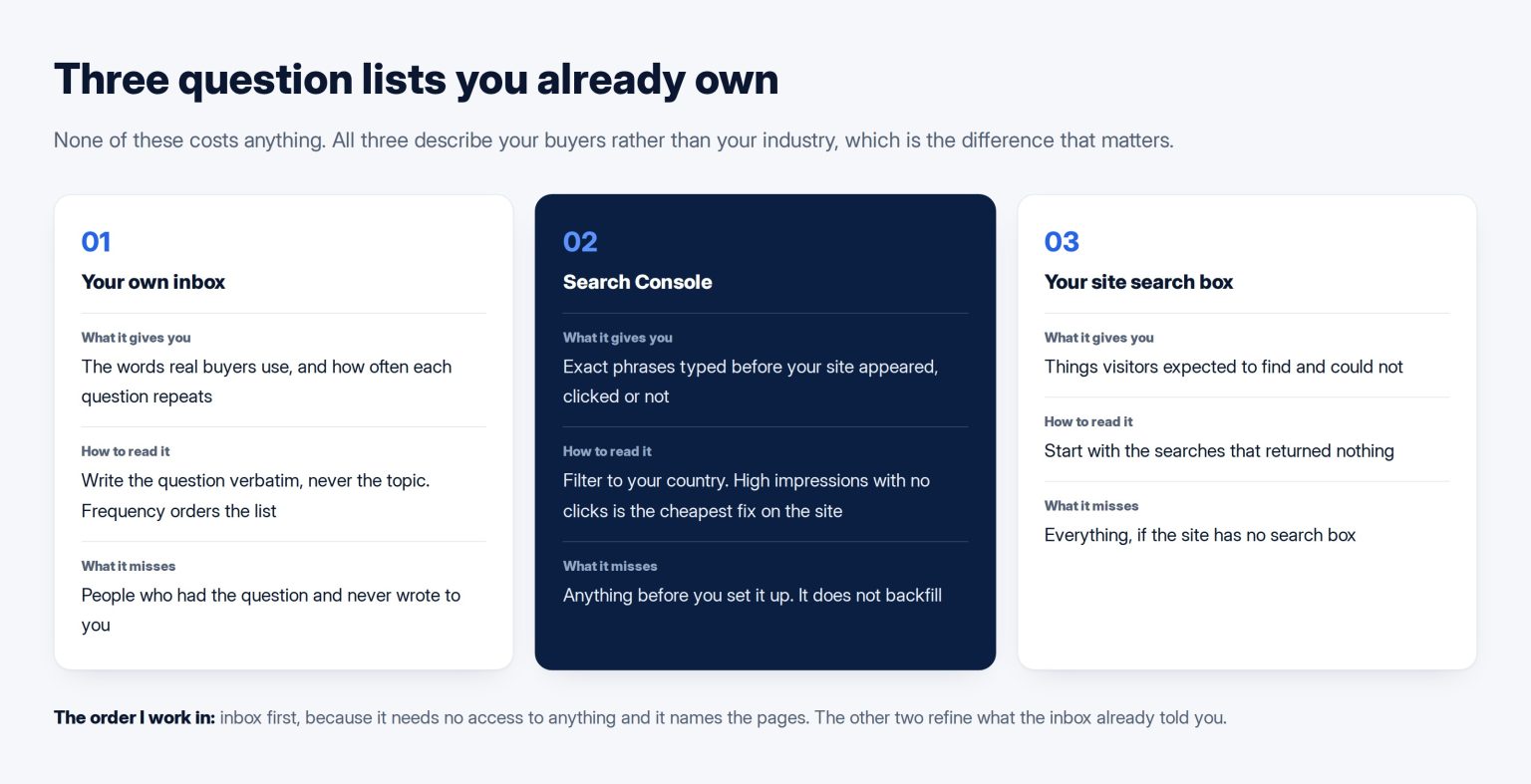
Source one: the questions people already ask you
Open the last two months of enquiries — the form, WhatsApp, the phone notes, the messages your sales person gets directly — and write down the question behind each one in the sender’s own words. Not the topic. The words.
You are looking for two things. Repetition, which tells you what deserves a page. And phrasing, which tells you what the page should be called. Buyers and suppliers name the same thing differently, almost always, and the supplier’s word is the one that ends up on the website. A company that sells what it calls integrated digital transformation receives messages asking whether they can connect the online store to the accounting system. Those are the same service and only one of them is a search anybody performs.
The UK government’s service manual states the discipline this enforces: review the evidence you already have — analytics, search logs, call centre data — and treat opinions that do not come from users as assumptions to be proven. In a small company that evidence is sitting in a phone.
Source two: Search Console, which you may not have opened
If your site is verified in Google Search Console, you already have a list of the exact phrases people typed before your site appeared, whether or not they clicked. That is first-party demand data about your own site, free, and no tool can substitute for it.
The performance report groups data by the query the user typed, and calculates click-through rate as clicks divided by impressions. The rows worth your attention are not the ones at the top. They are the queries with a decent number of impressions and almost no clicks, because those are the searches where Google already thinks you are relevant and the searcher disagreed after reading your title. That gap is the cheapest improvement available to any site, and it needs no new page at all.
The second thing to look for is queries you did not expect. Every site has a handful of phrases arriving from a direction nobody planned. They are usually the most honest description of what your customers think you sell.
Source three: your own site’s search box
If your site has an internal search, its log is a list of things visitors expected to find and could not. Nielsen Norman Group’s work on search logs contains the example that makes the point permanently: a health retailer found 11,750 people searching for heating pads in a month, of whom thirteen bought one. Enormous stated demand, almost no fulfilment, and it was invisible in every other report.
You do not need that scale for the same lesson. Twenty internal searches a month is enough to tell you what your navigation is failing to say. If your site has no search box, this is a fair reason to add one.
Source four: what Google will tell you for free
Two features of the search page are, in effect, a free question list.
Autocomplete first. Google’s own help page is explicit that predictions reflect real searches that have been done on Google, varying by language, location and trending interest. Type the beginning of the thing you sell, in Arabic and in English, with your location set to Kuwait, and write down every completion. Then type the same phrase with each question word in front of it.
Then the block of questions that appears mid-page, which Google documents as a related questions group, also known as People Also Ask. Expanding one of those questions produces more of them. Fifteen minutes of that on your three main services gives you a list nobody had to pay for.
Do both in both languages, and do not assume the Arabic list is a translation of the English one. It usually is not, and the difference is one of the most useful things you will learn in the exercise.
From a list of questions to a page
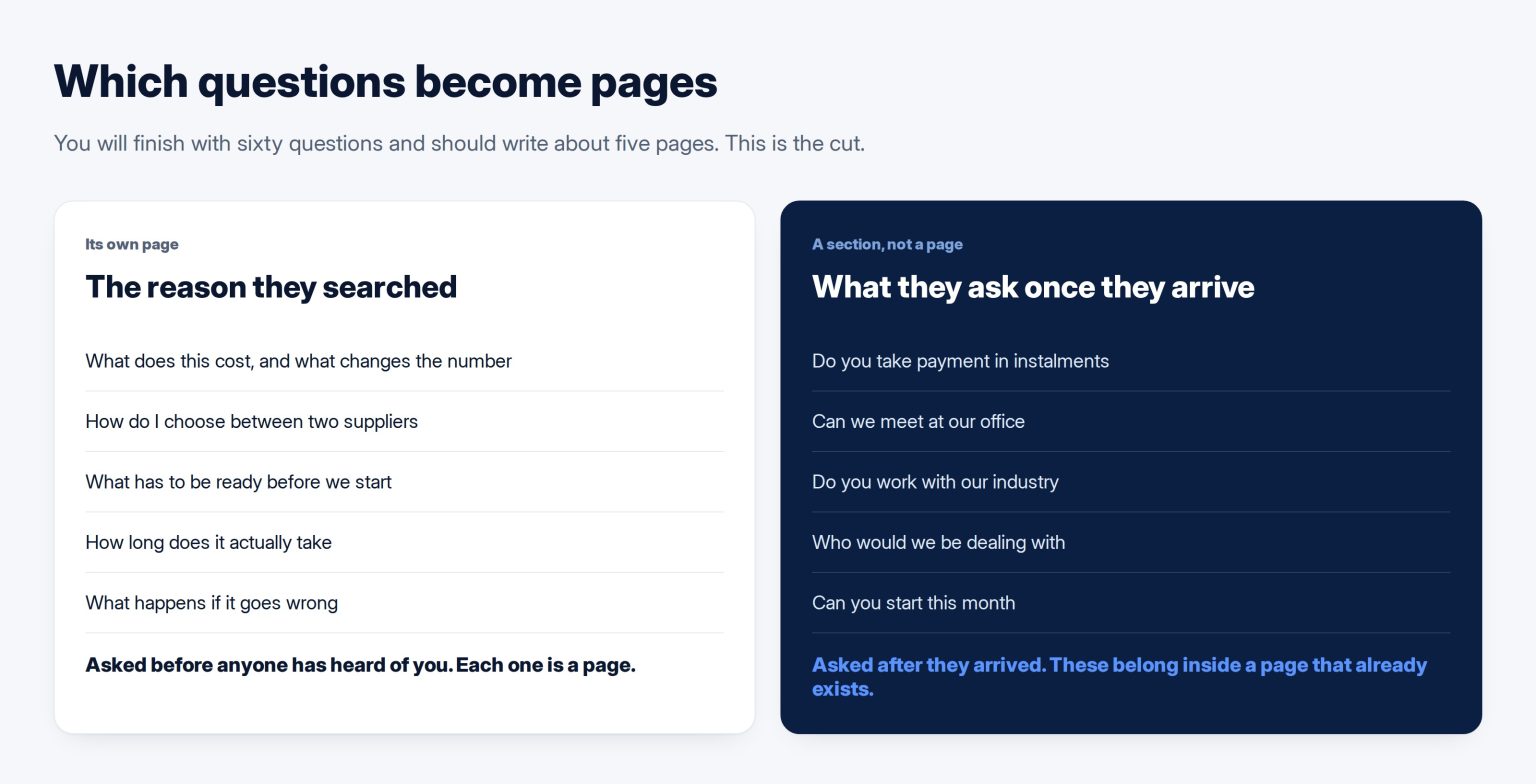
You will end up with sixty or seventy questions and you should not write sixty or seventy pages. Group them. Most will collapse into five or six real questions asked in many ways, and each of those is one page. The rest belong inside a page that already exists, as a section or an FAQ entry, where they are answered without diluting anything.
Then write for the person rather than for the phrase. Google’s guidance is unambiguous on which one its systems are built to reward: people-first content is created primarily for people, not to manipulate search engine rankings. In practice the test is simple. If the page answers the question so completely that the reader does not need to search again, it will do its job. If it circles the phrase without answering it, no amount of volume data saves it.
When there is no demand yet
Sometimes the honest finding is that almost nobody searches for what you sell, in your country, in either language. That is a real result and it changes the plan rather than ending it. It means search is not your first channel, and that the pages you write are there to be found by people who already heard your name, to be read before a meeting, and to be quoted by an assistant when somebody asks it a question in your field.
That is a different job from ranking and it is worth doing deliberately rather than by accident — the distinction covered in what actually changed with AEO and GEO, and what nobody can sell you. And if the demand you do have is local rather than national, the profile usually matters more than the pages, which is the argument in why your Google Business Profile decides more than your homepage.
None of this requires a subscription. It requires a week of writing things down, and the discipline to use your customers’ words instead of your own. If you would rather have someone run it with you, that is part of the search work I do, and the output is the same list either way — which is also the honest thing to check when reading an SEO proposal that opens with a tool licence.
Turning that list into pages that actually get found is the next job, and my company does it: AI search visibility at Tothiq.
Frequently asked questions
Are keyword tools a waste of money then?
No, they are a waste of money at the wrong stage. Once you have a list of real questions and several pages competing for related phrases, a tool helps you see which of them has room and what the competing pages look like. Bought before that, it produces a spreadsheet of national volumes for phrases your customers do not use, and the spreadsheet feels like progress. Order matters more than the purchase.
We have no Search Console access. Where do we start?
Set it up, because it is free and it is the only place this data exists, but do not wait for it. It reports going forward rather than backwards, so a fresh property shows you nothing useful for a few weeks. Start with the inbox exercise, which needs no access to anything, and let the query data arrive underneath it. If nobody at your company has the access, that itself is worth resolving — it usually means the site is registered under a former supplier’s account.
Should we chase the Arabic questions or the English ones?
Answer that from your own two lists rather than from a general claim about the market. Pull the questions from both languages, count how many of your actual enquiries arrive in each, and let the ratio decide where the effort goes first. What you should not do is write the English pages and machine-translate them, because the Arabic questions are usually different questions rather than the same ones in another language.
How long before a page written this way shows anything?
Weeks to months, and the first signal is impressions rather than clicks. Watch for the page appearing at all for the question it was written to answer, then for its position improving as it accumulates internal links and, eventually, external ones. Anyone promising a specific position by a specific date is describing something they do not control. What you can control is whether the page deserves to be the answer.
Our competitors publish weekly. Do we need to match that?
Volume is not the mechanism, coverage is. Five pages that completely answer the five questions your buyers actually ask will outperform fifty that touch each question lightly, because the fifty compete with each other for the same searches. Publish when you have something a buyer needs and cannot get elsewhere. If that turns out to be monthly, publish monthly, and use the time you save to make each one worth citing.