Introduction: Why Webflow for Kuwaiti Startups
Kuwait’s startup ecosystem is booming, fuelled by steady e-commerce growth and a digital market where most users browse on mobile and most prefer Arabic content. For startups, launching a fast, responsive, and visually appealing website is critical to stand out in this competitive landscape. Enter Webflow, a no-code platform that empowers businesses to create custom websites without coding expertise. With its intuitive design tools, Arabic right-to-left (RTL) support, and integrations like WhatsApp, Webflow is ideal for Kuwaiti startups aiming to engage mobile-first consumers and build community-driven experiences. This post explores Webflow’s features, technical setup and tailored strategies to help Kuwaiti entrepreneurs succeed in the digital market.
What is Webflow? A Deep Dive into Its Capabilities
Webflow is a no-code website development platform that combines a visual design editor, content management system (CMS), e-commerce tools, and cloud hosting to create custom, responsive websites. Launched in 2013, Webflow has grown into a mainstream platform, offering startups a cost-effective alternative to traditional coding or platforms like WordPress — the trade-offs against a self-hosted WordPress build are set out in the guide to optimising WordPress for Kuwaiti audiences. Its drag-and-drop interface, robust styling, and seamless integrations make it a game-changer for Kuwaiti startups with limited technical resources.
Core Features for Kuwaiti Startups
- Visual Design Editor: Build pixel-perfect layouts using a drag-and-drop interface, supporting Arabic RTL for most Kuwaiti users who prefer Arabic content.
- Responsive Design: Automatically optimizes sites for mobile (most of Kuwait’s traffic), tablets, and desktops, which matters when most visits arrive on a phone.
- CMS: Manages dynamic content like product listings, blog posts, or user feedback, ideal for community-driven platforms.
- E-Commerce Tools: Supports product pages, checkouts, and payment gateways (e.g., Stripe, PayPal), though it is lighter than a dedicated e-commerce platform, and the comparison with Shopify is worth reading before you commit.
- SEO Capabilities: Built-in meta tags, sitemaps and clean markup, which covers the basics in Google’s SEO starter guide and optimises for keywords like “Kuwaiti startup website.”
- Integrations: Connects with WhatsApp, Instagram, and AI tools like Zapier for automation.
- Custom Code: Embeds JavaScript or HTML for advanced features like user feedback forms.
- Hosting: Cloud-based with 99.9% uptime, leveraging CDNs for Kuwait’s mobile-first market.
- Animations and Interactions: Creates engaging micro-interactions (e.g., hover effects) to captivate Kuwaiti youth.
Why Webflow for Kuwait?
Webflow’s no-code approach eliminates the need for costly developers, a critical advantage for Kuwaiti startups where experienced web developers are in short supply. Its RTL support makes Arabic UX workable, though getting Arabic right involves more than mirroring a layout — see the guide to Arabic UX in the GCC, while its speed (sites live in hours) and mobile optimization align with Kuwait’s digital demands. Webflow’s CMS also supports community-driven features, like Q&A sections, resonating with your Crowd Thoughts vision.Webflow vs. Competitors
- WordPress: Flexible but complex; requires plugins and maintenance.
- Shopify: E-commerce-focused but limited for custom designs.
- Wix: Beginner-friendly but lacks Webflow’s advanced styling and CMS.
Kuwaiti Startup Needs in the Digital Landscape
Kuwaiti startups operate in a unique digital environment, shaping their website needs:
- Mobile-First Market: most users browse on mobile, requiring responsive designs that load quickly on a mobile connection.
- Arabic Content Preference: most favor Arabic, with Kuwaiti dialects (e.g., “زين”, “شلون الطلب؟”) enhancing trust and engagement.
- Cultural Aesthetics: Designs must incorporate vibrant colors for National Day or Islamic motifs for Ramadan to resonate with local values.
- Social Media Influence: a large share of traffic comes from Instagram, demanding visually stunning sites with social integrations.
- WhatsApp Dependency: most Kuwaitis use WhatsApp for inquiries, requiring embedded chat and contact forms.
- Trust and Transparency: many hesitate to shop online due to scam fears, necessitating clear navigation and user reviews.
- Community Engagement: many value user feedback, similar to Q&A platforms, driving demand for interactive features.
- Budget Constraints: SMEs need cost-effective solutions, with many citing high development costs as a barrier, per 2024 Kuwait Chamber of Commerce data.
Webflow’s no-code, mobile-first, and Arabic-friendly features address these needs directly.
Technical Setup: Building with Webflow for Kuwait
Webflow simplifies website creation for Kuwaiti startups. Here’s a detailed setup guide:
Setup Process
- Sign Up: Create a free Webflow account at webflow.com; upgrade to a paid CMS or Business plan for advanced features.
- Choose Template: Select a mobile-responsive, RTL-compatible template (e.g., “Flowbase”) or start from scratch.
- Design Layout:
- Use the visual editor to drag-and-drop elements (e.g., headers, buttons).
- Set for Arabic text, using fonts like Tajawal (16–18px).
- Add animations (e.g., fade-in for product images) to engage Kuwaiti youth.
- Configure CMS: Create collections for blogs, products, or user feedback, enabling dynamic content updates.
- Integrate Tools:
- WhatsApp: Embed chat buttons for inquiries.
- Instagram: Link feeds using Webflow’s embed feature.
- SEO: Add meta titles/descriptions with Yoast-like precision.
- Optimize for Mobile: Test responsiveness with Webflow’s device preview, and check it on a real phone rather than only the desktop preview.
- Publish: Deploy to Webflow’s hosting or export code for custom servers.
Sample code — embedding a WhatsApp contact button:
<a href="https://wa.me/96512345678?text=Hello%20from%20my%20startup">Contact Us</a> <style> .whatsapp-button { background: #25D366; color: white; padding: 12px 20px; border-radius: 8px; } </style>Key Integrations
- Zapier: Automates WhatsApp responses or Instagram posts.
- Memberstack: Adds user login for community features like feedback forums.
- Google Analytics: Tracks traffic and conversions.
- Finsweet Attributes: Enhances CMS with filtering for product listings.
Tools for Kuwait
- BrowserStack: Tests RTL and mobile compatibility.
- Udesly: Converts Webflow to WordPress for hybrid needs.
- Jetboost: Adds dynamic search for Arabic content.
Performance optimisation
- Use Webflow’s CDN for 99.9% uptime.
- Compress images with TinyPNG to maintain speed.
- Minify CSS/JS in Webflow’s code editor.
Pros and Cons of Webflow for Kuwaiti Startups
| Where Webflow helps | Where it costs you |
|---|---|
| No-code build: most of the site can be produced without a developer | Learning curve: expect days, not minutes, before you are productive |
| Strong responsive control out of the box, which suits a mobile-first market | Subscription cost is per site and per seat, and adds up for a small team |
| Arabic RTL is workable, but only if you set it up deliberately | E-commerce is lighter than a dedicated platform such as Shopify |
| Fast hosting on a global CDN, with no server to maintain | Anything beyond standard behaviour needs custom code |
| Forms and CMS collections cover most feedback and community needs | No local support in Kuwait’s timezone |
Kuwaiti-Specific Webflow Strategies
- Arabic RTL Design: Use and fonts like Noto Sans Arabic (16–18px) for readability.
- Cultural Aesthetics: Add seasonal themes (e.g., Ramadan patterns, National Day colors) via Webflow’s style panel.
- WhatsApp Integration: Embed chat and inquiry buttons for most users.
- Instagram Synergy: Link product showcases to Instagram using Webflow’s embed feature.
- Local SEO: Optimize for “Kuwait startup website” with meta tags and Google My Business.
- Community Engagement: Add feedback forms or Q&A sections, rewarding users like Crowd Thoughts.
- Mobile Optimization: Use Webflow’s responsive breakpoints for iPhone and Android compatibility.
- Accessibility: Follow WCAG 2.1 with high-contrast colors for Kuwait’s disabled population.
Testing Strategy
- Test RTL with native Kuwaiti users for dialect accuracy (e.g., “شلون الموقع؟”).
- Use BrowserStack for cross-device testing.
Challenges and Ethical Considerations
- Cost: Webflow’s per-site subscription adds up for a small team. Solution: Start with free plan, upgrade after ROI.
- Skills Gap: Only part of Kuwaiti developers know no-code platforms, per LinkedIn 2025. Solution: Train via Webflow University or hire experts.
- Privacy: User data collection risks Kuwaiti compliance. Solution: Audit with OneTrust for data protection laws.
- Cultural Sensitivity: Misaligned designs may offend Kuwaiti values. Solution: Test with native users for some iterations.
- Accessibility: accessibility is widely neglected on Kuwaiti sites, and the WCAG guidelines are the baseline worth designing to. Solution: Use Webflow’s accessibility checker and AccessiBe.
- Scalability: Large sites may require custom code. Solution: Use Finsweet Attributes for advanced CMS.
Getting Started: Comprehensive Steps for Kuwaiti Startups
- Define Goals: Identify site purpose (e.g., showcase services, collect feedback).
- Sign Up: Create a Webflow account; start with free plan for prototyping.
- Choose Template: Select RTL-compatible templates or design from scratch.
- Build Site:
- Use visual editor for layout and animations.
- Add CMS for dynamic content (e.g., blogs, reviews).
- Embed WhatsApp and Instagram integrations.
- Optimize:
- Set meta tags for SEO (e.g., “Kuwait startup services”).
- Check real-world mobile load time on a phone, not the desktop preview.
- Test accessibility with Webflow’s checker.
- Test: Use BrowserStack and 50 Kuwaiti users for RTL and mobile feedback.
- Launch: Publish via Webflow hosting or export code.
- Monitor: Track performance with Google Analytics and Hotjar.
Resources
- Webflow University: free tutorials, and the fastest way to judge whether the platform suits how you work.
- Flowbase: RTL-compatible templates.
- Google Analytics: Traffic insights.
- BrowserStack: Mobile and RTL testing.
Conclusion: The Future of Webflow in Kuwait’s Digital Economy
Webflow is transforming Kuwait’s startup landscape, offering no-code, mobile-first, and Arabic-friendly websites that drive engagement and growth. Its ability to create responsive, community-driven platforms aligns with Kuwait’s e-commerce boom and Vision 2035 tech goals. By leveraging its tools, startups can launch stunning sites in days, captivate mobile users, and build trust with Arabic UX. The honest test is whether you will still be happy with the platform in three years — decide that before you start building, not after.
If you are weighing Webflow against a self-hosted build, the decision is rarely about the tool and almost always about who will own the site in two years and what happens when you outgrow the platform. That is the conversation I have on the web consulting page, and the same reasoning applied to technology choices generally sits behind the Fractional CTO model. Whatever you build on, make sure the pages themselves are structured to be quoted by search engines and AI assistants — that discipline is set out in the guide to SEO, AEO and GEO for Kuwait.
Frequently asked questions
Is Webflow the right choice for a Kuwaiti startup?
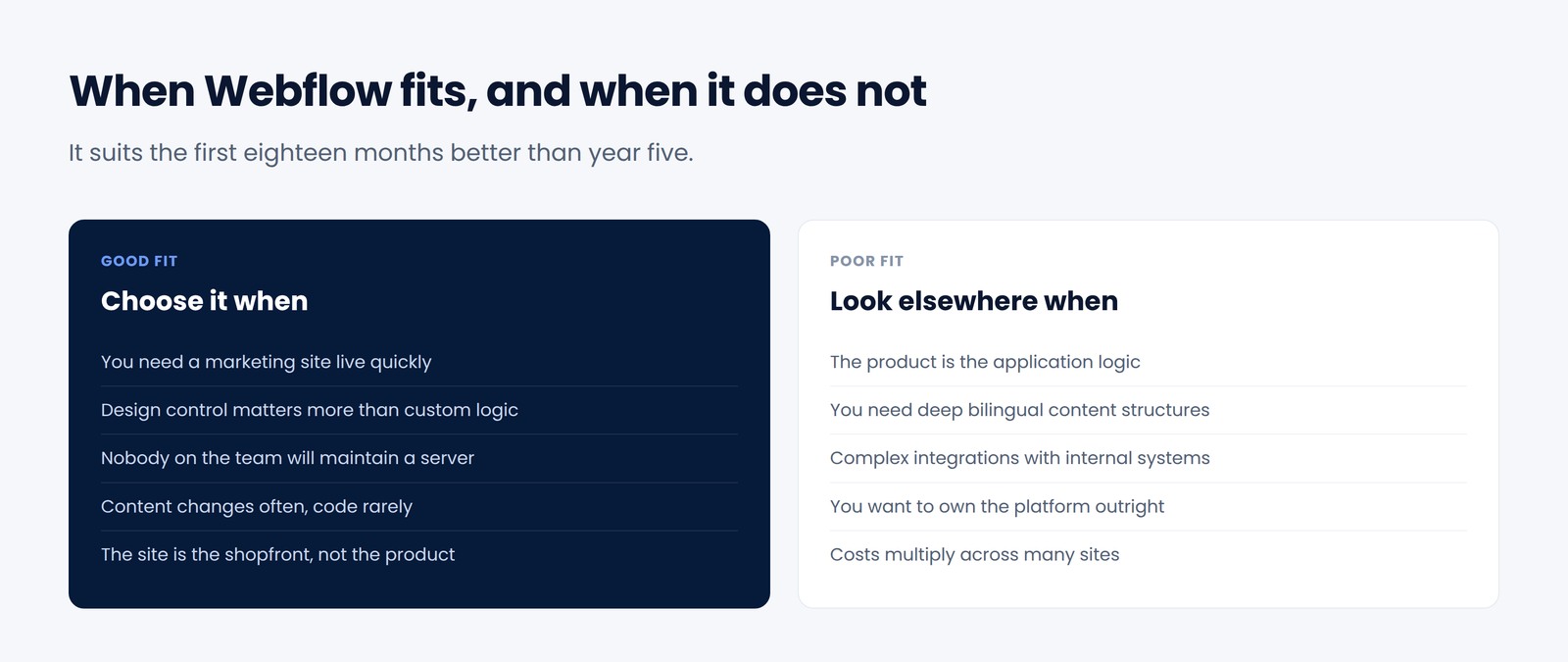
It suits a marketing site you need quickly, with design control and no one to maintain a server. It suits you less when the product is application logic, when you need deep bilingual content structures, or when you want to own the platform outright. Webflow usually fits the first eighteen months better than year five.
How well does Webflow handle Arabic and right-to-left layouts?
It can produce right-to-left layouts, but not by default. Direction, typography, spacing and mirrored components all need deliberate setup, and a bilingual site needs separate indexable pages per language rather than a translation widget bolted on top.
What does Webflow cost compared with WordPress?
Webflow is a monthly subscription per site with hosting included; WordPress is hosting plus maintenance. Webflow is usually cheaper to begin and more expensive at scale. The crossover arrives when you need several sites or custom back-end work.
Can we move off Webflow later?
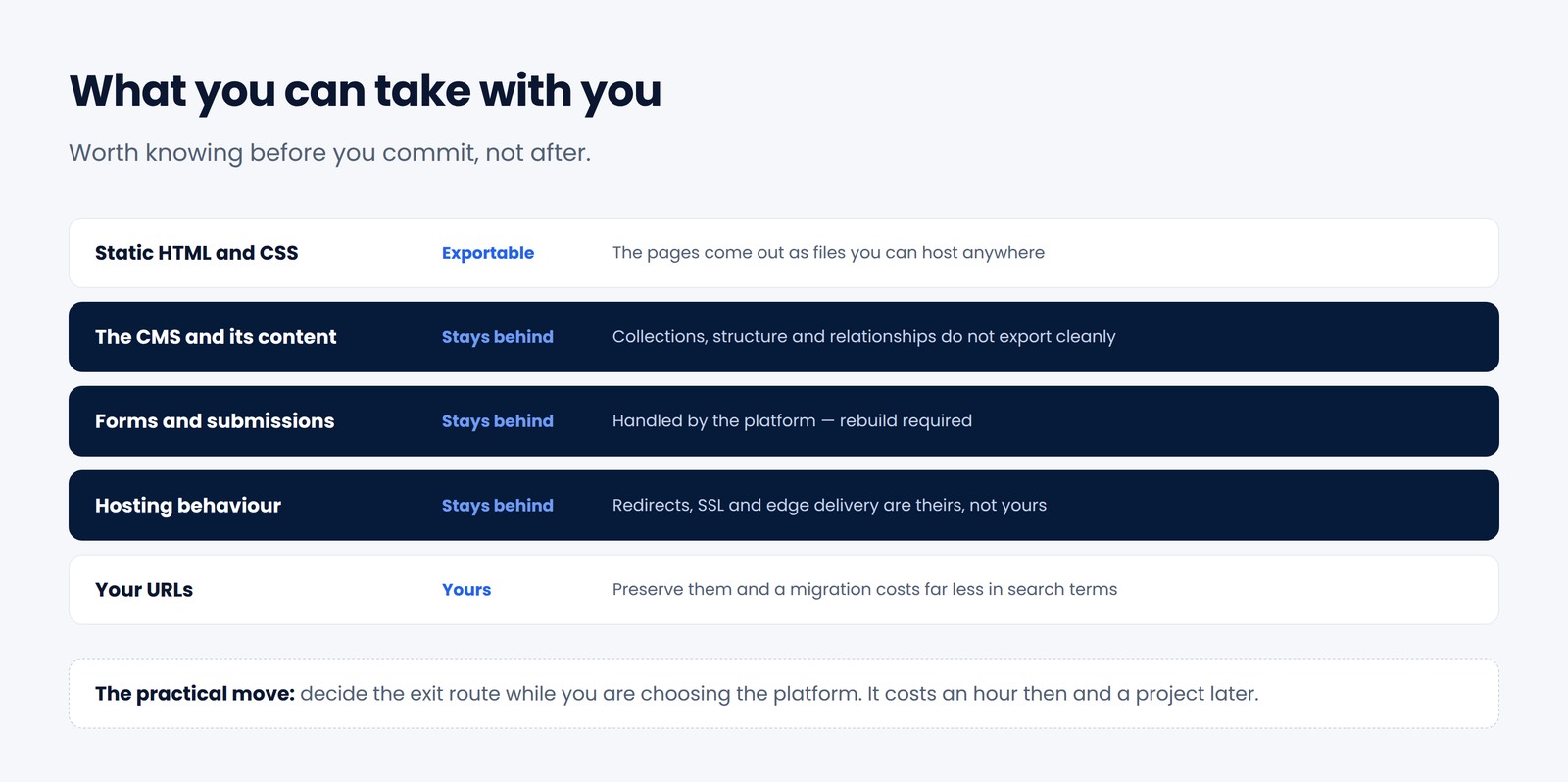
You can export static HTML and CSS, but not the CMS, the forms or the hosting behaviour. If you expect to outgrow it, agree the migration path before you commit rather than after.