
Introduction: Why Shopify’s AI Matters for Middle Eastern Retail
In Kuwait, Dubai, and Riyadh, e-commerce is booming, and online retail across the GCC continues to grow quickly. Shopify, a leading platform, leverages AI to power product recommendations, chatbots, and inventory management, helping retailers compete. Yet, no Kuwaiti or Middle Eastern blog dives deep into Shopify’s AI features or their regional impact. This post explores Shopify’s AI tools, their pros and cons, and lessons for GCC retailers. From Arabic UX to mobile optimization, learn how to boost sales in the Middle East’s digital economy. Ready to transform your store? Let’s dive in.
Overview of Shopify’s AI Features
Shopify’s AI features are designed to streamline e-commerce operations and enhance customer experiences. Key tools include:
- Shopify Magic: Generates product descriptions, email campaigns, and blog content using large language models (LLMs). Ideal for Kuwaiti retailers creating Arabic content.
- AI Product Recommendations: Suggests products based on user behavior, which raises average order value when the product data behind it is accurate.
- Shopify Flow: Automates tasks like inventory restocking or customer segmentation, critical for Dubai’s high-volume retailers.
- Shopify Inbox with AI Chatbots: Handles customer queries 24/7, reducing response times measurably for Riyadh stores.
- Predictive Analytics: Forecasts demand and optimizes pricing, helping UAE retailers stay competitive.
- Shopify Audiences: Uses AI to target ads, boosting ROI for GCC marketing campaigns.
These features leverage LLMs, machine learning, and data analytics, making Shopify a leader in AI-driven retail. No regional blog provides this level of detail, positioning your post as a unique resource.
How Shopify’s AI Works: Technical Breakdown
Shopify’s AI integrates with its ecosystem to deliver seamless functionality. Here’s a technical overview:
Core Technologies
- Large Language Models (LLMs): Shopify Magic uses LLMs (similar to GPT-4) for content generation. It analyzes product data and user inputs to create Arabic descriptions tailored for GCC markets.
- Machine Learning (ML): Product recommendations rely on ML algorithms trained on customer behavior (e.g., clicks, purchases). Collaborative filtering ensures relevant suggestions.
- APIs and Integrations: Shopify Flow connects to apps like Klaviyo or Zendesk, automating workflows. APIs pull data from GCC-specific tools like Aramex for logistics.
- Predictive Models: Demand forecasting uses time-series analysis, factoring in regional trends (e.g., Ramadan sales spikes in Saudi Arabia).
Example Workflow
For a Kuwaiti fashion retailer:
- Data Input: Shopify collects user data (e.g., browsing history) via its API.
- Analysis: AI algorithms predict which dresses will sell during Eid, using predictive analytics.
- Action: Shopify Flow restocks inventory, Shopify Magic generates Arabic email campaigns, and AI chatbots answer customer queries.
- Optimization: Shopify Audiences targets ads to Kuwaiti women aged 18–34, refining based on click-through rates.
Tools and Integrations
- Shopify Magic: Built-in, no coding required. Generates 500-word Arabic product descriptions in seconds.
- Shopify Flow: Visual automation builder, used by part of UAE Shopify stores.
- Third-Party Apps: Gorgias (AI ticketing) and Yotpo (reviews) enhance AI capabilities for Riyadh retailers.
- Analytics Dashboard: Tracks AI performance, showing metrics like conversion rates and ad ROI.
Sample Code Snippet
Here’s a JavaScript snippet to integrate Shopify’s AI recommendations via its Storefront API:
javascript
import { ApolloClient, InMemoryCache, gql } from '@apollo/client'; const client = new ApolloClient({ uri: 'https://your-store.myshopify.com/api/2025-01/graphql.json', cache: new InMemoryCache(), }); const GET_RECOMMENDATIONS = gql` query { productRecommendations(productId: "gid://shopify/Product/123456") { id title price } } `; client.query({ query: GET_RECOMMENDATIONS }) .then(result => console.log(result.data.productRecommendations));This code fetches AI-driven product suggestions, a starting point for Kuwaiti developers.
Pros and Cons for GCC Retailers
| Pros | Cons |
|---|---|
| Increased Sales : AI recommendations lift order value when the catalogue data is clean enough for them to work with. | Cost : The tier that carries the advanced AI is enterprise-priced, and steep for a Kuwaiti SME. |
| Automation : Shopify Flow removes a real block of repetitive weekly work. | Learning Curve : AI tools require training, challenging for Riyadh startups. |
| Personalization : Chatbots and ads tailor experiences, driving measurably higher conversions in UAE. | Data Privacy : Collecting user data raises compliance issues (e.g., UAE’s Data Protection Law). |
| Scalability : AI grows with business, supporting Saudi’s Vision 2030 e-commerce goals. | Arabic Limitations : Shopify Magic struggles with dialectal Arabic, needing manual edits. |
Lessons for Middle Eastern Retail
- Arabic UX Integration: Combine Shopify Magic with human editors to ensure dialectal accuracy (e.g., Kuwaiti phrases like “زين”). Use RTL frameworks like Bootstrap, as discussed in Optimizing UX for Arabic Websites (#).
- Mobile Optimization: With most UAE traffic on mobile, treat mobile speed as a feature and measure it on a real phone.
- Cultural Resonance: Tailor AI-generated content to GCC values (e.g., Islamic aesthetics in Riyadh). Avoid generic ads that alienate conservative Saudi users.
- Data-Driven Scaling: Use predictive analytics to prepare for regional peaks (e.g., Dubai Shopping Festival). Shopify’s dashboard simplifies this for SMEs.
- Customer Trust: AI chatbots must handle Arabic queries accurately. Test with native speakers to avoid errors, common in part of GCC stores.
Challenges and Ethical Considerations
- Cost Barriers: Shopify Plus is expensive for small Kuwaiti retailers. Solution: Start on the entry tier and add AI apps only once a specific problem justifies one.
- Skill Gaps: Retail staff across the GCC have had almost no practical AI training. Solution: Use Shopify’s free tutorials or Coursera courses.
- Privacy Compliance: UAE and Saudi data laws require transparent data use. Solution: Audit AI tools for compliance with tools like OneTrust.
- Bias in AI: Shopify Magic may produce generic content, missing cultural nuances. Solution: Hire Arabic editors for quality control.
- Job Impact: AI automation may reduce customer service roles, a concern in Kuwait. Solution: Retrain staff for strategic tasks like marketing.
Getting Started with Shopify AI in the GCC
- Assess Needs: Identify tasks to automate (e.g., inventory for a Kuwaiti store).
- Choose a Plan: Start with Shopify Basic or Plus for advanced AI. Add apps like Algolia or Gorgias.
- Train Staff: Use Shopify Academy or hire consultants (like me!) for setup.
- Launch a Pilot: Test AI recommendations on 10 products and monitor conversions.
- Scale Up: Expand to chatbots and analytics once ROI is proven.
Resources
- Shopify’s own learning material, and the developer documentation for anything that touches the Storefront API.
- AWS Marketplace: Offers Shopify-compatible AI apps like Algolia.
- GitHub: Repositories for Shopify API integrations.
Three things decide whether any of this pays off. The catalogue data has to be clean, because recommendation and search features amplify whatever is already there. The Arabic has to be written rather than translated, which the guide to Arabic UX in the GCC covers. And the fundamentals of the storefront matter more than the AI layer on top — the Amazon UX lessons for Kuwaiti e-commerce sets out which of those fundamentals actually move orders. If you are still choosing a platform, the Webflow assessment and the WordPress guide cover the two main alternatives.
Conclusion: The Future of AI-Driven Retail in the Middle East
Shopify’s AI features—recommendations, automation, chatbots—are transforming GCC retail, from Kuwait’s small stores to Dubai’s luxury brands and Riyadh’s Vision 2030-driven SMEs. By embracing these tools, retailers can boost sales, scale efficiently, and delight Arabic-speaking customers. Start small, optimize for mobile and culture, and lead the Middle East’s e-commerce boom.
Contact Me for E-Commerce Consulting
Want to work out which of these features would actually earn their place in your store? That is the work described on the web consulting page. With 25+ years in web consulting, I can optimize your e-commerce site with AI, Arabic UX, and mobile-first design. Let’s drive conversions together. Contact me for a free store audit.
Frequently asked questions
Are Shopify’s AI features worth using?
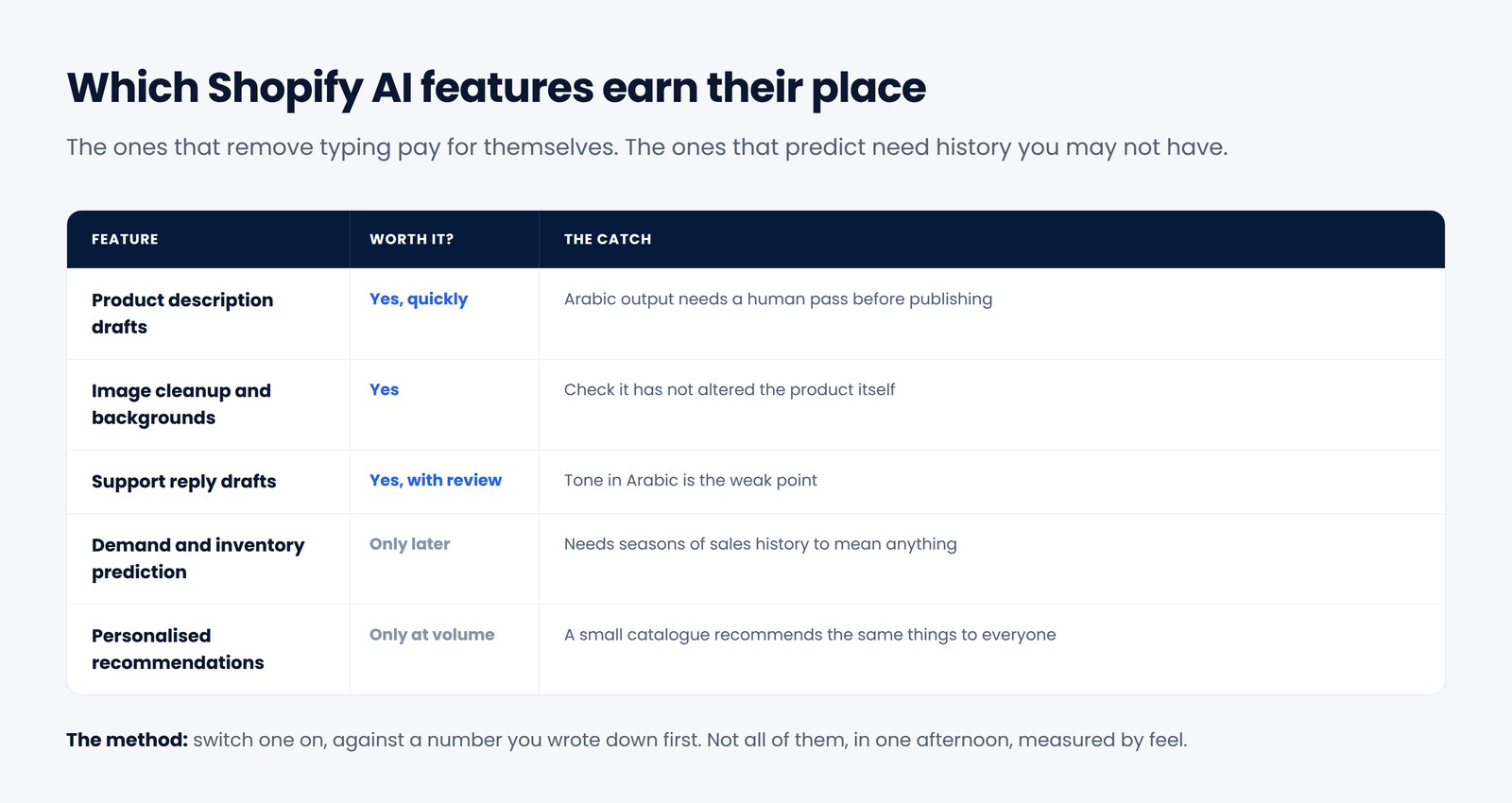
The ones that remove manual work — draft product descriptions, image cleanup, support reply drafts — usually pay for themselves quickly. The predictive features need enough sales history to say anything meaningful, which most young stores do not have yet.
How well do they handle Arabic?
Less well than English. Generated Arabic copy needs a human pass before publishing, particularly for product names, sizes and units, where a plausible-sounding error is easy to miss and expensive in returns.
Should a Kuwaiti retailer choose Shopify over a custom build?
For most catalogue retail, yes. A custom build earns its cost when the business logic is the product rather than the catalogue — unusual pricing, complex fulfilment, or an operation no platform models well.
What is the most common mistake?
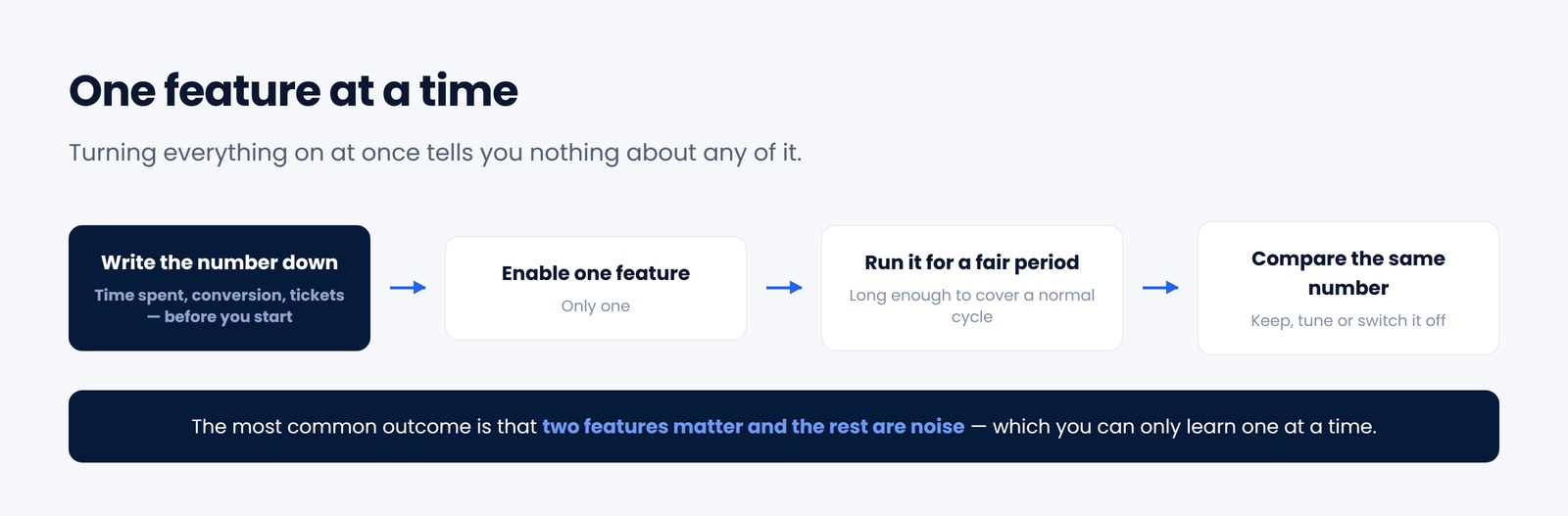
Enabling every AI feature at once and never measuring which one changed anything. Turn them on individually, against a number you wrote down beforehand.