Every few months a Kuwaiti company finds its service descriptions, product photos or a whole article sitting on someone else’s site. The usual reaction is to install something that disables right-click and selecting text. It protects against almost nobody, and it costs the site readers. What actually protects content is less visible and works at a different level.
Before I built sites full-time I spent time as copyright and web consultant at Al-Qabas, where content was the product and copying it was a daily event. This is how I think about protecting a company website now: who is copying you, what each of them takes, and which defences hold up.
Three different copiers, three different answers
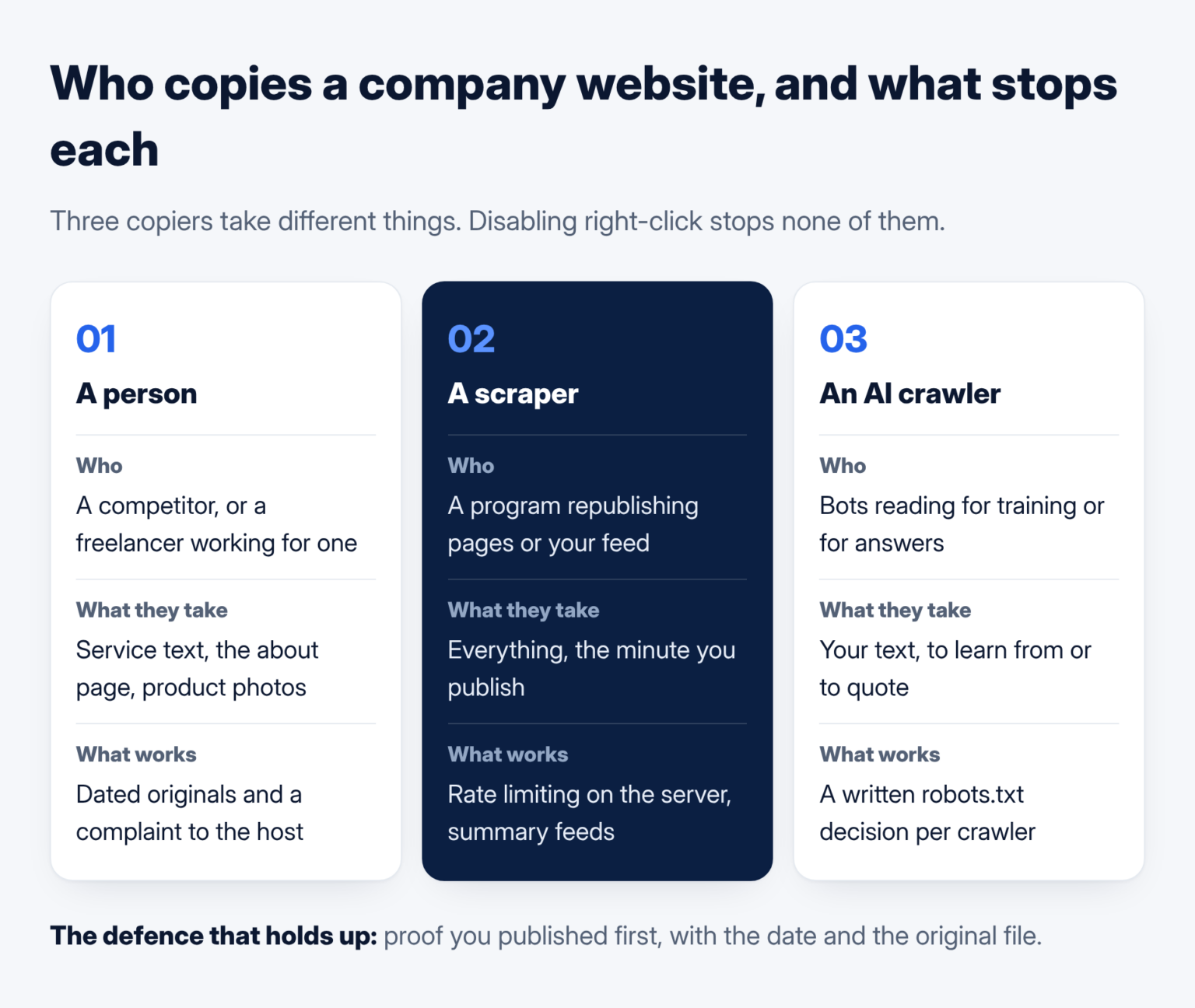
“Someone copied our site” usually means one of three things, and they need different responses.
The first is a person: a competitor, or a freelancer working for one, who opens your page and takes the text or the photographs by hand. They copy what persuades: your service descriptions, your about page, your product photography. The second is a scraper, a program that fetches pages or your feed automatically and republishes them on another site, often with ads around them. It takes everything and reads nothing. The third is an AI crawler, which reads your pages so that a model can learn from them or quote them in an answer. It does not republish your page, but it does use it.
A lock that works on one of these does nothing to the other two. Most of the wasted effort I see comes from treating all three as the same problem.
The right-click lock protects against nobody
Plugins that block right-click, text selection or the keyboard shortcut for copying run in the visitor’s browser. A scraper never runs that code: it reads the HTML the server sends and ignores the script entirely. A person who wants the text can view the page source, use the browser’s developer tools, print to PDF or take a screenshot. The lock stops none of them.
It does stop your real readers. A customer who wants to paste your phone number into WhatsApp, an Arabic reader who selects a paragraph to translate it, someone using a screen reader or a keyboard: all of them hit the lock. These scripts also add weight to every page. On a company site the visitors you annoy are the ones who might have hired you, and the copier was never slowed down.
So the first decision is subtraction. If one of these plugins is installed, I remove it. The same logic applies to scripts that scramble the text in the source: they make the page harder for search engines and assistants to read, which hurts you more than it hurts anyone copying you.
Scrapers: make copying expensive on the server
A scraper behaves differently from a reader. It asks for hundreds of pages in minutes, often from data centre addresses, often with a made-up browser name. That pattern is visible on the server, which is where the defence belongs: rate limiting at the host or a web application firewall, so that an address asking for pages faster than any human gets slowed or refused. Most decent hosts and firewall services offer this without touching the site itself.
The cheapest fix on a WordPress site is the feed. By default many sites publish the full text of every post in their RSS feed, which hands a scraper a clean copy the moment you publish. Setting the feed to show a summary instead removes the easiest source. Absolute internal links help too: when a scraper republishes your post, every link inside it still points back to your site, which tells search engines where it came from.
Search engines are not naive about this. Google’s spam policies name scraping feeds or other content to generate many pages, including by translating or rewording it, as an example of scaled content abuse. A scraped copy is low-value content in Google’s eyes. The risk to you is real but smaller than it feels, and it is mostly a risk when the copy is indexed before your original.
Being first is the protection that holds up
The defence that survives every argument is evidence that you published first. It costs almost nothing and most sites skip it.
Publish with a correct sitemap that carries the date each page changed, and submit important new pages in Search Console on the day they go live, so your version is discovered before any copy. Make sure every page carries a canonical tag pointing to itself; if a scraper copies the HTML wholesale, that tag often travels with it and points search engines back to you. Show the author and the publication date on the page. Keep the originals: the full-resolution photographs, the drafts, the design files, all with their dates.
None of this prevents copying. All of it decides what happens next, whether that is a search engine choosing which version to show or a host deciding whether to act on your complaint. Getting the same discipline into old content is covered in bringing an old post back without losing what it already earns.
AI crawlers: a decision, not a defence
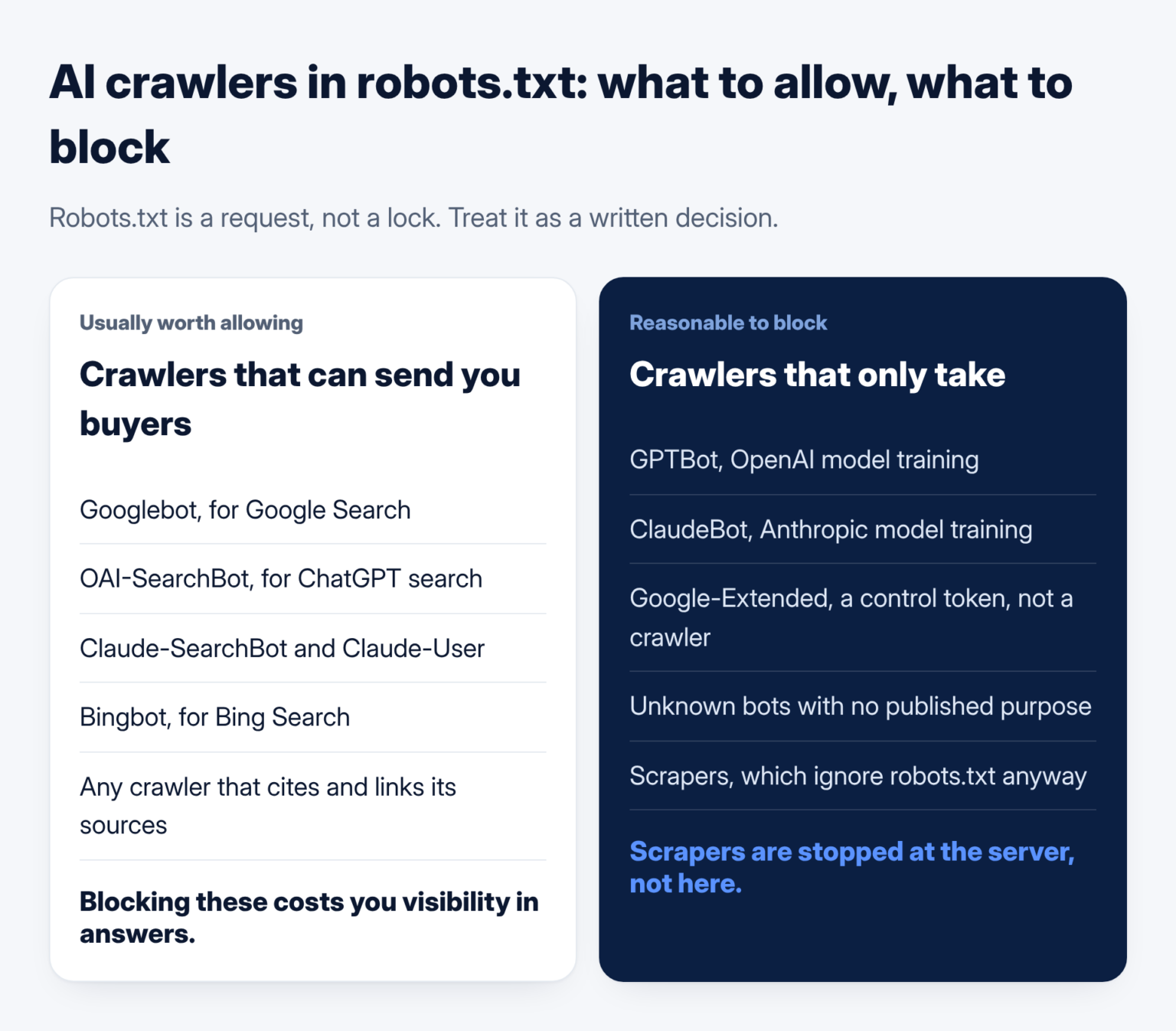
The robots.txt file is where you tell crawlers what they may fetch. It is a request, not a lock. The standard that defines it, RFC 9309, says plainly that its rules are not a form of access authorization. Well-behaved crawlers follow it; scrapers ignore it.
For AI, the useful detail is that the major companies now split their crawlers by purpose. OpenAI separates GPTBot, used for training, from OAI-SearchBot, used to show sites in its search results, and says each setting is independent. Anthropic separates ClaudeBot, for training, from Claude-SearchBot and Claude-User, and warns that disabling the last two may reduce your visibility in user search results. Google lists Google-Extended as a token used only in a control capacity, with no crawler of its own: blocking it does not stop Googlebot from fetching your pages for Search.
That turns a vague worry into a choice you can write down. For a company that sells services, being named when someone asks an assistant who to hire is usually worth more than withholding a service page from a training set. Blocking the training crawlers while allowing the search and answer crawlers is a coherent middle position. A business whose content is the product, a publisher or a course seller, may reasonably decide the other way. What I advise against is blocking everything out of anxiety and then wondering why assistants never mention you, the subject of SEO, AEO and GEO in Kuwait.
Photographs are where copying actually costs money
Text copied by a competitor rarely outranks you. Photographs are different. Product photography is expensive, it sells, and in Kuwait it is lifted constantly by stores selling on Instagram and in marketplaces, where no search engine weighs who published first.
A visible watermark helps on images that are likely to be lifted, product shots above all, if it sits where cropping it out ruins the picture. It does not belong on diagrams or team photographs, where it only makes the site look defensive. More useful is the archive: keep every original at full resolution with its date, because the original file is the strongest evidence you own the photograph. A reverse image search once a month on your ten most valuable images finds most copies.
When you find a copy, work in this order
First, record it: the copy’s address, a dated screenshot, and your own original with its publication date and source file. Then ask the site owner to remove it; a surprising share of copies come down on the first polite message, because the person who copied it did not expect to be noticed.
If that fails, contact the host. Every reputable host has an abuse process, and a complaint with dated evidence is the kind they act on. For the search results themselves, Google runs a legal removal request for copyright complaints. Kuwait has its own copyright law, and a lawyer is the right person when the copying causes real commercial damage, but most cases are settled long before that step, and they are settled with the evidence described above.
What I set up, and what I leave alone
On a site I build or take over, protecting content is a short list done once. The feed shows summaries. Every page has a self-referencing canonical tag and a correct date. The sitemap is clean and new pages are submitted on the day. Rate limiting runs at the host or firewall. The robots.txt decision about AI crawlers is written down, with the reason. Originals are archived, and there is a monthly check for copies of the pages and images that matter.
What I leave alone: right-click blockers, text scrambling, and the content protection features bundled into some security plugins, which add weight and break things without stopping anyone. Plugins that promise to lock your content are the same class of dependency described in the plugin that is holding your site hostage. Who controls the robots.txt and the server rules is also one of the questions to settle in a supplier handover.
This is part of the WordPress development work I do in Kuwait, and the visibility side of it sits with SEO consulting. Where a new site needs designing and building with this in place from the start, Tothiq’s website design and development service does that work.
Frequently asked questions
Does disabling right-click stop people copying my website?
No. It runs in the browser, so scrapers never see it, and anyone can still view the source, print the page or take a screenshot. It mainly blocks genuine visitors who want to copy a phone number or translate a paragraph.
Should a company website block AI crawlers?
Usually not all of them. Many companies block training crawlers such as GPTBot and ClaudeBot while allowing search and answer crawlers, so assistants can still find and cite the site. A publisher whose content is the product may decide differently.
Can a copied version outrank my original page?
It can happen, mostly when the copy is indexed first. A clean sitemap, a self-referencing canonical tag and submitting new pages on the day they are published make it much less likely.
Is robots.txt enough to stop scrapers?
No. Robots.txt is a request that well-behaved crawlers follow and scrapers ignore. Scrapers are slowed at the server, with rate limiting at the host or firewall, and by not publishing full text in the feed.
Should we watermark our product photos?
On product photos that are likely to be lifted, a watermark placed where cropping it would spoil the image is worth it. Keep the full-resolution originals with their dates as well, because they are your strongest proof of ownership.