Introduction: Why Amazon’s UX Matters for Kuwait
In Kuwait, where e-commerce grows steadily and most users shop on mobile, user experience (UX) is critical for success. Amazon, the global e-commerce leader, sets the standard with its intuitive, fast, and personalized UX. This post explores Amazon’s design principles, pros, cons, and strategies to enhance Kuwaiti e-commerce sites. Ready to boost your online store? Let’s dive in.
Overview of Amazon’s UX Design
Amazon’s UX is engineered to maximize conversions, retention, and customer satisfaction. Its design prioritizes speed, simplicity, and personalization, making it a benchmark for Kuwaiti e-commerce.
Core Principles
- User-Centricity: Focuses on ease of use, with clear navigation and minimal clicks to purchase.
- Mobile Optimization: much of Amazon’s traffic is mobile, aligning with Kuwait’s mobile-first user base.
- Personalization: AI-driven recommendations tailor product suggestions, which lifts basket size when the recommendations are actually relevant and quietly annoys people when they are not.
- Speed: Pages are relentlessly fast, and speed is treated as a feature rather than a technical detail.
- Accessibility: Meets WCAG 2.1 standards, ensuring inclusivity for diverse users.
Key Elements
- Search Bar: Prominent, predictive search with filters for quick product discovery.
- Product Pages: Clean layouts with high-quality images, reviews, and “Buy Now” buttons.
- Checkout: Streamlined, with one-click options and multiple payment methods.
- Recommendations: AI-powered “Frequently Bought Together” and “Inspired by Your Browsing” sections.
- Reviews: User feedback builds trust, critical for Kuwaiti shoppers.
Amazon’s UX is a model for Kuwait, where mobile-first, Arabic-friendly designs are essential.
Key Features of Amazon’s UX
Amazon’s UX leverages advanced technologies and design strategies:
- AI Recommendations: Uses machine learning to suggest products based on browsing, purchases, and trends. Example: Suggesting Kuwaiti perfumes after a search for “عطور الكويت.”
- Predictive Search: Autocomplete and filters (e.g., price, brand) speed up discovery, vital for Kuwait’s mobile users.
- Responsive Design: Adapts seamlessly to mobile, tablet, and desktop, with right-to-left (RTL) support for Arabic.
- Fast Checkout: One-click purchasing and saved payment options remove the friction where most carts are actually lost.
- User Reviews: Displays ratings and comments, fostering trust among Kuwaiti shoppers wary of online scams.
- A/B Testing: Continuously tests layouts to optimize conversions, a practice Kuwaiti sites can adopt.
- Cloud Infrastructure: AWS ensures 99.Reliable uptime and consistently fast pages, which matters in a market that shops at every hour.
Technical Tools
- React: Powers Amazon’s responsive frontend, adaptable for Kuwaiti sites.
- Algolia: Drives predictive search, usable in Kuwait via plugins.
- AWS CloudFront: CDN for speed, similar to Cloudflare for Kuwait.
Pros and Cons of Amazon’s UX for Kuwait
| Pros | Cons |
|---|---|
| High Conversions : AI recommendations boost sales measurably. | Complexity : Getting close to this standard is a serious build, not a theme tweak. |
| Mobile-Friendly : Retains most Kuwaiti mobile users. | Overload : Too many options can overwhelm Kuwaiti shoppers. |
| Trust-Building : Reviews and fast checkout build confidence. | Cultural Gaps : Lacks Kuwaiti-specific aesthetics (e.g., National Day themes). |
| Scalability : Handles Kuwait’s e-commerce growth. | Privacy Concerns : Heavy data use raises Kuwaiti compliance issues. |
Lessons for Kuwaiti E-Commerce
- Simplify Navigation: Use a prominent search bar and clear categories, reducing clicks to purchase, as Amazon does.
- Personalize Experiences: Implement AI recommendations to suggest products like Kuwaiti perfumes or Ramadan gifts.
- Optimize for Mobile: Ensure sub-2-second load times with Cloudflare and responsive themes like Astra, matching Kuwait’s mobile-first traffic.
- Build Trust: Add user reviews and ratings, critical for Kuwaiti shoppers skeptical of online stores.
- Streamline Checkout: Offer one-click purchasing and WhatsApp payment links, used by most Kuwaitis.
- Test Continuously: Use A/B testing (e.g., Google Optimize) to refine UX, as Amazon does.
These lessons, tailored for Kuwait, are absent from local blogs.
Kuwaiti-Specific UX Strategies
- Arabic RTL Design: Use WordPress themes with and fonts like Noto Sans Arabic. Test with BrowserStack for mobile compatibility.
- Cultural Aesthetics: Add vibrant colors for National Day or Islamic patterns for Eid, avoiding imagery conflicting with Kuwaiti values.
- WhatsApp Integration: Embed checkout and support via WhatsApp, which matches how people actually message here.
- Local SEO: Optimize for “متجر الكويت” or “electronics Kuwait” with Yoast SEO and Google My Business.
- Accessibility: Use AccessiBe for WCAG 2.1 compliance, serving Kuwait’s disabled population.
- Community Feedback: Integrate user reviews and Q&A sections, rewarding contributors to foster Kuwaiti engagement.
Sample Code
Add WhatsApp checkout button to WordPress:
html
<a href="https://wa.me/96512345678?text=I%20want%20to%20buy">Buy via WhatsApp</a> <style> .whatsapp-button { background: #25D366; color: white; padding: 10px; } </style>Challenges and Ethical Considerations
- Cost: Doing this properly costs real money, which is steep for a Kuwaiti SME. Solution: Start with free plugins like Smush and scale up.
- Skills Gap: Few developers in Kuwait specialise in UX, so it is hard to hire the skill locally. Solution: Train via Coursera or hire experts.
- Privacy: AI recommendations collect data, raising Kuwaiti compliance issues. Solution: Audit with OneTrust for data protection laws.
- Cultural Sensitivity: Generic UX may alienate Kuwaiti users. Solution: Test designs with native Kuwaitis for cultural fit.
- Accessibility Gaps: most Kuwaiti sites lack WCAG compliance. Solution: Prioritize AccessiBe and regular audits.
Getting Started: Steps for Kuwaiti Businesses
- Audit UX: Use Hotjar to analyze user behavior and WAVE for accessibility.
- Choose Tools: Install WooCommerce, Algolia, and AccessiBe via WordPress.
- Optimize Design: Implement RTL, mobile-first themes, and WhatsApp integration.
- Add Personalization: Use Shopify or WooCommerce AI plugins for recommendations.
- Test and Launch: Conduct A/B testing with 50 Kuwaiti users and monitor with Google Analytics.
Resources
- Hotjar: Free UX analytics.
- Google Optimize: A/B testing tool.
- WPBeginner: WordPress UX tutorials.
The pattern most Kuwaiti stores get wrong
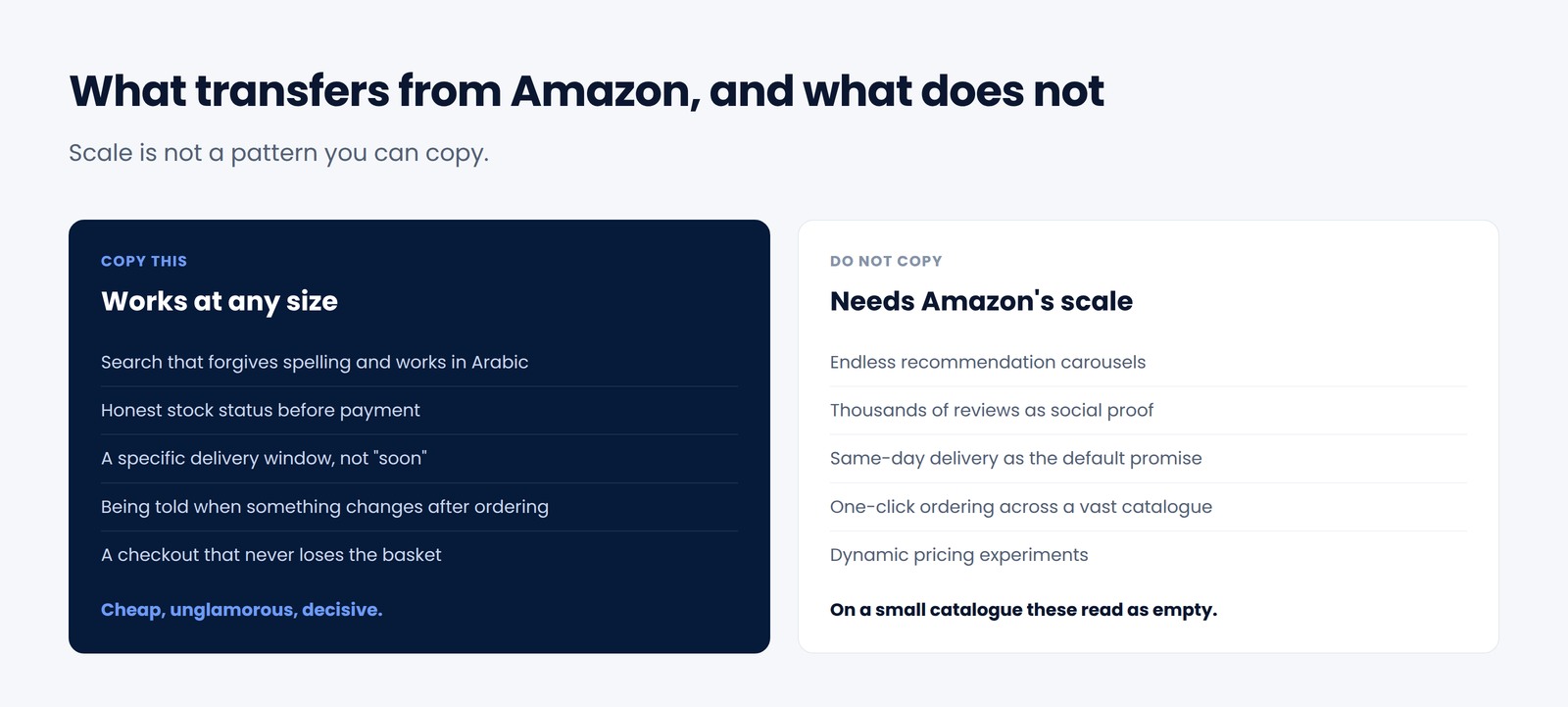
Of everything Amazon does, the one worth copying first is the least glamorous: it tells you the truth about availability and timing, before you pay.
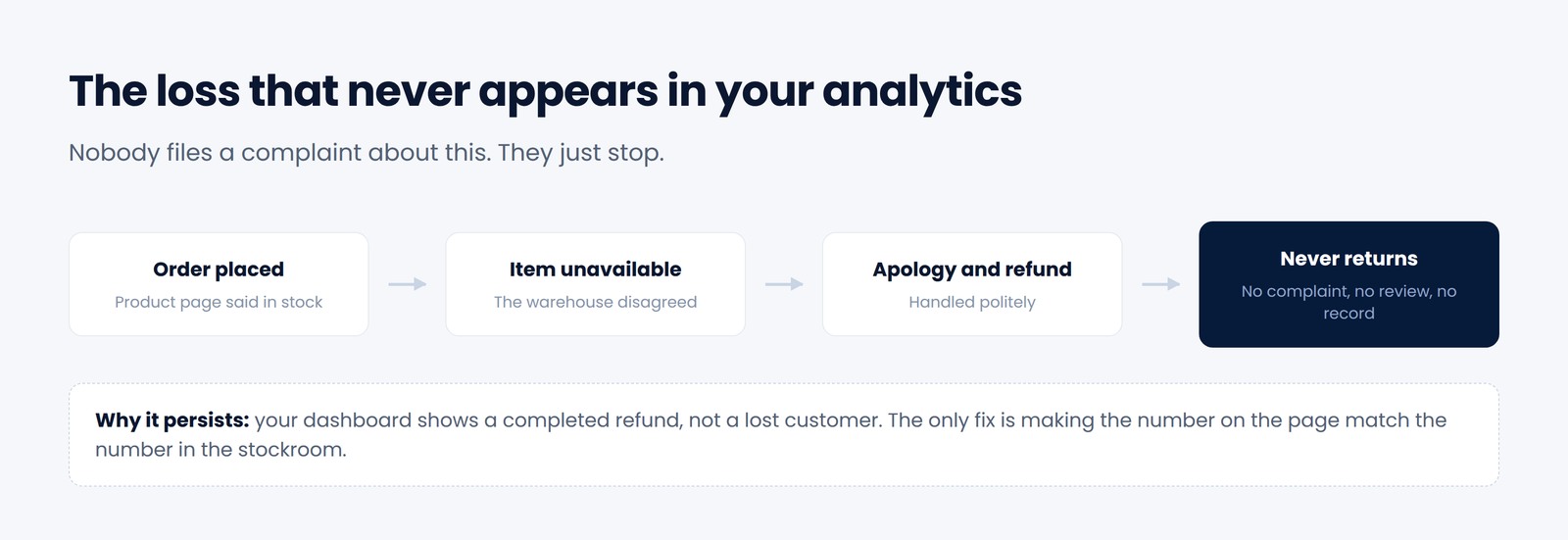
Stock status is real. The delivery window is specific. If something changes after you order, you are told. None of that requires Amazon’s scale — it requires your website to know what is actually in the warehouse, which is an integration problem rather than a design one. Most local stores fail here not because the checkout is ugly, but because the number on the product page and the number in the stockroom were never connected.
The cost of getting it wrong is invisible in your analytics. A customer who orders something that turns out to be unavailable does not file a complaint. They stop buying, and nothing in your dashboard records why.
Fix that before redesigning anything. It is unglamorous, it does not photograph well in a portfolio, and it will do more for repeat orders than any amount of visual polish.
Three things are worth reading alongside this. If your store runs on Shopify, the assessment of Shopify’s AI features covers which of them actually earn their place. If the Arabic side of the store is weaker than the English one — which it usually is — the guide to Arabic UX in the GCC is the practical fix. And if you are thinking about personalisation, AI-driven customer insights for Kuwaiti retail sets out what is worth doing before you buy anything. On the technical side, measure the store against Core Web Vitals on a real phone rather than trusting a desktop score.
Conclusion: The Future of E-Commerce UX in Kuwait
Amazon’s UX offers powerful lessons for Kuwait’s e-commerce, from AI personalization to mobile optimization and trust-building reviews. By adopting these strategies, your business can thrive in Kuwait’s growing market. Start now, design for Kuwaiti users, and lead the digital future.
Contact Me for UX Consulting
Ready to fix the parts of your store that quietly lose orders? That is the work described on the web consulting page. Ready to enhance your Kuwaiti e-commerce site with Amazon-inspired UX? With 25+ years in web consulting, I can design mobile-first, Arabic-friendly, and accessible sites. Let’s boost your conversions. Contact me for a free UX consulation.
Frequently asked questions
Which Amazon patterns actually transfer to a Kuwaiti store?
Forgiving search, honest delivery promises and a checkout that keeps the customer informed. Those work at any catalogue size and are where most local stores lose orders.
Which ones do not transfer?
Anything that depends on Amazon’s scale — endless recommendations, vast review volume, same-day logistics as a default. Copying those with a small catalogue makes a store look empty rather than sophisticated.
How important is Arabic search inside the store?
Very. Customers search in Arabic, often in dialect and with inconsistent spelling. A search box that only matches exact English product names loses sales silently, because nobody reports a search that returned nothing.
What single fix returns the most?
Usually checkout and delivery clarity: real stock status, an honest delivery window, and KNET working without surprises. Design polish rarely beats those three.