Introduction: Why AI Customer Insights Matter for Kuwait
In Kuwait, where e-commerce grows steadily and most users shop on mobile, understanding customers is key to retail success. AI-driven insights from sentiment analysis and predictive analytics unlock preferences, boosting sales. This post dives into AI customer insights, their applications, and strategies for Kuwaiti retail, e-commerce, and community platforms. Ready to transform your business? Let’s dive in.
What Are AI-Driven Customer Insights?
AI-driven customer insights use artificial intelligence to analyze data—such as purchase history, reviews, and social media interactions—to understand customer behavior and preferences. Powered by Natural Language Processing (NLP), machine learning, and predictive analytics, these tools help Kuwaiti retailers personalize experiences and optimize operations.
Core Components
- Sentiment Analysis: Evaluates customer feedback (e.g., Arabic reviews) to gauge satisfaction.
- Predictive Analytics: Forecasts trends, like demand for perfumes during Kuwait’s National Day.
- Customer Segmentation: Groups users (e.g., Kuwaiti youth, a young population) for targeted marketing.
- Arabic NLP: Processes Kuwaiti dialect queries (e.g., “شلون المنتج؟”) for local relevance.
- Behavioral Analysis: Tracks browsing and purchase patterns to personalize offers.
How It Works
- Data Collection: Gathers data from Shopify, WhatsApp, or Instagram.
- Processing: AI models analyze text, clicks, and purchases.
- Insights: Generates reports (e.g., “some prefer fast delivery”) or predictions.
- Action: Informs marketing, inventory, or customer support strategies.
Relevance to Kuwait
With most Kuwaitis preferring Arabic content and heavy Instagram use, AI insights tailored to local dialects and platforms drive engagement.
Key AI Tools for Kuwaiti Retail
Several AI tools deliver customer insights for Kuwaiti businesses, balancing cost and functionality:
- AWS Comprehend: Cloud-based NLP tool for sentiment analysis and topic modeling. Supports Arabic, ideal for Kuwaiti reviews. Usage-based pricing, charged per volume of text analysed.
- Google Cloud NLP: Analyzes Arabic text for sentiment and entity recognition. Integrates with Google Analytics for e-commerce. Usage-based pricing, charged per unit of text processed.
- Hugging Face: Open-source platform with Arabic NLP models (e.g., AraBERT) for startups. Free for basic use.
- Tableau with AI: Visualizes customer data with predictive analytics, used by Kuwaiti retailers for dashboards. Paid per user, per month.
- Hootsuite Insights: Monitors Instagram sentiment, critical for Kuwait’s Instagram traffic. Paid monthly, per seat.
- Grok (xAI): Provides concise insights via grok.com, with free quotas for testing Kuwaiti data.
Integration
- Shopify: Connects AWS Comprehend to analyze product reviews.
- WhatsApp: Uses Google Cloud NLP for chat sentiment, handling most Kuwaiti interactions.
- Instagram: Hootsuite tracks trends for targeted ads.
Sample Code
Python snippet for AWS Comprehend sentiment analysis:
python
import boto3 # Initialize Comprehend client comprehend = boto3.client('comprehend', region_name='us-east-1') # Analyze Arabic review text = "المنتج زين بس التوصيل بطيء" response = comprehend.detect_sentiment(Text=text, LanguageCode='ar') print(response['Sentiment']) # Output: MIXEDThis code helps Kuwaiti developers analyze customer feedback.
Applications for Kuwaiti Businesses
AI insights transform Kuwaiti retail:
- E-Commerce: Personalize product recommendations, which lifts basket size when the recommendations are genuinely relevant and irritates people when they are not.
- Customer Support: Analyze WhatsApp chats to prioritize high-value customers, cutting response times measurably.
- Marketing: Target Kuwaiti youth with Instagram ads based on sentiment, boosting ROI measurably.
- Inventory Management: Predict demand for Eid or National Day, reducing stockouts measurably.
- Community Platforms: Analyze feedback on Kuwaiti Q&A forums, rewarding active users to drive measurably more engagement.
These applications align with Kuwait’s mobile-first, Arabic-speaking market.
Pros and Cons of AI Insights in Kuwait
| Pros | Cons |
|---|---|
| Personalization : Boosts sales measurably with tailored offers. | Cost : Enterprise tooling carries a real setup cost before it returns anything. |
| Efficiency : Turns a weekly analysis chore into a short review. | Skills Gap : Very few people locally have production experience with this, so hiring is hard. |
| Arabic Support : Processes Kuwaiti dialects for most users. | Privacy : Risks under Kuwait’s data laws. |
| Scalability : Grows with Kuwait’s e-commerce market. | Bias : Arabic NLP errors in some cases, needing native testing. |
Kuwaiti Strategies for AI Implementation
- E-Commerce: Use AI insights for personalized recommendations, targeting Kuwait’s market growth.
- Customer Support: Analyze WhatsApp chats to prioritize urgent queries.
- Marketing: Leverage Instagram sentiment for Arabic ads with Kuwaiti phrases like “زين”.
- Inventory: Predict demand for seasonal sales (e.g., Eid) using Tableau or AWS.
- Community Platforms: Analyze Q&A forum feedback to boost engagement, rewarding active Kuwaiti users.
Arabic Optimization
- Ensure AI tools handle Kuwaiti dialects via native testing.
- Use Modern Standard Arabic for reports to ensure clarity.
Challenges and Ethical Considerations
- Cost: Enterprise licensing is steep enough for a Kuwaiti SME to need a clear business case. Solution: Use free options like Hugging Face or Grok’s free quotas.
- Skills Gap: Analytics skills of this kind are scarce in the local market. Solution: Train via Coursera or hire experts.
- Privacy: Kuwait’s data laws require transparency. Solution: Audit with OneTrust for compliance.
- Bias: Arabic NLP may misinterpret dialects, offending users. Solution: Test with native speakers across a sample of real interactions.
- Job Impact: Automation may reduce analysis roles. Solution: Retrain staff for AI oversight.
Getting Started: Steps for Kuwaiti Retailers
- Identify Needs: Pinpoint tasks (e.g., personalization, inventory prediction).
- Choose Tools: Start with AWS Comprehend, Hugging Face, or Grok (grok.com).
- Integrate: Connect to Shopify, WhatsApp, or Instagram via APIs.
- Train or Hire: Use AWS Skill Builder or partner with consultants (like me!).
- Pilot Project: Test AI insights on 100 reviews or sales data.
- Scale Up: Expand based on ROI, tracked via Google Analytics.
Resources
- AWS Skill Builder: Free NLP tutorials.
- Hugging Face: Arabic NLP models.
- Grok: Free access via grok.com.
Two caveats worth carrying into any of this. Insight is only as good as the Arabic underneath it — sentiment tooling trained mainly on Modern Standard Arabic reads Kuwaiti dialect badly, which is part of the wider problem described in the guide to Arabic UX in the GCC. And the tooling only pays off once it is wired into a process someone actually acts on, which is the argument in the piece on AI in operations. If you are choosing the model layer or the integration route, the LLM guide and the MCP explainer cover those decisions.
Conclusion: The Future of AI Insights in Kuwait
AI-driven customer insights are transforming Kuwait’s retail with personalization, efficiency, and community engagement. By adopting these solutions, retailers can lead in 2025’s digital economy. Start small, optimize for Kuwaiti Arabic, and unlock growth.
Contact Me for AI Consulting
Ready to turn customer data into decisions rather than dashboards? That is the work described on the AI consulting page. With 25+ years in web consulting, I can design AI solutions for e-commerce, support, and more. Let’s boost your sales. Contact me for a free AI consultation.
Start with the decision, not the dashboard
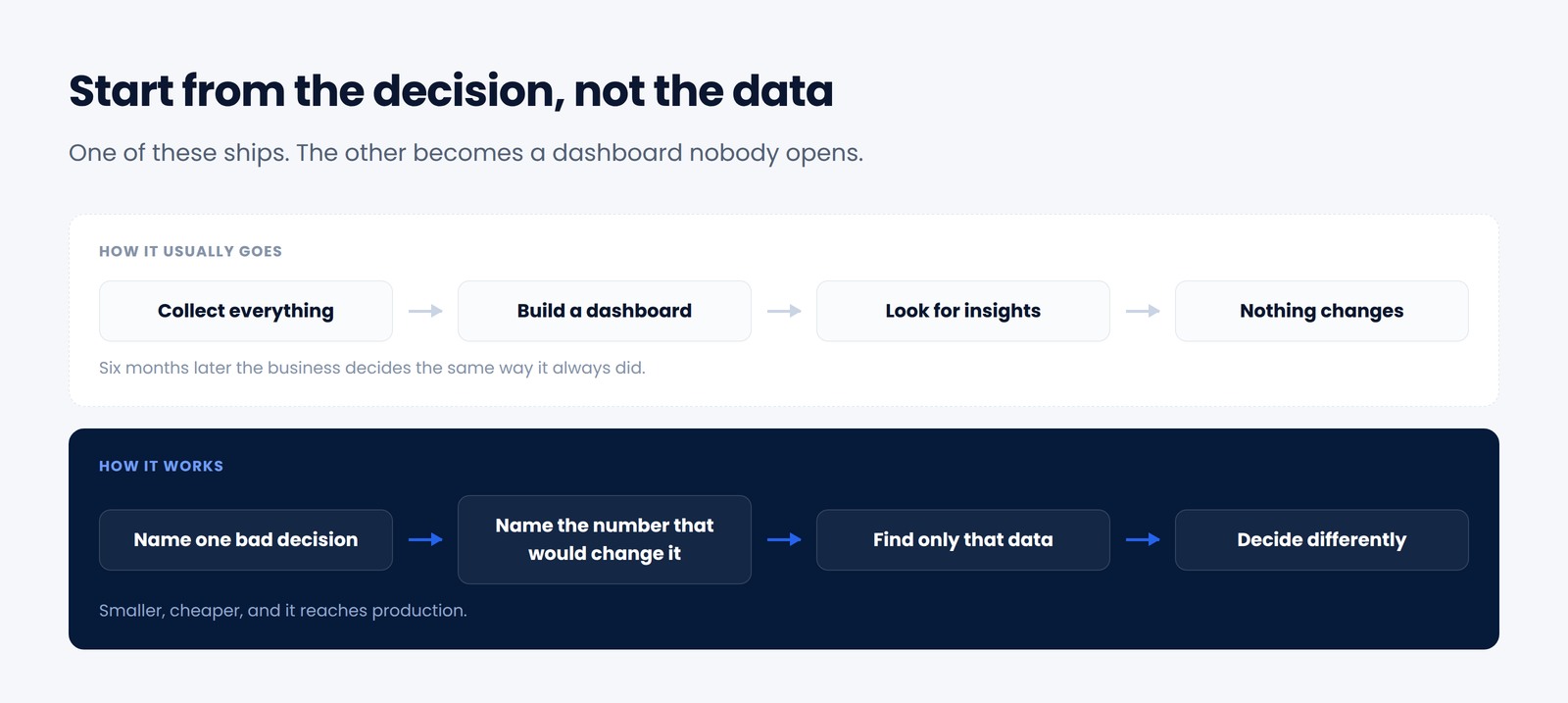
The common failure in customer analytics is building a dashboard nobody acts on. It looks like progress, it gets demonstrated in meetings, and six months later the business is making the same decisions it always did, on the same instincts.
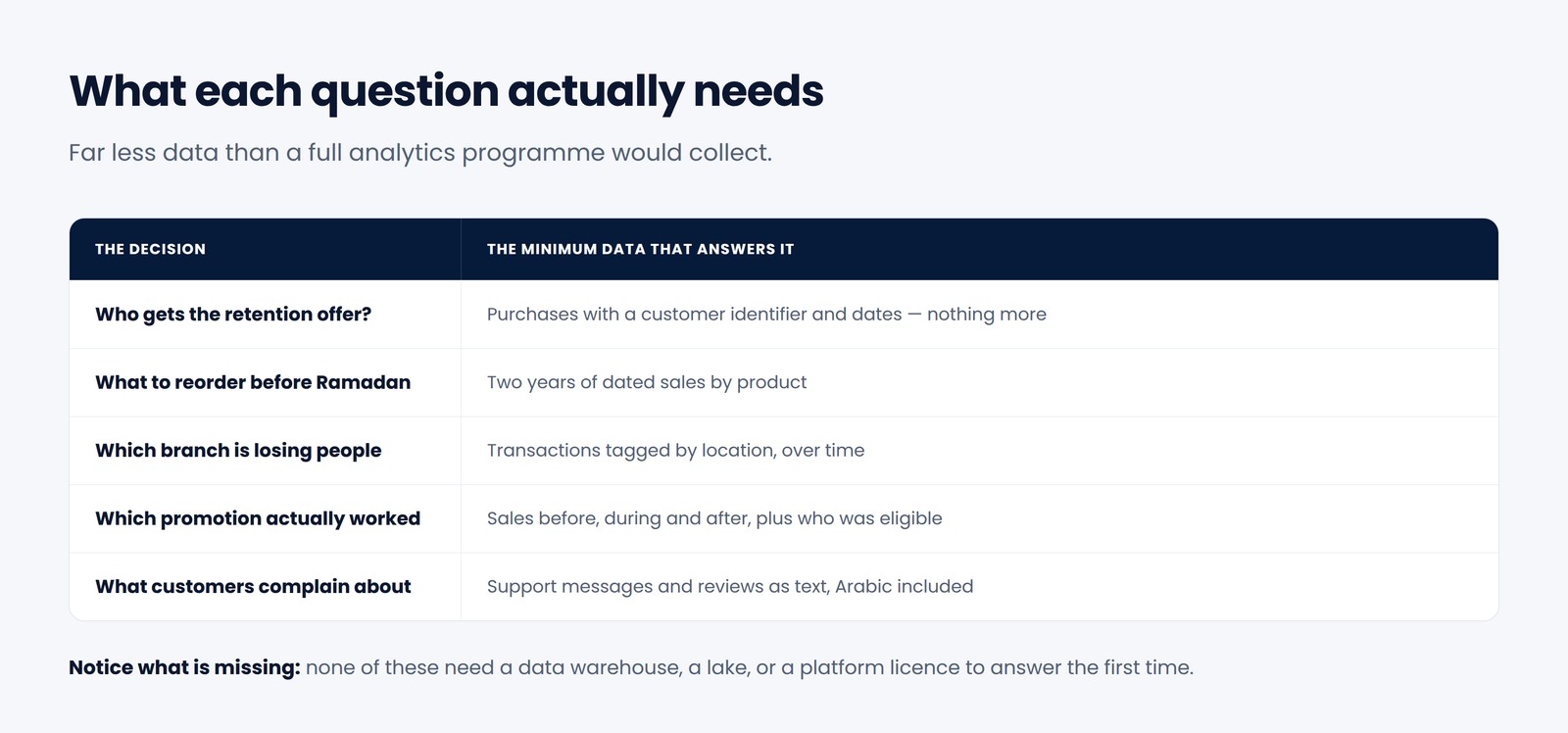
The fix is to start from a decision you are already making badly. Which customers deserve the retention offer. Which products to reorder before Ramadan. Which branch is quietly losing people. Each of those is a question with a cost attached, and each tells you exactly which data you need — usually far less than a full analytics programme would collect.
Write the decision down first, then the number that would change it, then go looking for the data. Done in that order the project is small and it ships, and the step after it is turning the insight into an automated action rather than a report someone reads on Sunday. Done in reverse you get a dashboard.
Frequently asked questions
What data do we need before AI insights are useful?
Transactions linked to a customer identifier, with dates. Without that link between purchases and people, most analysis stays descriptive rather than predictive. Loyalty records, returns and support tickets add depth once the basics are in place.
Do we need to hire a data scientist?
For a first project, usually not. Rented models and off-the-shelf analytics answer the common questions — who is likely to lapse, what sells together, which promotion actually moved anything. Hire specialists once you know which question is worth answering every week.
How well does this work with Arabic customer feedback?
Modern models read Arabic reviews reasonably well, with dialect and mixed Arabic-English comments the weak point. Sample the output against your own data and check accuracy before trusting any dashboard built on top of it.
What about customer privacy?
Collect only what you use, keep it somewhere you can account for, and set a retention period. Most retailers hold considerably more personal data than their analysis actually requires, which is risk without return.