Most Kuwaiti businesses still take their most valuable enquiries by phone, and most of them miss a share of those calls: after hours, at lunch, when the one person who answers is already on another line. AI voice agents can now hold a real spoken conversation, in Arabic and English, and answer that phone. Whether callers stay on the line is decided by a handful of details most demonstrations skip.
This is how I would judge one for a Kuwaiti business: what it can take on, where callers hang up, and what has to be true about your phone line before any of it works.
A voice agent is not the old phone menu
The “press one for sales” systems many Kuwaiti companies already have play recordings and listen for a key press. A voice agent listens to what the caller says, decides what to do, and answers in a generated voice, in a back-and-forth conversation. The newer models do this speech to speech, without turning everything into text in between; OpenAI describes its Realtime API in exactly those terms, recommended where interruptions, low latency and natural turn-taking matter.
That is a real change, and it is why the question has moved from “can it understand?” to “will a caller tolerate it?”. The answers below are about the second question.
Callers notice two hundred milliseconds
People taking turns in conversation leave remarkably short gaps. A study of ten languages published in PNAS found that the most common gap between one speaker finishing and the next starting falls between zero and two hundred milliseconds, in every language studied.
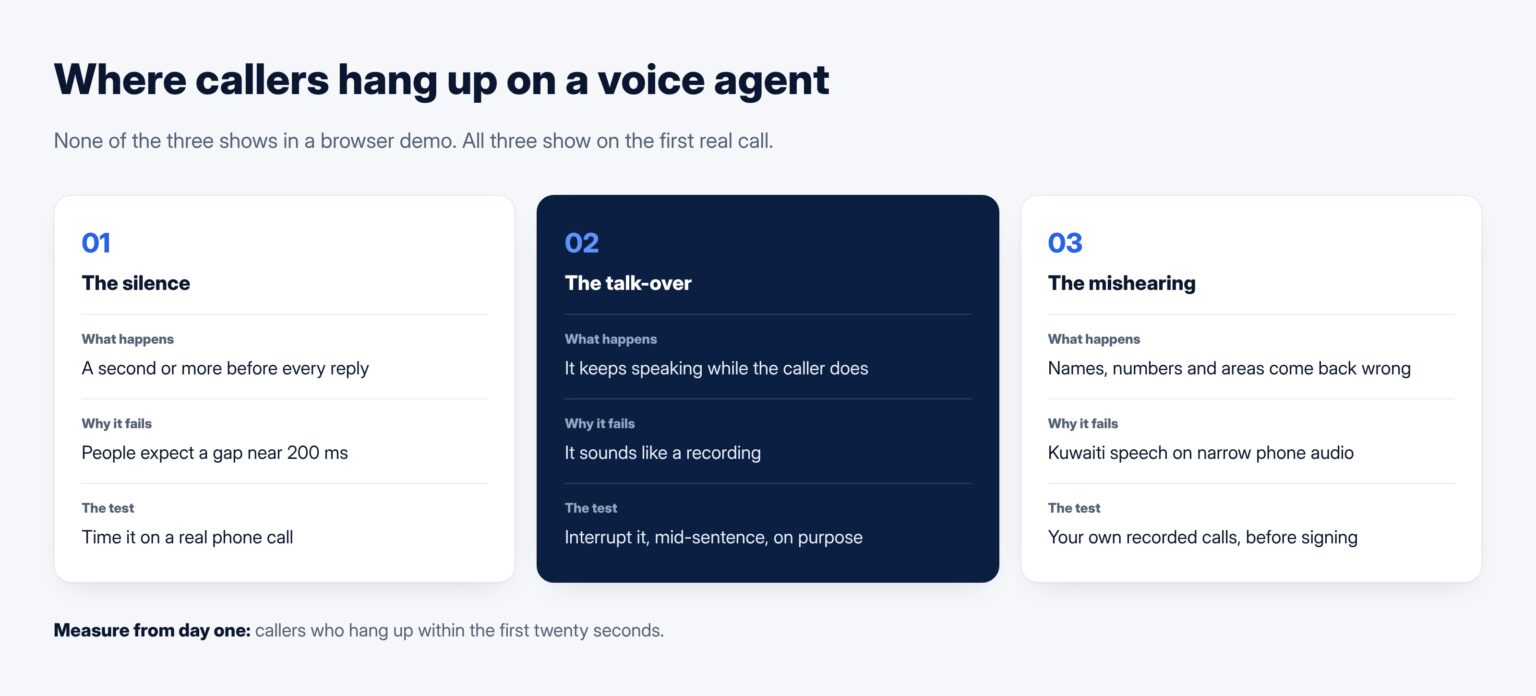
A voice agent that takes a second and a half to answer feels broken on the phone, even if every answer is right. The delay builds up in several places: hearing that the caller has finished, the model working out a reply, looking something up in your systems, generating the voice, and the phone network in both directions. Ask any supplier to demonstrate on a real phone call, not in a browser, and time the gap yourself. If they bridge a slow lookup with “one moment, let me check”, that is fine. Silence is not.
Callers interrupt, and the agent has to stop
On the phone people talk over each other constantly: to correct a detail, to say “yes, yes”, to answer before the question is finished. An agent that keeps reading its sentence while the caller speaks sounds like a recording, and callers treat it like one.
The platforms handle this explicitly. OpenAI’s documentation on voice activity detection describes a mode that judges from the audio how likely it is the caller has finished, a setting for how eager it should be, and a switch for whether caller speech interrupts the agent. Those settings are the difference between an agent that cuts people off and one that waits too long. Test them with Kuwaiti callers, who pause and restart differently from the voices the defaults were tuned on.
Kuwaiti Arabic on a phone line is the hard part
Phone audio is narrow and noisy, callers are in cars and shops, and Kuwaiti speech mixes dialect, English words and names that no model has seen. Speech services do list Kuwaiti Arabic: Google’s supported languages include Arabic (Kuwait), and Microsoft’s Azure lists it too. Listing a locale is not the same as handling your callers.
I have not found a published accuracy benchmark for Kuwaiti dialect on phone audio, and I would not trust one that was not recorded on your own lines. So record twenty or thirty real calls, with consent, and test any system against those before you sign. Pay particular attention to the things it repeats back: names, phone numbers, civil ID digits, area names and dates. Tothiq has written about the same problem in Arabic voice notes, and the conclusion carries over: let it transcribe freely, and confirm the critical details narrowly.
The voice it answers in matters as much as what it hears. Many generated Arabic voices sound Levantine or Egyptian, or read Modern Standard Arabic like a news bulletin. A Kuwaiti caller hears that in the first second. Listen to every voice a supplier offers with a few Kuwaiti staff in the room, and choose the one they would not mind answering in their name. Check the English voice too, because many callers will switch to English halfway through a sentence.
Getting the call to the model
Behind the conversation there is plumbing. A call has to arrive from the phone network to the AI service, usually over SIP, the standard telephone connection between systems. OpenAI’s SIP guide describes pointing a phone trunk at its service, with your own server deciding whether to accept, reject, transfer or end each call.
The Kuwaiti part of this is the number. International telephony providers have patchy support for Kuwaiti numbers, and a voice agent answering from a foreign number is not what your customers dial. The usual arrangement keeps your existing Kuwaiti number and forwards calls, all of them or only unanswered ones, to the system. Check with your operator what forwarding they support and what it costs per minute, before you choose a platform.
What it can take on, and what stays with a person
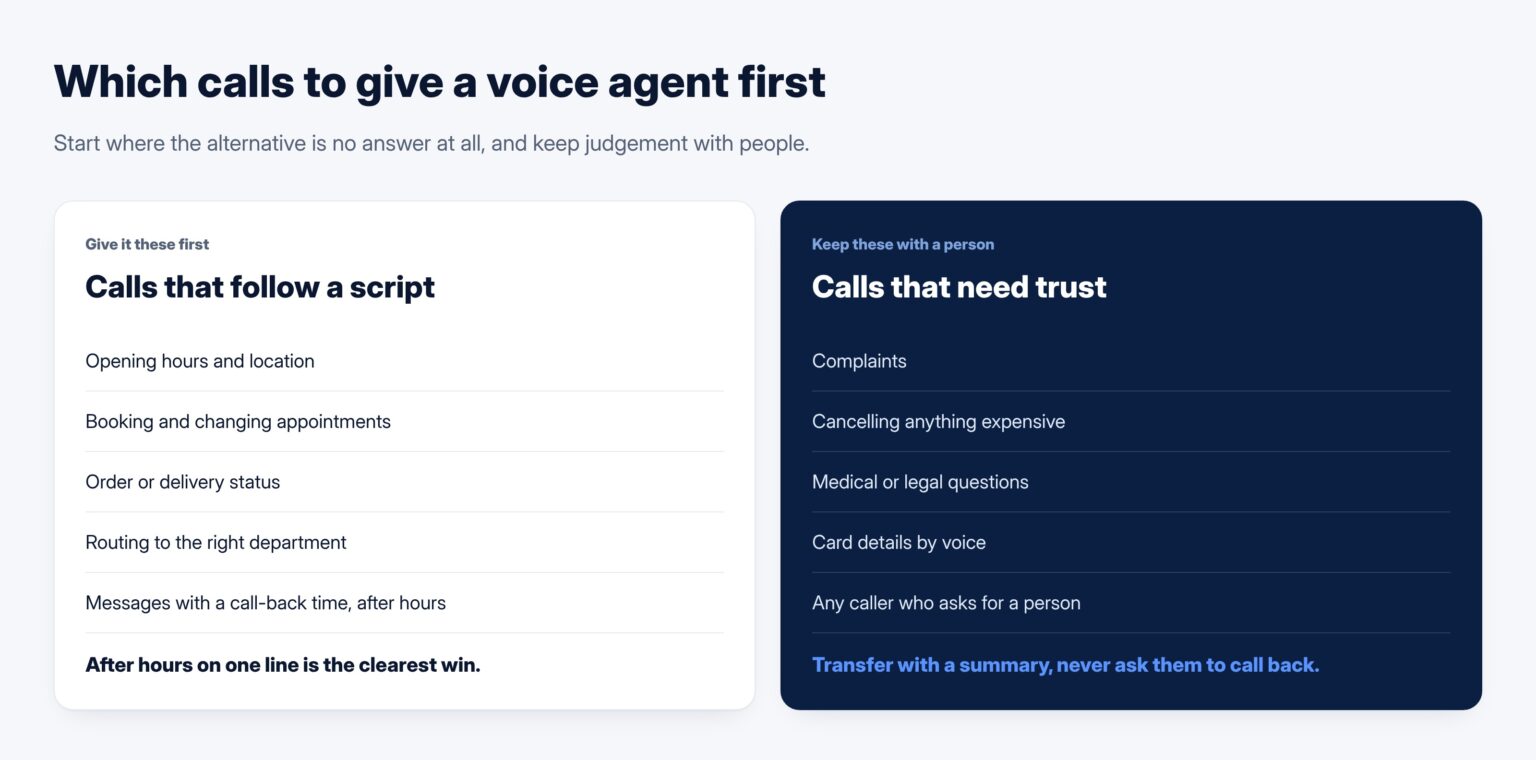
Good first jobs are the calls that follow a script anyway: opening hours and location, appointment booking and changes, order or delivery status read from your system, routing the caller to the right department, and taking a message with a call-back time when nobody is free. After-hours calls are the clearest win, because the alternative is no answer at all. They are the spoken version of what a chatbot does in writing.
Keep with people the calls where judgement or trust carries the conversation: complaints, cancellations of anything expensive, anything medical or legal, and taking card details over the phone. The reasoning is the same as for written enquiries in which enquiries should never reach a machine first, only sharper, because a caller cannot scroll back to check what was said.
The handover is a transfer, not “please call back”
When the agent reaches the edge of what it may do, it should transfer the call to a person during working hours, with a short summary on that person’s screen so the caller does not repeat everything. Outside hours, it should take the details and give a specific promise: a call back before eleven tomorrow, not “someone will contact you”.
Measure the handover rate from the first week. Too low often means the agent is holding on to calls it should pass; too high means it is not earning its cost. The same trade-off for written channels is in AI agents in Kuwaiti customer service.
Tell callers it is a machine, and ask before recording
Say it in the first sentence, in Arabic and English: this is the company’s automated assistant, and you can ask for a person at any time. Callers who find out halfway through feel deceived, and they say so. Regulation is moving the same way elsewhere; in the United States, the FCC ruled in 2024 that AI-generated voices count as artificial voices under its calling rules.
Recording and transcripts are personal data. In Kuwait, the telecom regulator’s data privacy regulation requires providers to obtain consent before collecting and processing data, and I have not found a published Kuwaiti rule specific to recording calls. Ask for consent at the start of the call, keep recordings only as long as you need them, and confirm your position with your operator before launch.
How I would start
One line, after hours only, for four weeks. Forward unanswered calls on a single number to the agent, limit it to three jobs, and read every transcript in the first fortnight. Track three numbers: calls answered that would have been missed, callers who hung up within the first twenty seconds, and handovers that turned into business the next morning.
If those numbers are good, widen it to daytime overflow, then to more jobs. If they are not, you have lost four weeks and a few hundred calls that nobody would have answered anyway. That is the approach I take as a conversational AI consultant in Kuwait, and where the agent needs building and connecting to your systems, Tothiq’s AI agents and automation service does that work.
Frequently asked questions
Can an AI voice agent speak Kuwaiti dialect?
It can understand a good deal of it and reply in clear Gulf-flavoured Arabic. How well it handles your callers depends on your audio and vocabulary, so test it on your own recorded calls before deciding.
Do we need a new phone number?
Usually not. Most set-ups keep your existing Kuwaiti number and forward calls, all of them or only unanswered ones, to the system. Check forwarding options and per-minute costs with your operator.
How fast does it need to answer?
Close to the pace of a person, well under a second for ordinary replies. Time it yourself on a real phone call; demonstrations in a browser are always faster than the phone network.
Can it take payments over the phone?
It should not take card details by voice. Send a payment link by SMS or WhatsApp during the call instead, so card numbers never pass through the conversation or its recording.
What does it cost to run?
You pay per minute for the model and for the phone connection, plus the build and someone’s time to review transcripts. Ask for the estimate on your own monthly call minutes, not on a sample.