Most business websites in Kuwait were built on two assumptions. That a person would arrive from Google, and that the site’s job was to impress that person once they landed.
Both assumptions are now shaky, and the second one is what makes this expensive. A brochure site — handsome, static, updated when someone remembers — was a reasonable thing to own in 2019. In 2026 it is a business sitting quietly outside the conversation where buying decisions are increasingly being made.
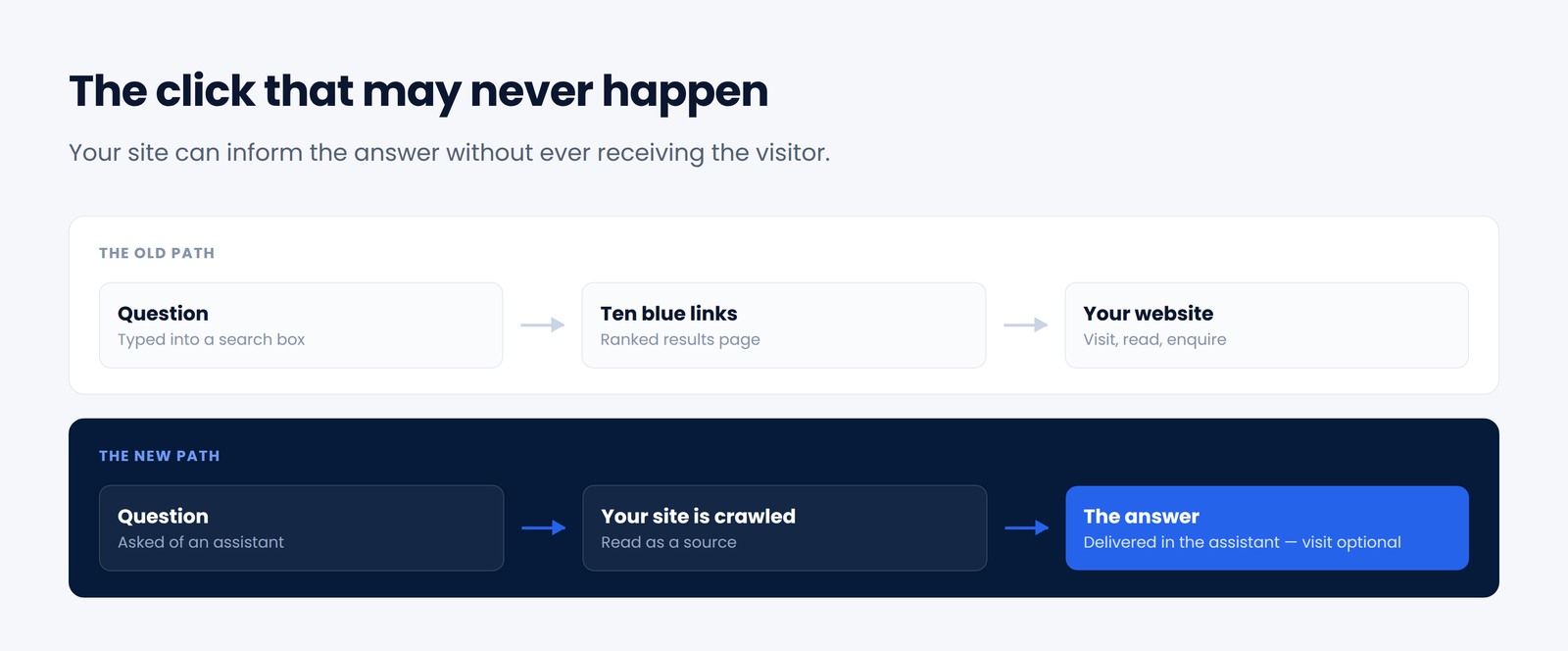
The click that may never happen
When someone asks an AI assistant where to service a fleet in Shuwaikh, or which firm handles commercial licensing, the assistant does not hand back ten blue links. It answers. Your website may well have informed that answer without ever receiving a visitor.
The scale of that gap is now measurable. Cloudflare’s crawl-to-refer data, published in mid-2025, tracks how often each AI platform crawls content compared with how often it sends a visitor back. The ratios are startling: for one major platform it was around 70,900 content requests for every single referral. Others sit far lower, but the direction is consistent — AI systems read enormously more than they refer.
Being read is no longer the same thing as being visited. Plan for both, and stop measuring only one.
This is not a reason to panic about traffic, and anyone selling you that panic is selling something. It is a reason to change what the website is for. Its job used to be persuading a visitor. Its job now is also to be the source a machine reaches for, and to be unambiguous enough that the machine gets your business right.
What this actually changes
Three things, and none of them are cosmetic.
Content has to answer, not tease. Marketing pages are written to create curiosity so the visitor keeps clicking. That structure is useless to a system extracting an answer. A page that states what you do, where, for whom, at what kind of scale, in plain sentences, is more valuable than one built entirely of headlines and adjectives. It also happens to serve human readers better, which is the pleasant part.
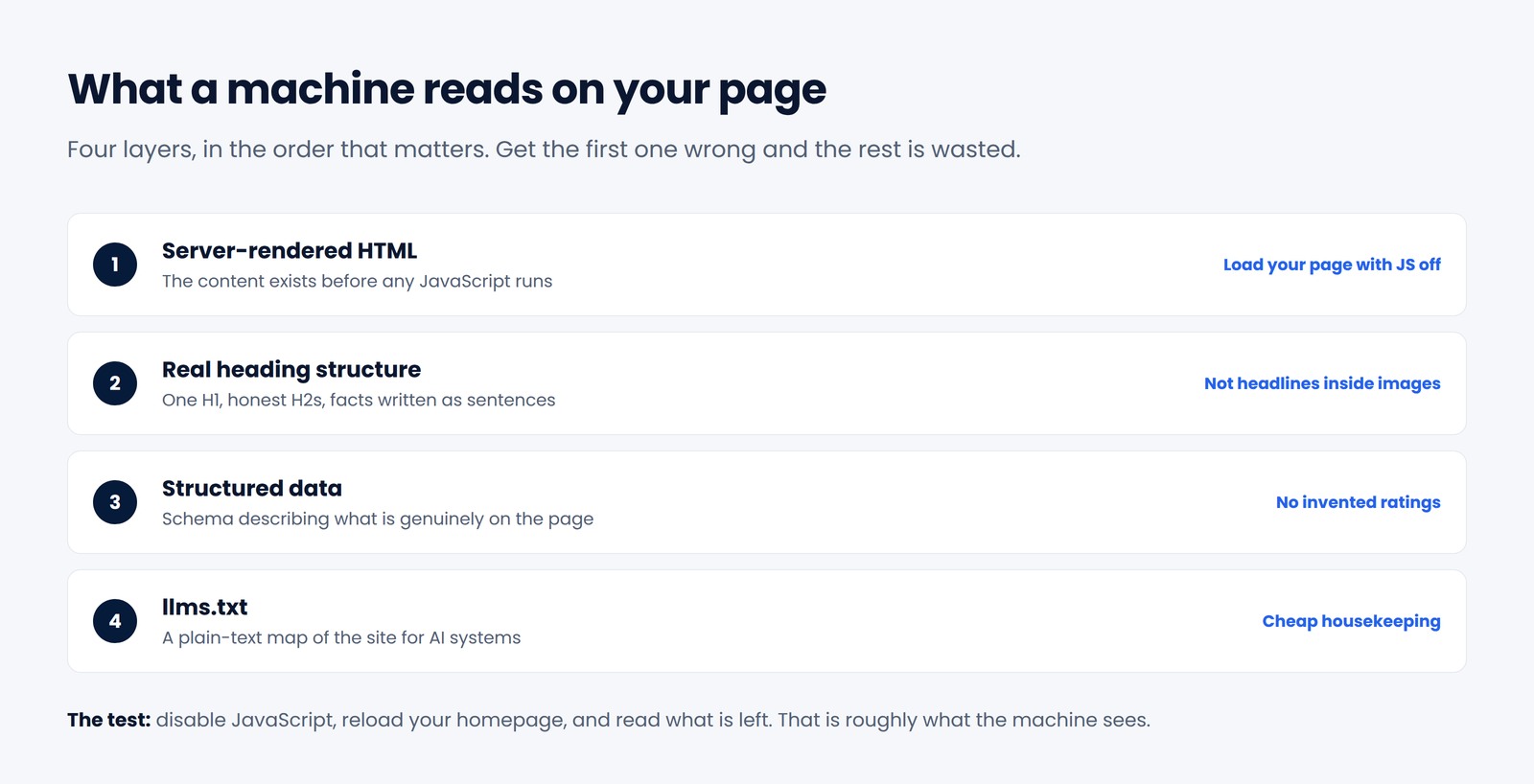
Machines have to be able to read the page. Text rendered by JavaScript after load, key facts trapped inside images, contact details in a graphic — all of it is invisible to something that does not run your front-end the way a browser does. Server-rendered HTML, real headings, honest structured data and a machine-readable summary of the site are the plumbing that makes the difference.
Arabic changes the calculation. Assistants answer Arabic queries with whatever Arabic sources they can find, and in most Kuwaiti sectors there are few good ones. A business that publishes genuinely useful Arabic content — not a machine translation of the English page — is competing in a far emptier field. I went through the practical side of that in optimising Arabic UX across the GCC.
Brochure site versus machine-legible site
| Brochure site | Machine-legible site | |
|---|---|---|
| Written for | A visitor who already arrived | A visitor and the system that summarises you |
| Structure | Headlines and imagery | Clear headings, direct statements, real text |
| Key facts live in | Design elements and images | Text, structured data, machine-readable files |
| Measured by | Sessions and bounce rate | Sessions, plus whether you are cited correctly |
| Updated | When someone remembers | When the business changes |
The part I would be careful about
There is a fashionable idea that websites should now rebuild themselves per visitor — layouts that morph in real time depending on who the AI thinks is looking. It demos beautifully.
I would not spend a Kuwaiti SME’s budget on it yet. Interfaces that change unpredictably are harder to trust, harder to support over the phone, and considerably harder to keep accessible. Worse, personalisation built on shaky inference tends to guess wrong about exactly the visitors who matter most. The businesses winning in AI-mediated search are not the ones with shape-shifting homepages — they are the ones whose ordinary pages are clear, fast and factually unambiguous. Do the boring version first. It is cheaper and it works.
What the machines currently get wrong
When I check what assistants say about a Kuwaiti business, the errors fall into three patterns, and all three are fixable from your own site.
- Stale facts. An address, a branch or a phone number from an old directory listing that the business changed years ago and never corrected at source.
- Service drift. The assistant describes what the company did five years ago, because that version of the story is repeated across more pages than the current one.
- Category confusion. Two Kuwaiti firms with similar names get merged into one description, or a competitor is named as the specialist in your own field because their site states it plainly and yours does not.
None of these are mysterious. They happen because the clearest, most repeated, most machine-readable statement about your business is not currently coming from you.
What to do about it, in order
- Make the site render without JavaScript. Load your own page with scripts disabled. If the content disappears, nothing else on this list matters.
- Write the facts down in text. What you do, where you operate, who you serve, how to reach you — in sentences, not only in a designed hero image.
- Add structured data that describes what is genuinely on the page. Not invented reviews or fabricated ratings, which are worse than nothing.
- Answer the real questions your customers ask, on the page, in the words they use. Add an FAQ section where it fits naturally.
- Publish an llms.txt summarising your site for AI systems. This site generates its own, along with a full-text version.
- Publish in Arabic properly if your customers are Arabic speakers — as original content with its own URLs, not a translation layer.
- Check what the assistants say about you. Ask three of them about your company and your category. The errors you find are the work list.
That last step is the one almost nobody does, and it is free. Businesses are often surprised to learn what the machines currently believe about them — an old address, a service they stopped offering, a competitor named as the local specialist.
Why this counts as economic change and not just marketing
Because it moves where the value sits. For twenty years, being findable in Kuwait meant buying visibility — ads, agencies, keyword campaigns. What AI-mediated discovery rewards is different: being the clearest, most complete, most verifiable source on a subject you actually know. That is harder to fake and cheaper to earn, which is genuinely good news for small competent firms and bad news for anyone whose advantage was purely a marketing budget.
The same logic runs through the difference between SEO, AEO and GEO and through optimising for LLM search. Different labels, one underlying shift: from buying attention to being worth citing.
Making a site legible to the machines that now answer for it is a service my company sells: AI search visibility at Tothiq.
Frequently asked questions
Will AI assistants stop sending traffic to my website altogether?
Not altogether, but the mix is changing. Cloudflare’s 2025 data shows AI platforms crawling content vastly more often than they refer visitors — in one case around 70,900 requests per referral. Practically, that means some queries will be answered without a visit, while higher-intent visitors still arrive. The sensible response is to make sure the answer given about you is correct, and to stop treating raw sessions as the only measure of visibility.
Does my Kuwaiti business need to rebuild its website for AI?
Usually not rebuild — repair. The common problems are content that only exists inside images or JavaScript, pages that state nothing concrete, missing structured data and no Arabic version worth reading. Those are fixable on most existing sites. A rebuild is only justified when the platform itself cannot produce clean server-rendered pages.
What is llms.txt and do I actually need one?
It is a plain-text file at the root of your site that summarises what the site contains and points to the pages that matter, in a form AI systems can read cheaply. It is a proposed convention rather than a guaranteed standard, and it costs very little to publish. Treat it as useful housekeeping, not a magic ranking factor.
Should our website personalise itself for each visitor using AI?
For most Kuwaiti SMEs, no — not yet. Real-time personalised layouts are expensive to build, hard to support, difficult to keep accessible, and they fail quietly when the inference about the visitor is wrong. Clear, fast, factually complete pages beat shape-shifting ones in both human and machine terms today.
How do I check what AI assistants say about my company?
Ask them. Query several assistants about your company by name, then about your category without naming yourself, in both Arabic and English. Record what comes back. Wrong facts, outdated details and competitors named in your place are the most useful content brief you will get this year, and it costs an afternoon.
Does this apply to companies selling to government rather than consumers?
Yes, and often more sharply. Procurement teams and their advisers research suppliers the same way everyone else now does, and government buyers across the GCC are themselves being rebuilt around structured data and APIs. A supplier whose capabilities are described only in a PDF profile emailed on request is harder to verify than one whose website states them plainly. In that context, being machine-readable is closer to a qualification requirement than a marketing tactic.
How long before this affects my sector in Kuwait?
It already does in any sector where buyers research before they call — professional services, equipment, healthcare, education, logistics. It matters least where the purchase is impulsive or purely local footfall. The honest test is not a forecast: ask an assistant what it recommends in your category today and see whether your business appears at all.
Where to start
If you want to know how your site looks to the systems that now sit between you and your customers, that is a short, specific audit: what renders without scripts, what facts exist as text, what structured data is present and accurate, and what the assistants currently say about you.
If that sounds worth knowing, see how I approach search and AI visibility, or send me your site and I will tell you what I find.