For decades, using software meant learning how the software wanted us to work.
We opened apps, navigated menus, filled in forms, selected categories, created folders, and decided where information belonged before we could actually do anything with it.
Artificial intelligence is beginning to reverse that relationship.
Instead of humans adapting to software, software is becoming capable of adapting to how humans naturally communicate.
And one of the most natural interfaces we have is already with us:
Our voice.
From Clicking to Expressing Intent
Traditional software is built around interfaces.
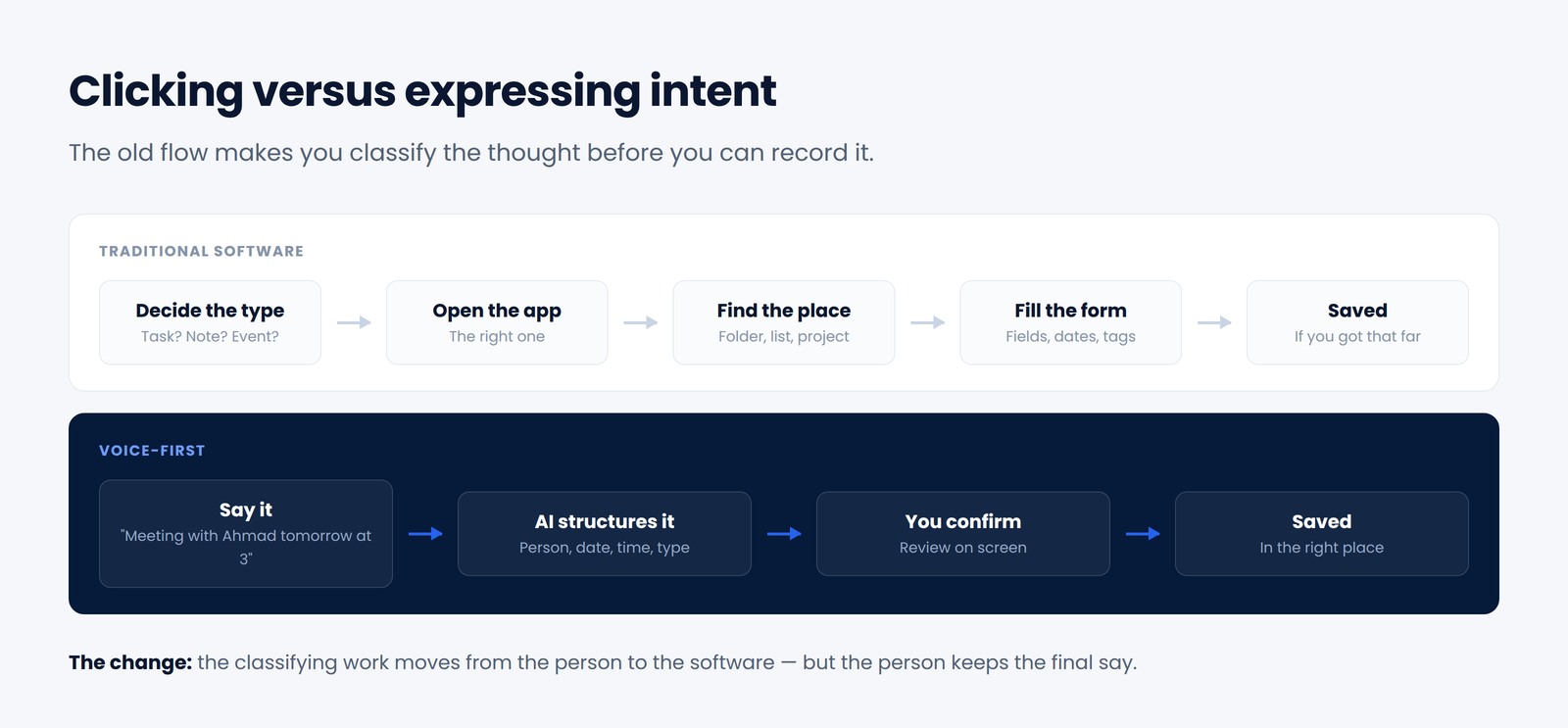
You click a button because you know what that button does. You open a calendar because you know you want to create an appointment. You open a task manager because you have already decided something is a task.
But human thoughts rarely arrive that neatly.
You might suddenly think:
“I need to call Ahmed tomorrow afternoon about the proposal.”
Before AI, you had to decide what to do with that thought.
Is it a task?
A reminder?
A calendar event?
A note?
Then you had to open the correct application and enter the information in the format that application expected.
A voice-first AI assistant can approach the same situation differently.
You simply say the thought.
The system determines what you are trying to accomplish and helps structure it.
That is a fundamental change in the relationship between people and software.
Voice-First Does Not Mean Voice-Only
When people hear “voice assistant,” they often think about traditional assistants that respond to basic commands:
“Set a timer.”
“What is the weather?”
“Play music.”
That is not what I mean by voice-first AI.
Voice-first means voice becomes the easiest starting point for expressing intent.
The rest of the experience can still be visual.
For example, you might say:
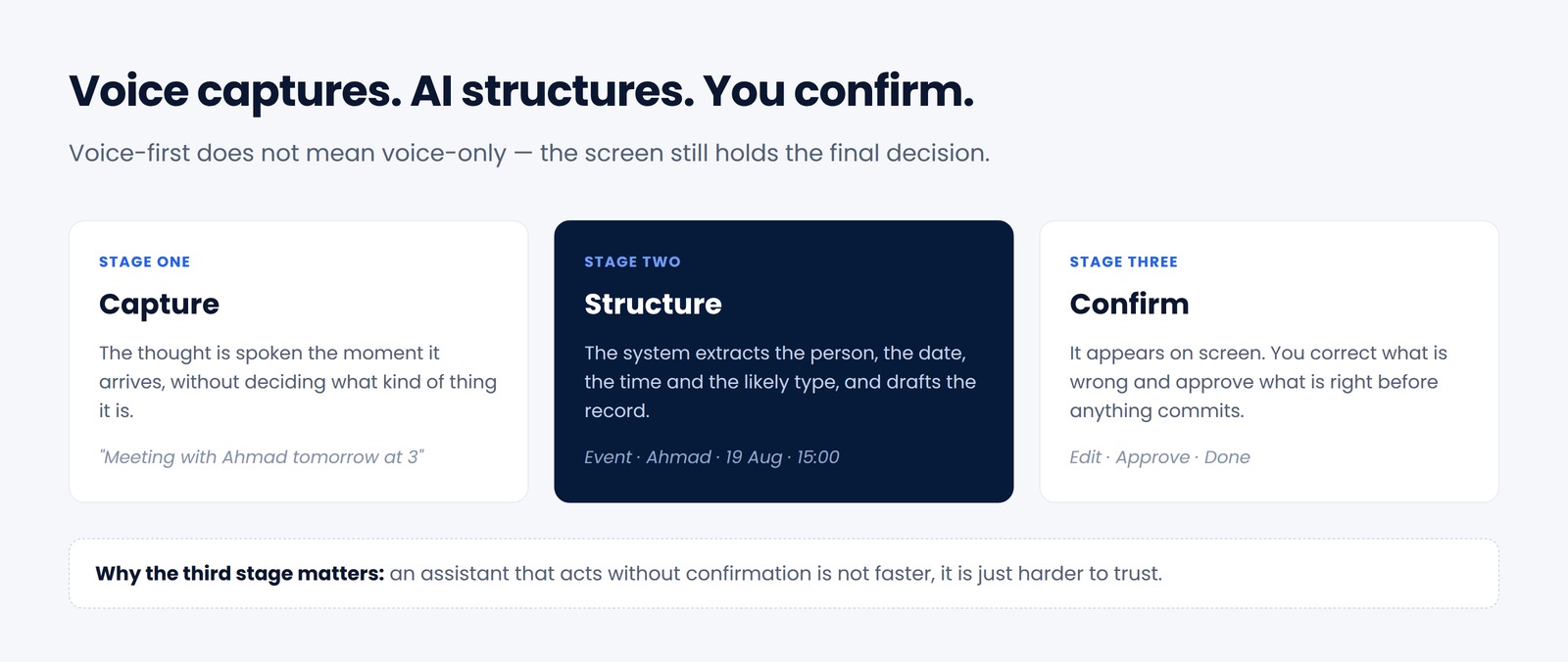
“Meeting with Ahmad tomorrow at 3 PM.”
The AI can recognize that this is likely an appointment, extract the person, date and time, and prepare it for you.
You then see the structured information on screen.
You review it.
You approve it.
Voice captures the thought.
AI organizes it.
The interface gives you control.
Speech-to-Text Is Only the Beginning
Turning speech into text is no longer the most interesting problem.
Modern speech recognition can already convert spoken language into written words with impressive accuracy.
The more important question is:
What does the person actually want to happen?
Consider these examples:
“Remind me to renew the domain next Thursday.”
“I should look into adding Arabic support.”
“Dinner with Khaled Friday at eight.”
“I want to launch the new campaign after Ramadan.”
“Buy printer ink when I’m near the office.”
These sentences contain very different intentions.
One might be a reminder.
Another is an idea.
Another is an appointment.
Another could become a multi-step plan.
A useful AI assistant should not simply transcribe those sentences into a list of notes.
It should understand enough context to help transform them into something actionable.
That intelligence layer is where voice-first AI becomes much more interesting.
Capture Naturally First. Organize Second.
Most productivity systems require organization before capture.
I believe the order should increasingly be reversed.
Capture naturally first. Organize second.
When an idea comes to mind, the priority should be getting it out of your head quickly.
The AI can handle much of the structural work afterward.
This becomes particularly useful when you are:
- Driving
- Walking
- Between meetings
- Working away from your computer
- Thinking through an idea
- Managing several responsibilities simultaneously
Typing is useful when you are already sitting in front of a screen.
Voice is useful almost everywhere else.
Why Kuwait and the GCC Are Particularly Interesting
Voice AI becomes even more interesting when you look at markets such as Kuwait and the wider GCC.
People here frequently communicate across languages.
A conversation might begin in Arabic, contain an English business term, include the name of a company in English, and then return to Arabic.
That creates a very different design challenge from building an assistant exclusively for standard written English.
Real conversations can include:
Arabic.
English.
Gulf dialects.
Local place names.
English technical terminology.
Arabic names written or pronounced in different ways.
And people switch between them naturally.
The next generation of assistants cannot expect users to change how they speak just to make the software understand them.
The software needs to become better at understanding the user.
The Opportunity Goes Beyond Personal Productivity
Voice-first interfaces will not be limited to personal assistants.
The same interaction model can influence many industries.
A property agent could dictate new property information while visiting a location.
A sales representative could record follow-up instructions immediately after a meeting.
A restaurant manager could capture operational issues while moving around the restaurant.
A consultant could record an idea between client meetings.
An executive could create tasks without opening a laptop.
A field worker could update systems without stopping to type.
Once AI becomes capable of converting natural language into structured actions, the traditional interface becomes less important.
The intent becomes the interface.
The Human Should Still Remain in Control
There is also a danger in making AI assistants too autonomous.
Convenience should not require surrendering control.
If an AI misunderstands:
“Call Ahmad tomorrow”
as:
“Schedule a meeting with Ahmad tomorrow”
the difference matters.
For important actions, I prefer a model where AI handles the organizational work while the human remains the final decision-maker.
The principle is simple:
AI organizes. You approve.
The goal should not be to remove humans from everyday decisions.
The goal should be to remove unnecessary administrative steps surrounding those decisions.
What Building UTTER IN Has Taught Me
I have been exploring these ideas while building UTTER IN, a voice-first AI assistant designed around tasks, plans, appointments, reminders and ideas.
One of the most important product decisions has been not to begin with the category.
Traditional productivity software asks:
“What do you want to create?”
UTTER IN starts with a different question:
“What’s on your mind?”
The user expresses the thought naturally.
The system then helps determine what that thought should become.
That sounds like a small interface difference.
I think it represents a much bigger shift.
People should not need to understand the internal structure of software before they can use it.
Software should increasingly understand the structure hidden inside human intent.
Where voice-first still falls down
Anyone selling voice as finished technology is overstating it. These are the conditions where it still struggles, and they matter more here than in the markets where most of these products are designed.
- Code-switching. A sentence that starts in Arabic, names a company in English and ends with a number is normal here, and hard for most recognition systems. Accuracy drops exactly where daily speech lives.
- Names and places. Gulf personal, company and area names are routinely mangled. A calendar entry with the wrong name is worse than no entry at all.
- Noisy and shared spaces. A car with the windows down, a majlis, an open-plan office. Voice works best in quiet rooms, and most work does not happen in quiet rooms.
- Privacy. People will not dictate salary details or client matters within earshot of colleagues. That is a social limit, not a technical one, and no better model solves it.
None of these make the direction wrong. They set the boundary of where it is worth building today, which is the useful thing to know before spending money.
The Interface Is Becoming Invisible
We have spent decades designing better buttons, menus, dashboards and forms.
Those interfaces will not disappear.
But their role may become smaller.
The most important interface in many AI applications may eventually be the simplest one:
A person expressing what they want.
Through text.
Through voice.
Or eventually through a combination of both.
The winners in the next phase of AI may not simply be the companies with the most powerful models.
They may be the companies that remove the most friction between human intention and useful action.
For many everyday situations, voice could become the shortest path between the two.
When the interface is speech, the assistant behind it still has to know your business, and that is the part my company builds: custom AI assistants at Tothiq.
Frequently asked questions
Is voice-first the same as a voice assistant like Siri or Alexa?
No. Those assistants respond to commands they were built to recognise — set a timer, play music, check the weather. Voice-first means speech is simply the fastest way to express an intention, which software then structures and shows back to you for approval. The interface stays visual. Only the starting point changes.
How well does this work in Arabic?
Better than it did two years ago, and still behind English. Modern Standard Arabic is handled reasonably; Gulf dialect is harder; sentences that switch between Arabic and English mid-flow are hardest of all, and that is how many people here actually speak. Test any product on your own speech before believing a demo, because the demo will have been recorded in English.
What about privacy when everything is spoken aloud?
Two separate questions. The social one — whether people will speak sensitive information in a shared space — limits adoption regardless of technology. The technical one is answerable: know where audio is processed, how long it is retained, whether it trains anyone’s model, and whether processing can happen on the device. Ask those four questions of any vendor before deployment.
Where this is going
The direction is not that people stop using screens. It is that fewer interactions begin with one. The businesses that benefit first are those whose work involves capturing information away from a desk — property, field service, retail operations, clinics, logistics — and whose systems can accept it without a human retyping it afterwards. That second half is what most companies are missing, and it is the same integration question I covered in connecting AI to your own systems. In practice that means building an assistant that reaches your systems, not one that only talks back.
Much of this comes from building UTTER IN and watching where people actually stumble. If you are considering voice in your product or your operation, see how I work on AI or tell me what you are trying to capture.