Qatar has a problem that no other GCC market has in quite the same form: two data protection regimes operating inside one country, with two different regulators, two different rulebooks, and no mutual recognition between them. A business can be fully compliant with one and in breach of the other, and most of the companies I speak to have never established which one they are actually under.
For years this was a theoretical risk, because enforcement was light. That has changed quietly, and the change is the reason this is worth your time now rather than next year.
First question: which regime are you under?
Not what the rules say. Which rules apply. Everything else follows from that answer, and it is decided by where your legal entity is registered rather than by where your customers are or where your servers sit.
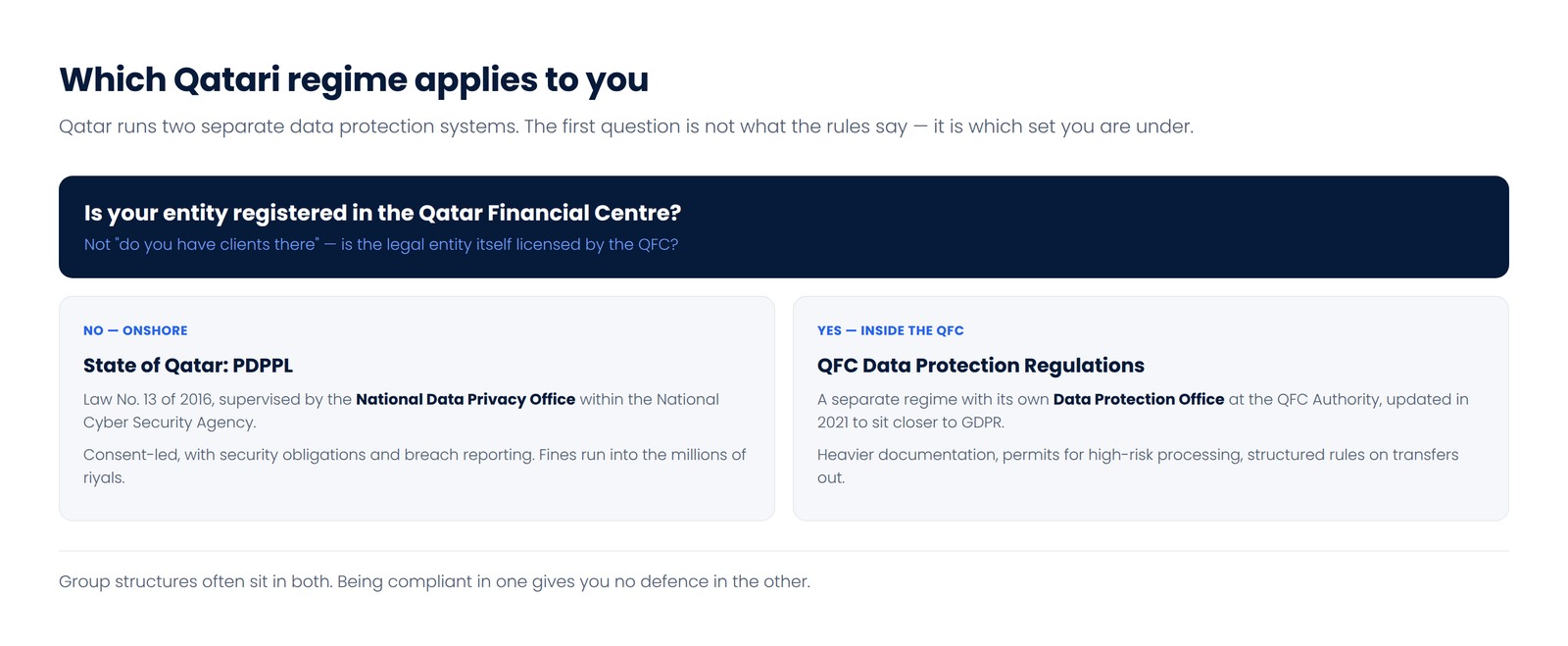
If your entity is licensed in the Qatar Financial Centre, you fall under the QFC’s own Data Protection Regulations, administered by the Data Protection Office at the QFC Authority. If it is registered onshore, you fall under the Personal Data Privacy Protection Law — Law No. 13 of 2016 — overseen by the National Data Privacy Office, which sits within the National Cyber Security Agency.
Group structures frequently straddle both. A holding company onshore with a financial services arm in the QFC is subject to both regimes simultaneously, in different parts of the business, with different obligations attaching to what may be the same customer database. Compliance with one is not a defence in the other, and neither regulator is interested in what the other one thinks.
How the two regimes actually differ
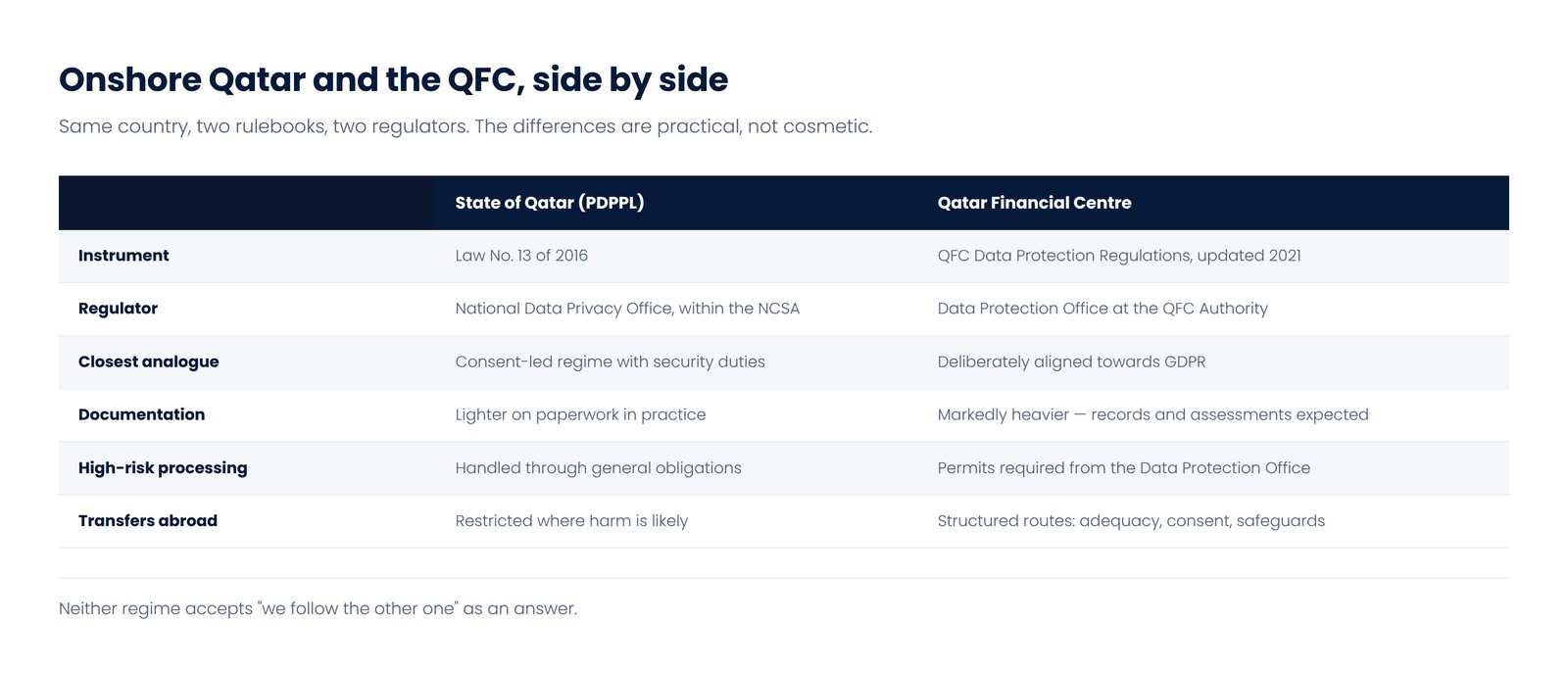
The onshore PDPPL is consent-led. It requires a lawful footing for processing personal data, obliges you to protect it with appropriate administrative and technical safeguards, expects accuracy, and makes you responsible for the processors you hand data to. Penalties are substantial: PwC puts the fine range at QAR 1 million to QAR 5 million.
The QFC regime was updated in 2021 to sit much closer to GDPR, and the practical consequence is documentation. Records of what you process and why, assessments before high-risk processing, permits from the Data Protection Office for sensitive data or transfers to jurisdictions without adequate protection, and structured routes for moving data out. Breach notification runs to a 72-hour expectation. The detail is set out in DLA Piper’s summary of the QFC regime, and the QFC publishes the regulations and guidance itself.
If you have built anything to GDPR before, the QFC will feel familiar and the onshore regime will feel lighter — which is exactly the trap. Lighter on paperwork is not the same as lighter on consequences, and the onshore regulator has just demonstrated that.
What changed: guidance became decisions
For most of its life the National Data Privacy Office behaved like an educator. It published guidelines, ran awareness work, and issued very little that looked like enforcement. Businesses drew the obvious conclusion and deprioritised the whole subject.
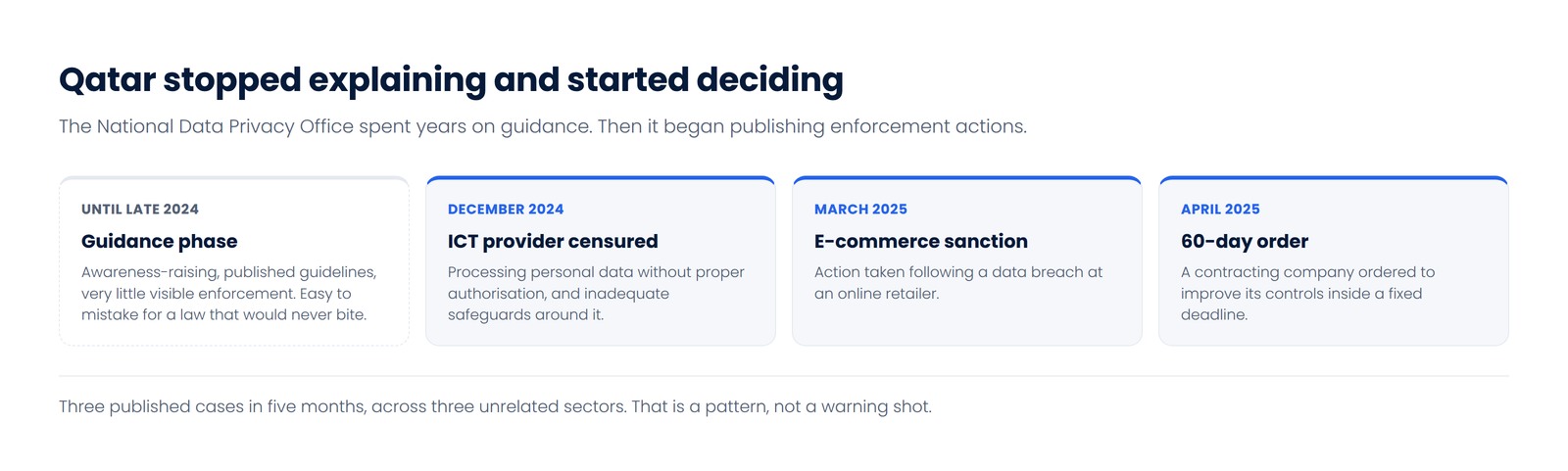
Then published enforcement actions started appearing. In December 2024 an ICT provider was ordered to strengthen its safeguards after a complaint that it had processed personal data without consent. In March 2025 an e-commerce company was sanctioned following a data breach. In April 2025 a contracting company was ordered to improve its controls within 60 days. Baker McKenzie’s enforcement update sets out the pattern.
Three cases is not a large number in absolute terms. What makes it significant is the spread — technology, retail and construction, none of them obviously connected — and the fact that they were published at all. A regulator that names organisations is a regulator that has decided visibility is part of the deterrent.
What this means for your systems, not your policies
The violations that have been acted on are instructive because none of them are policy failures. Processing without proper authorisation is a consent-capture problem in the sign-up flow. Inadequate safeguards is an access-control and encryption problem. Failing to supervise a processor is a vendor-management problem that shows up in whichever third-party tool someone connected without asking. Data accuracy is a database problem.
Every one of those lives in engineering, not in a document. A privacy notice on your website describes intent; the regulator will look at what the system does. That gap is where most businesses in the region are exposed, and it is why I keep saying that a compliance project owned solely by legal will produce a compliant folder and a non-compliant product.
The practical starting point is unglamorous: a map of where personal data actually sits. Every system, every integration, every marketing tool, every export sitting in someone’s inbox. You cannot demonstrate a lawful basis, honour a deletion request, or answer a regulator’s questions without it, and producing one almost always surfaces two or three flows nobody knew existed.
The AI question nobody has answered yet
Here is where it gets genuinely uncertain, and I would rather say so than pretend otherwise. Feeding customer records into a hosted language model is a cross-border transfer of personal data to a processor, and it is often done without anyone treating it as such. Someone pastes a spreadsheet of enquiries into a chat assistant to summarise them. A support tool routes conversations through a model hosted in another country. Neither of those decisions goes through procurement, and neither is visible in an architecture diagram.
Under the QFC regime that plausibly needs a documented transfer route and, for sensitive data, a permit. Onshore, it engages the consent and safeguarding obligations. I am not aware of published Qatari enforcement on this specific point yet, which is precisely why it is worth deciding your own position deliberately rather than discovering it during an investigation. The architectural options — hosted model, private deployment, or controlled access through something like the Model Context Protocol — have very different data-residency consequences, and I have set out how to think about the model layer in the LLM guide for businesses in the region.
If you sell into Doha from elsewhere in the Gulf
Being registered in Kuwait, Dubai or Riyadh does not put you outside this. If you process personal data of people in Qatar, work on the assumption that the onshore regime is relevant to you, and check whether any Qatari entity you contract with is QFC-licensed — because if it is, its obligations will be pushed onto you contractually whether or not the law reaches you directly.
The wider point for anyone operating across the Gulf is that these regimes are converging in direction but not in detail. Saudi Arabia’s enforcement is live and its e-invoicing deadlines are running. Bahrain’s law carries criminal penalties and shapes where Gulf businesses should host. The UAE has its own timetable, set out in the UAE 2027 deadlines guide. Building three separate compliance postures is a way to be mediocre at all of them. Build once to the strictest standard you are subject to — in practice usually the QFC or GDPR — and the others become a subset.
Where I would start
Establish the jurisdiction in writing. Every Qatari entity in your group, onshore or QFC, recorded somewhere durable. This is an hour of work and it changes everything downstream.
Map the data. Where Qatari personal data enters, where it rests, where it leaves, and which third parties touch it on the way. Include the tools nobody formally approved.
Fix consent at the point of capture. Most authorisation problems begin in a form that was designed by whoever built the website, years ago, with no legal input at all.
Decide your AI position before someone decides it for you. Write down which categories of data may go to which models, and enforce it technically rather than by memo.
Then automate. Retention monitoring, request triage and access reviews are all good candidates — but automating a non-compliant process only produces non-compliance faster, an argument I make at length in the piece on AI in operations.
None of this requires a large team. It requires someone senior enough to make binding decisions about architecture, which is the case I make on the Fractional CTO page. What it does not tolerate is being assigned to whoever has capacity this quarter.
Dates move. I keep a tracker of every dated compliance obligation across the GCC, each one checked against the regulator’s own source.
Frequently asked questions
How do I know whether my company is under the QFC regime or the onshore one?
It is determined by where the legal entity is licensed, not by where you operate or who your customers are. If the entity holds a QFC licence, the QFC Data Protection Regulations apply to it and the Data Protection Office at the QFC Authority is your regulator. If it is registered onshore, the PDPPL applies and the National Data Privacy Office supervises. Groups with entities in both are subject to both, in the relevant parts of the business — and being compliant in one gives you no protection in the other.
What are the penalties under Qatar’s PDPPL?
PwC states a fine range of QAR 1 million to QAR 5 million for non-compliance. In practice the published enforcement actions so far have taken the form of censures and binding orders to improve controls within a set period, rather than headline fines. Treat the fine ceiling as the outer bound and the remediation orders as the more likely near-term outcome — though a remediation order arriving with a 60-day clock is itself expensive if your systems are not ready.
Does Qatar’s law apply to my business if I am based in Kuwait or the UAE?
Very possibly. Data protection regimes in the region are generally concerned with the processing of personal data relating to people in the jurisdiction, so the location of your office or your servers is not by itself a defence. The safer assumption is that it applies, with the practical trigger being whether you market to, sell to or support customers in Qatar. Whether it applies in your specific case is a question for a Qatar-qualified lawyer — I am not one, and this article is not legal advice.
Can I use ChatGPT or similar tools with Qatari customer data?
Not without deciding, deliberately, that you are making a cross-border transfer to a processor and satisfying the relevant requirements for it. Under the QFC regime that points towards a documented transfer route and possibly a permit for sensitive data. Onshore it engages consent and safeguarding duties. The common failure is not a considered decision that turns out to be wrong — it is nobody making a decision at all, while individual staff quietly paste customer data into whatever tool is convenient.
Is enforcement in Qatar actually happening, or is this precautionary?
It is happening. The National Data Privacy Office moved from an awareness-raising posture to publishing enforcement actions from late 2024, with cases against an ICT provider, an e-commerce company and a contracting business inside five months. The sectors are unrelated, which suggests the regulator is not focused on one industry. Publishing the decisions at all is the clearest signal — a regulator that wanted quiet compliance would settle privately.
What is the single most useful thing to do first?
Produce an honest map of where personal data lives, including the systems nobody officially approved. Every obligation in both regimes — lawful basis, security, retention, deletion requests, transfer control, breach notification — depends on knowing what you hold and where. Organisations that skip this step end up writing policies describing a system they do not actually have, which is worse than having no policy, because it documents the gap for anyone who looks.