Introduction: Why MCP Matters for Kuwait
In Kuwait, where e-commerce grows steadily and most users browse on mobile, AI automation is key to staying competitive. The Model Context Protocol (MCP) enables businesses to integrate AI models for tasks like inventory management and customer insights. This post dives into MCP, its technical workings, and strategies for Kuwaiti e-commerce, retail, and community platforms. Ready to unlock AI automation? Let’s dive in.
What is Model Context Protocol (MCP)?
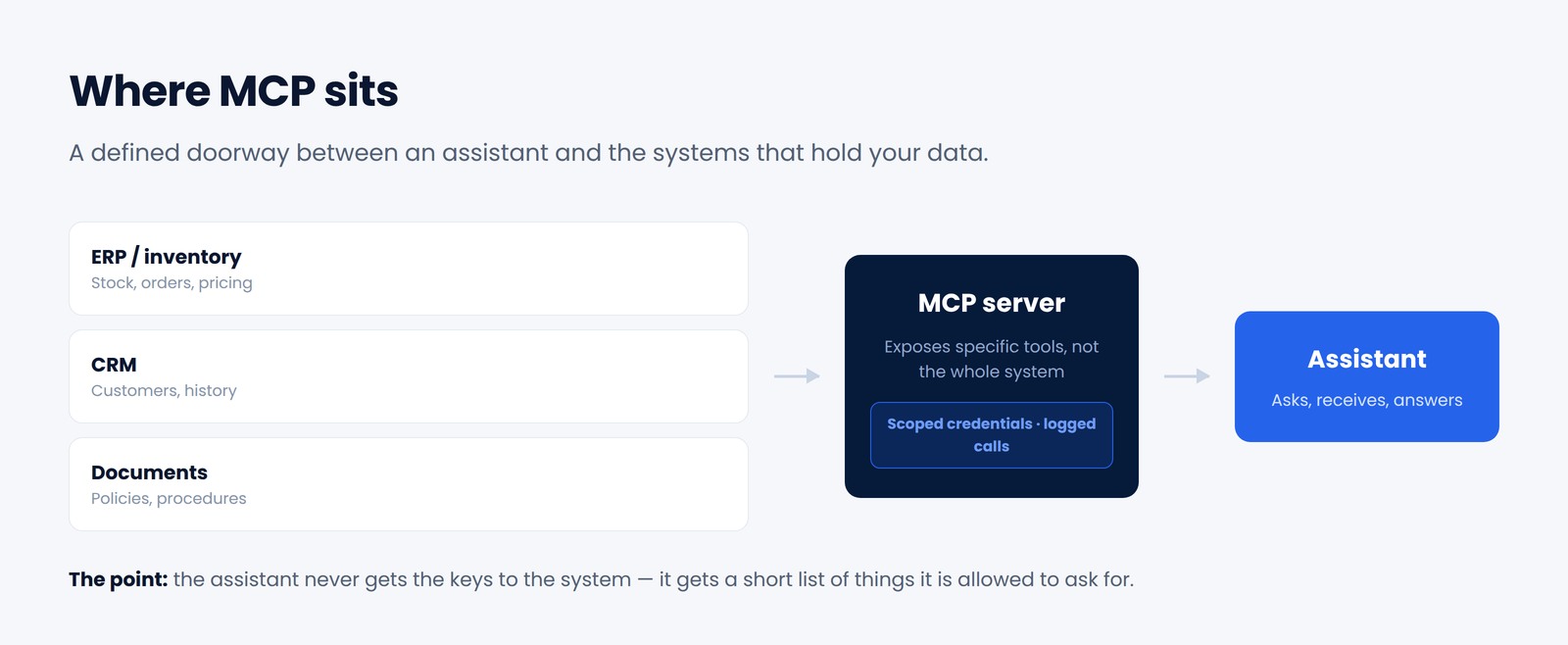
The Model Context Protocol (MCP) is a standardized framework for integrating large language models (LLMs) and AI systems with enterprise applications. It acts as a bridge between AI models (e.g., GPT-4, Claude) and business data, enabling seamless automation of complex tasks.
Core Components
- Client-Server Architecture: MCP defines how clients (e.g., a Kuwaiti retailer’s app) communicate with AI servers (e.g., AWS Bedrock) via APIs.
- Context Management: Stores and processes data (e.g., sales history, user preferences) to inform AI decisions.
- Interoperability: Connects LLMs with tools like Shopify, WhatsApp, or CRM systems used in Kuwait.
- Scalability: Supports high-volume tasks, from a heavy daily order flow to analysing community feedback.
How It Differs
Unlike traditional APIs, MCP standardizes AI integration, so each new tool does not require its own bespoke integration. It’s ideal for Kuwait’s digital economy, where businesses need fast, scalable AI solutions.
Use Cases
- E-Commerce: Automates inventory and pricing for Kuwaiti stores.
- Customer Support: Enhances chatbots with context-aware responses.
- Community Platforms: Analyzes user input on Kuwaiti Q&A forums, rewarding top contributors.
Why MCP for Kuwaiti Businesses?
Kuwait’s digital landscape makes MCP a game-changer:
- E-Commerce Boom: With e-commerce growing steadily, MCP automates inventory, predicts demand, and personalizes offers, which pays off when the underlying inventory and pricing data is accurate, and misleads when it is not.
- Mobile-First Market: most Kuwaiti traffic is mobile, requiring fast AI responses MCP delivers via APIs.
- Arabic UX: MCP integrates with Arabic NLP tools, supporting Kuwaiti dialects (e.g., “شلون الطلب؟”).
- Community Engagement: MCP powers AI-driven Q&A platforms, analyzing user feedback to foster Kuwaiti community interaction.
- Cost Efficiency: Automates repetitive tasks, which frees staff for work that actually needs a person.
Technical Breakdown: How MCP Works
MCP enables AI automation through a structured workflow. Here’s how it works for Kuwaiti businesses:
Workflow
- Data Input: MCP pulls data from APIs (e.g., Shopify sales, WhatsApp chats) or databases.
- Context Processing: Stores data in a context layer, enabling LLMs to understand Kuwaiti market trends (e.g., Eid sales spikes).
- AI Decision: LLMs like AWS Bedrock analyze data and make decisions (e.g., restock inventory).
- Action: MCP executes tasks via integrations (e.g., sends WhatsApp order updates).
- Learning: Reinforcement learning refines performance, adapting to Kuwaiti user behavior.
Key Technologies
- LLMs: Powers MCP’s reasoning (e.g., Anthropic’s Claude for Arabic NLP).
- APIs: Connects to Kuwaiti tools like WooCommerce or Aramex for logistics.
- Model Context Protocol: Standardizes data exchange, reducing integration time.
- Cloud Platforms: AWS Bedrock, Google Vertex AI, or Azure host MCP servers.
Example: Kuwaiti Retail
A Kuwaiti electronics store uses MCP:
- Input: Shopify API provides sales data.
- Context: MCP stores past purchases and Instagram trends.
- Decision: AWS Bedrock predicts demand for smartphones.
- Action: Auto-restocks inventory and launches Arabic WhatsApp ads.
- Learning: Refines predictions based on National Day sales.
Sample Code
Python snippet for MCP client using AWS Bedrock:
python
import boto3 # Initialize Bedrock client bedrock = boto3.client('bedrock', region_name='us-east-1') # MCP request response = bedrock.invoke_model( modelId='anthropic.claude-v2', body={ 'prompt': 'Analyze Kuwait sales data and suggest restocking', 'context': {'sales_data': '100 units sold', 'trend': 'National Day'} } ) print(response['body'])This code is a starting point for Kuwaiti developers.
Tools
- AWS Bedrock: Pre-built MCP integration for Kuwaiti retailers.
- LangChain: Open-source MCP framework for startups.
- Zapier: Simplifies API connections for SMEs.
Pros and Cons of MCP for Kuwait
| Pros | Cons |
|---|---|
| Automation : Removes a large block of repetitive weekly work (e.g., inventory tasks). | Cost : Setup is a real project with real cost, which is steep for a Kuwaiti SME. |
| Scalability : Handles Kuwait’s e-commerce growth. | Complexity : Requires AI expertise, scarce in Kuwait. |
| Arabic Support : Enhances Kuwaiti UX with NLP. | Data Privacy : Risks under Kuwait’s data laws. |
| Efficiency : Cuts costs measurably for retailers. | Integration Time : 2–3 months for full setup. |
Kuwaiti Strategies for MCP Implementation
- E-Commerce: Use MCP to automate inventory and pricing, targeting Kuwait’s market growth. Integrate with WhatsApp for updates.
- Retail: Deploy MCP for demand forecasting during National Day or Eid, using Shopify or WooCommerce APIs.
- Marketing: Analyze Instagram trends (much of Kuwaiti traffic) with MCP to create targeted Arabic ads.
- Community Platforms: Use MCP to process feedback on Kuwaiti Q&A forums, rewarding users to boost engagement.
- Arabic UX: Ensure MCP outputs use Kuwaiti dialects (e.g., “زين”) via native testing.
Compliance
Align with Kuwait’s data protection laws by auditing MCP data flows with tools like OneTrust.
Challenges and Ethical Considerations
- Cost: Setup cost is high enough that it needs a clear business case first. Solution: Start with open-source tools like LangChain.
- Skills Gap: Very few people in Kuwait have production experience with AI integration, so hiring is hard. Solution: Train via AWS Skill Builder or hire experts.
- Privacy: Kuwait’s data laws require transparent data use. Solution: Use encrypted APIs and compliance tools.
- Bias: LLMs may misinterpret Kuwaiti Arabic, offending users. Solution: Test outputs with native speakers.
- Job Impact: Automation may reduce Kuwaiti retail jobs. Solution: Retrain staff for AI oversight.
Getting Started: Steps for Kuwaiti Businesses
- Identify Needs: Pinpoint tasks for automation (e.g., inventory, marketing).
- Choose Tools: Start with AWS Bedrock or LangChain. Integrate with Shopify or WhatsApp.
- Hire or Train: Partner with consultants (like me!) or train staff via Coursera.
- Pilot Project: Test MCP on one workflow (e.g., demand forecasting for 100 products).
- Scale Up: Expand based on ROI, tracked via Google Analytics.
Resources
- AWS Skill Builder: free training, alongside AWS Bedrock if you want the models running in your own account.
- LangChain Docs: the LangChain documentation, useful for the orchestration layer around the protocol.
- Google Cloud: Vertex AI, the equivalent managed route if your stack is already on Google Cloud.
MCP is an open specification rather than a vendor product — the protocol documentation is the authoritative reference, and worth reading before accepting any supplier’s description of it. It is also only useful once you know which process you are connecting: the piece on AI in operations covers that sequencing, the LLM guide for Kuwaiti businesses covers the model layer underneath, and the deep dive on AI agents covers what happens when you let the model act rather than only answer.
Conclusion: The Future of AI Automation in Kuwait
MCP is unlocking AI automation for Kuwait’s e-commerce, retail, and community platforms, streamlining operations and boosting engagement. By adopting MCP, businesses can lead in 2025’s digital economy. Start small, optimize for Kuwaiti Arabic, and transform your operations.
Contact Me for AI Consulting
Ready to work out whether MCP earns its place in your stack? That is the work described on the AI consulting page. With 25+ years in web consulting, I can design AI automation solutions for e-commerce, retail, and more. Let’s drive efficiency and growth. Contact me for a free consultation.
Before you connect anything
MCP makes it easy to give an assistant access to real systems, which is exactly why the first connection deserves more care than the demo suggests. This is the difference between a chatbot and an assistant that can actually query your systems.
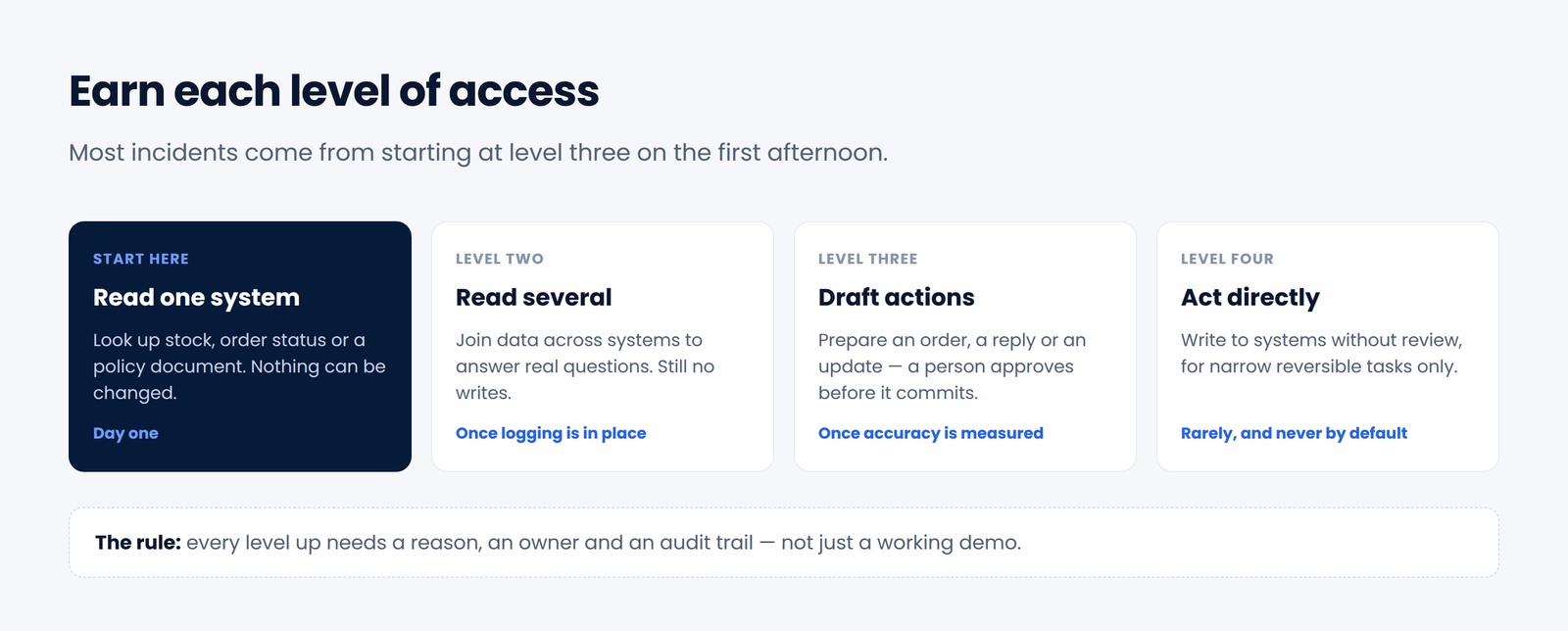
- Start read-only. The first integration should be able to look things up and nothing else. Write access is a separate decision made later, deliberately.
- Scope the credentials. One account, minimum permissions, revocable independently. Not the integration user that already has access to everything because it was convenient in 2019.
- Log every call. You need to be able to answer what the assistant asked for and what it received. Without that, an incident is unauditable.
- Decide what it must never touch. Payroll, personal data, anything under contractual confidentiality. Write the list before someone connects it in an afternoon.
None of this is exotic — it is ordinary integration discipline. It gets skipped because MCP connections are quick to set up, and quick setup is how broad access ends up granted by someone who was only trying to test something.
Frequently asked questions
What is Model Context Protocol, in plain terms?
A standard way to let an AI assistant use your own systems and data through defined tools, instead of people copying information into a chat window and pasting the answer back.
Is it safe to connect our business systems to an assistant?
It can be, with the discipline you would apply to any integration: scoped credentials, least privilege, audit logging, and an explicit decision about what the assistant may do rather than only what it may read. The risk is not the protocol, it is granting broad access because it was easier.
Do we need MCP to use AI at all?
No. It matters when you want AI working against live business data. For drafting, summarising and analysing content you paste in, you do not need it.
What is a sensible first use?
Read-only access to one system people query constantly — stock levels, order status, policy documents — with a person reading the result before acting on it.