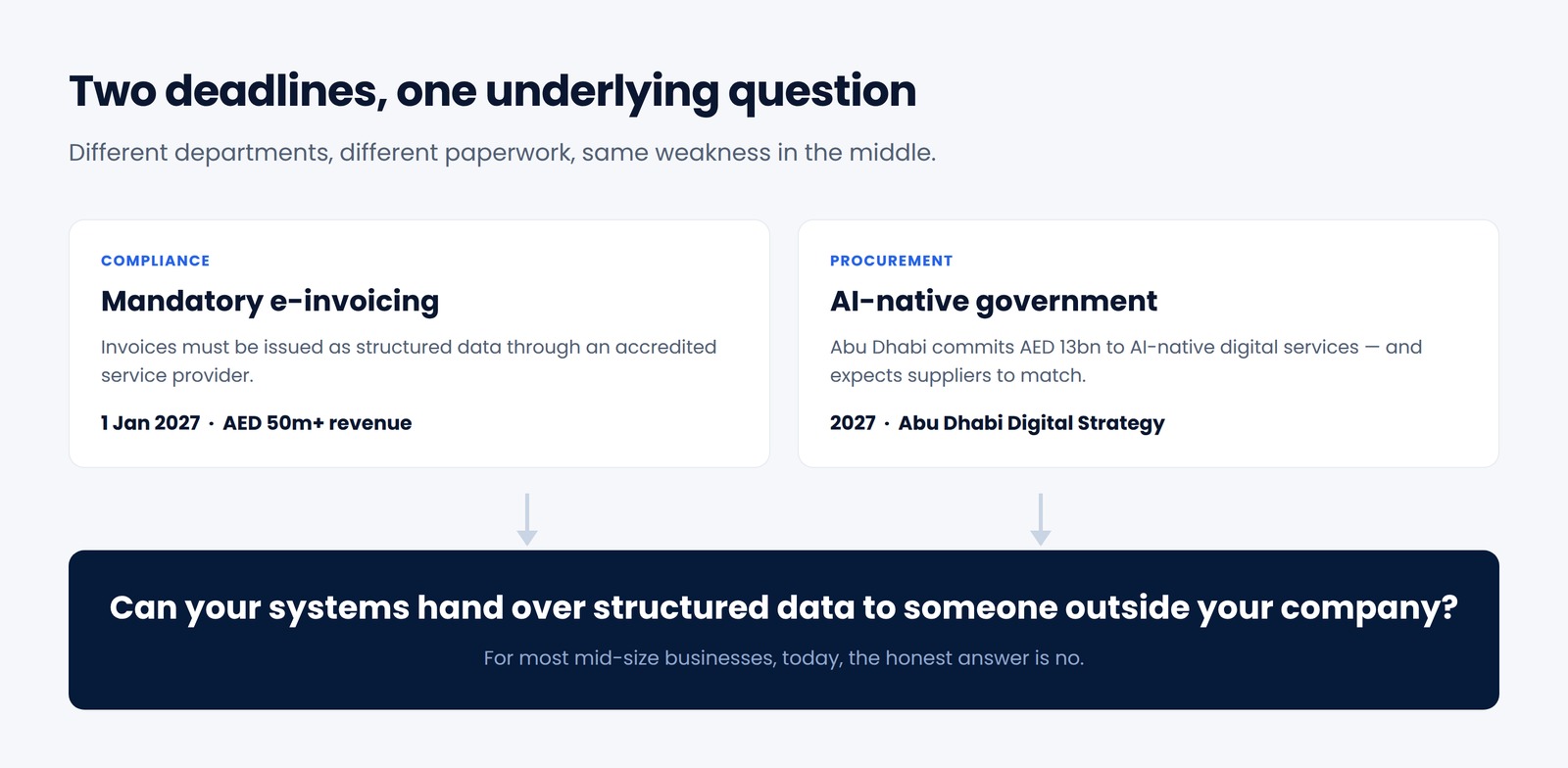
Two dates are going to reorganise a lot of UAE businesses, and almost nobody I speak to has either of them in a calendar.
The first is 1 January 2027. From that date, a UAE business turning over AED 50 million or more has to be issuing structured electronic invoices through an accredited service provider. The second is not a compliance date at all — it is Abu Dhabi’s commitment to become the world’s first fully AI-native government across all of its digital services by 2027.
They look unrelated — one a tax reform, the other a government programme. In practice they land on the same part of your company: the systems that hold your data, and whether those systems can talk to anything outside themselves. Most UAE businesses I look at would fail both tests.
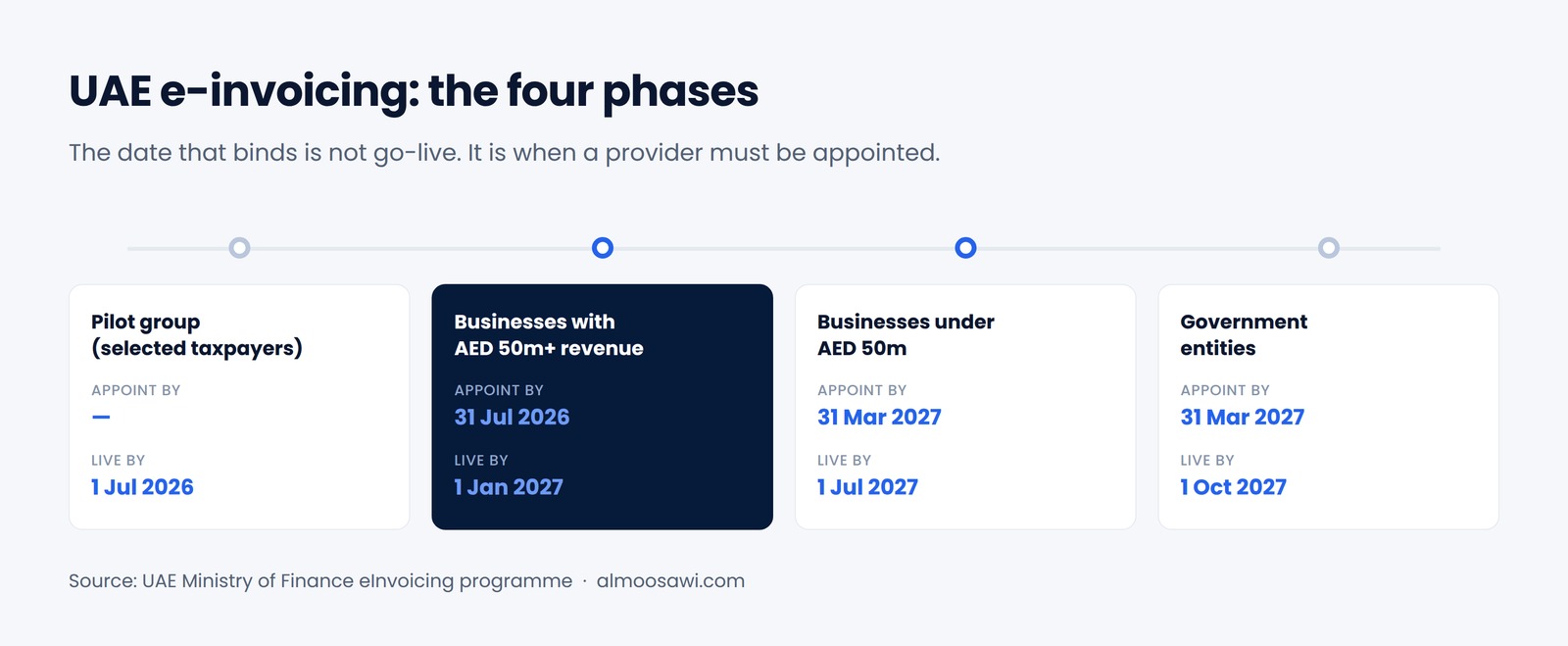
The e-invoicing deadline is closer than the paperwork suggests
The Ministry of Finance eInvoicing programme moves the country to invoices exchanged as structured data through accredited service providers, rather than PDFs and paper. The published timeline runs like this.
| Who | Appoint a provider by | Live by |
|---|---|---|
| Pilot group (selected taxpayers) | — | 1 July 2026 |
| Businesses with AED 50m+ revenue | 31 July 2026 | 1 January 2027 |
| Businesses under AED 50m | 31 March 2027 | 1 July 2027 |
| Government entities | 31 March 2027 | 1 October 2027 |
The penalties are not catastrophic on their own — AED 5,000 a month for failing to appoint a provider or implement on time, plus AED 100 per missing invoice, capped at another AED 5,000 a month. What is expensive is not the fine. It is discovering in November that the work takes four months.
Notice which column actually binds. A business over the AED 50m line had to appoint a provider by 31 July 2026 — a date that has passed. Everyone else has until March 2027, which sounds generous until you count backwards from it.
This is not an accounting project
Here is where I disagree with how this is being handled. E-invoicing landed on finance departments, and they went looking for a software vendor. Wrong shape of response: the invoice is the last step in a chain, not the first.
Your finance team does not create invoice data. It receives it — from systems that were never designed to hand it over.
Think about where one invoice comes from. The customer record sits in a CRM, or in a salesperson’s head. The line items come from an ERP customised in 2016 by a developer who has since left. The price came from a quote agreed on WhatsApp. If you sell online, part of it starts in a checkout built to take payment, not to capture a tax number.
Structured e-invoicing needs all of that in one place, in a defined format, correct, every time, automatically. That is an integration problem, and it fails in the same three ways.
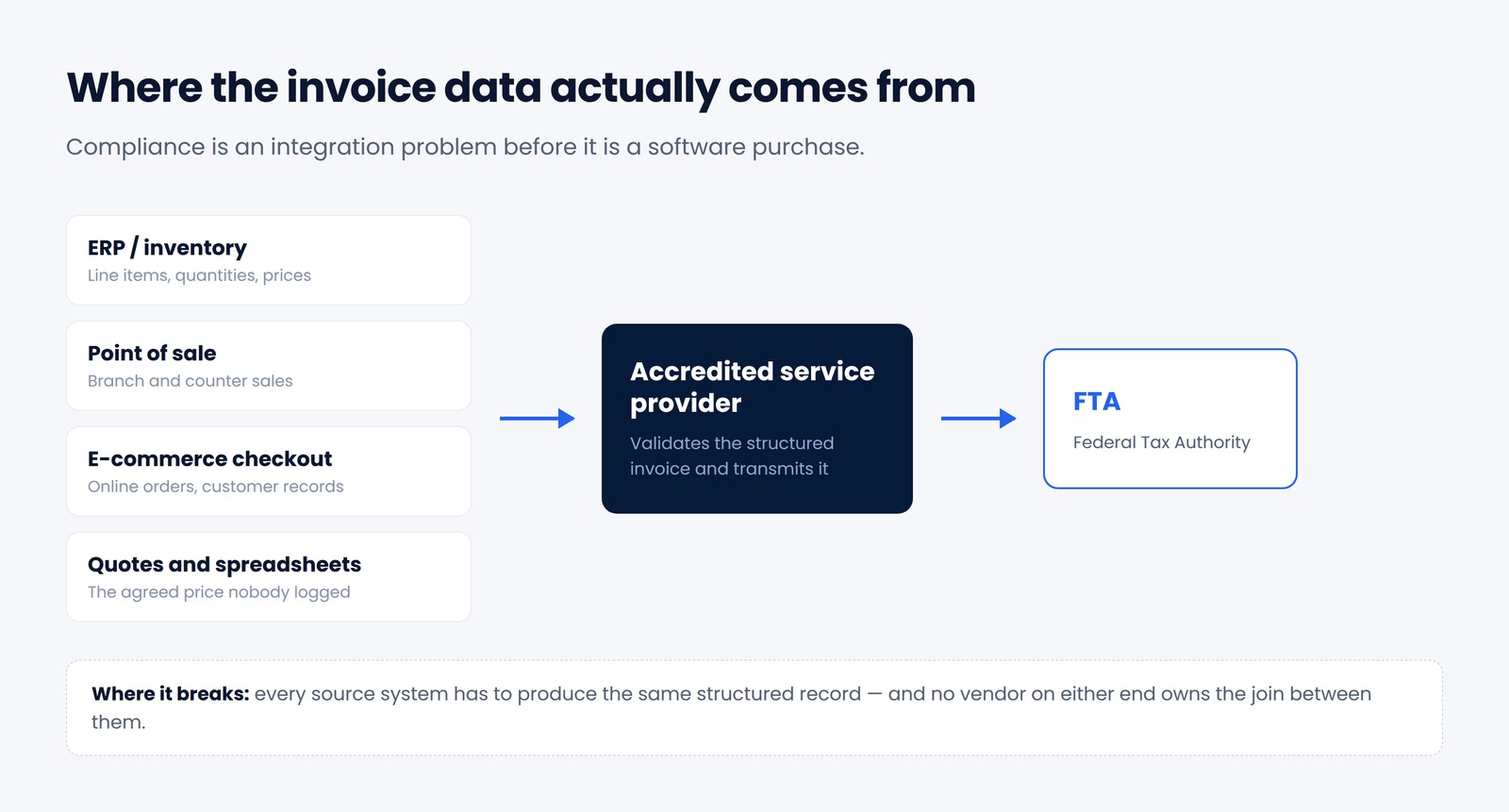
- Your systems disagree. The ERP, the store and the accounting package hold three versions of the same customer, and nobody reconciled them because a human retyped the invoice.
- Nobody owns the middle. The ERP vendor owns the ERP, the agency owns the website, the accountant owns the filing. The connections between them belong to no one — which is exactly where the mandate applies.
- The data was never clean. Missing tax numbers, free-text descriptions, inconsistent units. It never mattered while a person patched it by hand. It matters when a machine transmits it.
It is the same failure I described in the decision nobody in the room was qualified to make: competent vendors each answering their own brief correctly, and nobody whose job is the whole. Closing that gap is what senior technical oversight is for, and it does not need a full-time hire.
Abu Dhabi is quietly changing what buyers expect
Now the second date. Under the Abu Dhabi Government Digital Strategy 2025–2027, the emirate has committed AED 13 billion to becoming the world’s first fully AI-native government across all digital services by 2027: 200+ AI solutions and 100% sovereign cloud adoption.
If you sell to government in Abu Dhabi, or to the entities in its orbit, that reshapes what you are expected to do — not by memo, but because procurement standards follow the buyer’s own capability. An AI-native organisation expects suppliers to expose data through APIs rather than email attachments, to meet data-residency conditions, and to explain how their systems handle information, not only what the product does.
Businesses treating AI adoption as a marketing exercise — a chatbot, a logo on the deck — have prepared the wrong answer.
Dubai is running a different play
Dubai’s pressure is commercial, not institutional. The Dubai Economic Agenda D33 aims to double the emirate’s economy by 2033. For a mid-size company the consequence is competitive: more entrants, faster cycles, and customers whose expectations are set by whoever moved first.
Same weakness, different symptom. In Abu Dhabi it looks like failing a supplier assessment. In Dubai it looks like losing to a competitor whose checkout works properly in Arabic and whose stock levels are real — a problem I covered in optimising Arabic UX across the GCC.
Dubai and Abu Dhabi are not one market
Worth saying plainly, because too many expansion plans treat “the UAE” as one customer. It is not. What impresses one emirate is often what the other quietly discounts.
| Dubai | Abu Dhabi | |
|---|---|---|
| Who buys | Private sector, SMEs, regional HQs | Government and government-linked entities |
| What moves a decision | Speed and commercial upside | Process, standards, institutional confidence |
| Sales cycle | Weeks | Quarters |
| What wins | A working thing you can show | A credible answer to how it is run |
| What fails | Slow, over-engineered proposals | Informally run, under-documented vendors |
What to actually do, in order
If you have read this far with a mild sense of unease, this is the sequence I would follow. The order matters — most of these steps are cheap, and doing them out of order is what makes them expensive.
- Find your date. Above or below AED 50 million, government entity or not. That answer sets everything else.
- List where invoice data is born. Every system that creates an invoice line — ERP, PoS, e-commerce, quoting tools, the spreadsheet nobody admits to.
- Check what each one can export. Not whether the vendor’s site says “e-invoicing ready” — whether your instance, with your customisations, produces the required fields. The full field list — the eight transaction flags, the line-level requirements and the identifier trio — is set out on my UAE site: what an e-invoicing-ready accounting stack has to emit.
- Fix the data before the plumbing. Missing tax numbers and inconsistent product records break the integration whichever provider you appoint.
- Appoint an accredited service provider — from the Ministry of Finance’s list, not from whoever emails you first.
- Name one owner. One person accountable for the whole chain, with authority over the vendors at each end.
- Test with real invoices, early. Voluntary early adopters are not penalised before their own deadline — a free rehearsal almost nobody is taking.
Who this hits hardest
Not the large groups — they have finance systems teams, and this is a line on a roadmap that already exists.
It hits the profitable mid-size company — the distributor, the clinic group, the retailer with four branches and a store bolted on three years ago. Systems bought at different times, each fine alone, none designed to hand data to the next. No CTO, because there was never a reason for one.
That company will not fail through incompetence. It will fail through absence — of anyone whose job is the whole system rather than one part of it.
Dates move. I keep a tracker of every dated compliance obligation across the GCC, each one checked against the regulator’s own source.
Where the gap turns out to be reading documents you already hold — pulling identifiers and line detail out of invoices and contracts rather than retyping them — that is a separate build from the accounting change: document intelligence, which my company Tothiq does.
Frequently asked questions
When does UAE e-invoicing actually become mandatory?
In phases. A pilot opened on 1 July 2026 for selected taxpayers. Businesses with revenue of AED 50 million or more had to appoint an accredited service provider by 31 July 2026 and must be live by 1 January 2027. Businesses under AED 50 million appoint by 31 March 2027 and go live by 1 July 2027. Government entities go live by 1 October 2027.
What are the penalties for missing the e-invoicing deadline?
AED 5,000 per month for failing to appoint an accredited service provider or implement on time, plus AED 100 for each missing or delayed electronic invoice, capped at AED 5,000 per month. For most businesses the larger cost is the compressed timeline, because the integration work behind compliance takes months rather than weeks.
Can our accounting software handle this on its own?
Sometimes, if you run one modern system and your data is clean. Most businesses invoice from several places — an ERP, a point-of-sale system, an online checkout — and the problem is getting all of them to produce the same structured record. That is an integration question, not a software purchase, which is why picking a vendor first is usually the wrong move.
Is Abu Dhabi’s AI-native government programme relevant to a private company?
It is if you sell to government or government-linked entities in Abu Dhabi. Procurement expectations follow the buyer’s own capability: an AI-native organisation expects suppliers to integrate through APIs, meet data-residency requirements and explain how their systems handle data. That standard then spreads into the private sector.
Do you work with businesses in Dubai and Abu Dhabi?
Yes, across the GCC from Kuwait — remotely, with on-site sessions where they earn their place. The work is usually a technical audit of what your systems can actually produce, then oversight of the vendors doing the integration, in Arabic or English.
Where to start
If you do not know which of your systems can produce a compliant invoice, that is the audit to run first, and it is short work. It answers the Abu Dhabi supplier question and the Dubai one at the same time, because all three ask the same thing: can your data leave your building in a form somebody else can use?
If you want an independent read before committing to a provider or a rebuild, tell me what you are running and I will tell you what you are actually facing.