Most Gulf businesses choose where to host the same way they choose an office: by price, then by whoever is nearest. It works until a regulated customer sends a procurement questionnaire, or a regulator asks where a particular record physically sits, and the answer turns out to be a data centre in Frankfurt that nobody remembers choosing.
Bahrain is worth understanding in this context for two unrelated reasons that ended up reinforcing each other. It moved on cloud policy before anyone else in the region, so the infrastructure arrived first. And its data protection law is stricter than most of its neighbours’ in one specific way that changes how seriously boards take it.
Neither fact is interesting on its own. Together they make Bahrain a useful case for any business in Kuwait or the wider Gulf deciding where its data should live.
Bahrain went first, and it compounded
In 2017 Bahrain became the first country in the Middle East and North Africa to adopt a cloud-first policy for government. That is a policy decision, not a technical one — but policy decisions of that kind create demand, and demand attracts infrastructure.
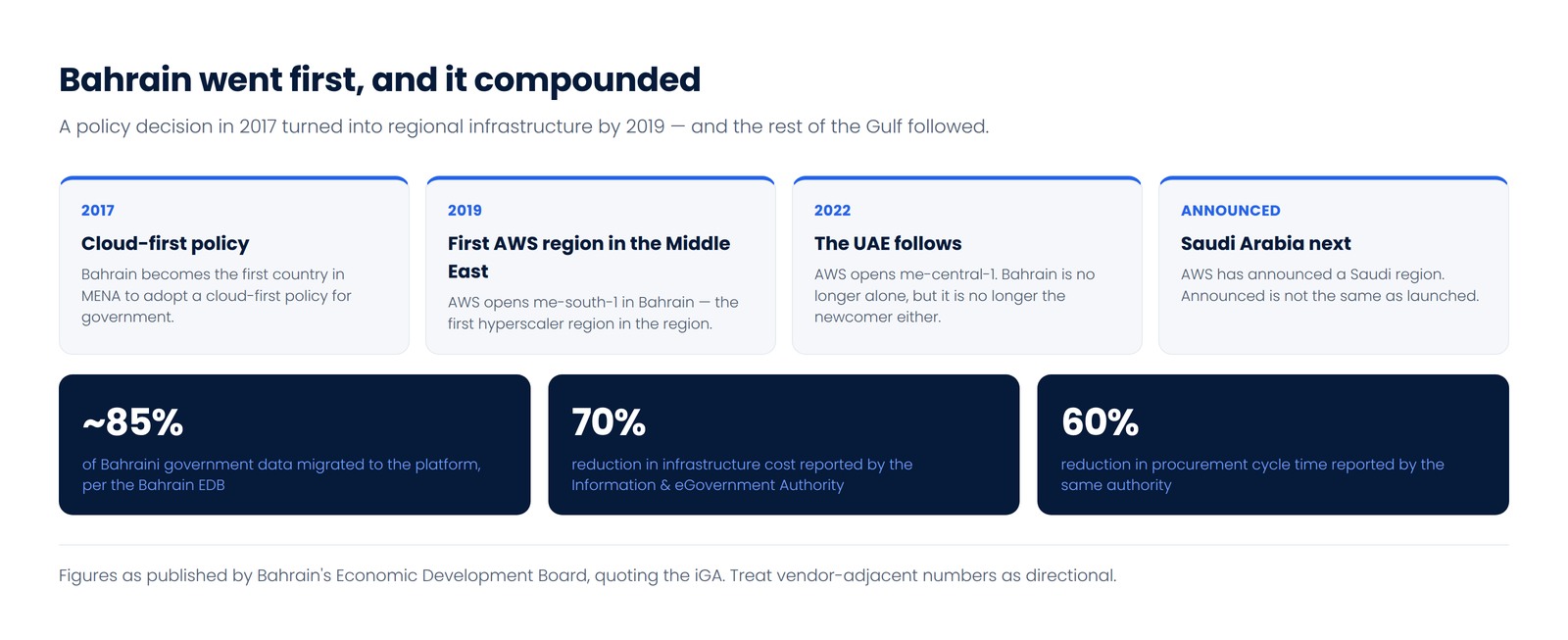
Two years later AWS opened its Middle East region in Bahrain — the first hyperscaler region in the region. The UAE followed in 2022. Saudi Arabia has been announced and, at the time of writing, still appears under announced plans rather than available regions on AWS’s own infrastructure page. Announced is not the same as launched, and architecture decisions should be made against what exists.
Bahrain’s Economic Development Board reports around 85% of government data migrated, with the Information & eGovernment Authority citing a 70% reduction in infrastructure cost and 60% in procurement cycle time. Treat those as directional rather than audited — they are published by the parties with an interest in the outcome. The direction is still the point: the head start was real, and it is why a Bahraini deployment has had more years of operational maturity behind it than anywhere else in the Gulf.
Which is how a great deal of Kuwaiti, Qatari and Saudi data ended up in Bahrain without anyone deciding it should. Being first meant being the default: for years, a team that wanted low latency without hosting in Europe had one sensible regional choice, and a developer picked the nearest region from a dropdown. That was a reasonable engineering decision. It was never a compliance decision, because nobody framed it as one. It has since become one.
Where Bahrain’s law is unlike its neighbours’
Bahrain’s Personal Data Protection Law — Law No. 30 of 2018 — came into force on 1 August 2019. In shape it will look familiar to anyone who has read a modern privacy law: lawful basis, data subject rights, transfer restrictions, a supervisory authority. The difference is in the teeth.
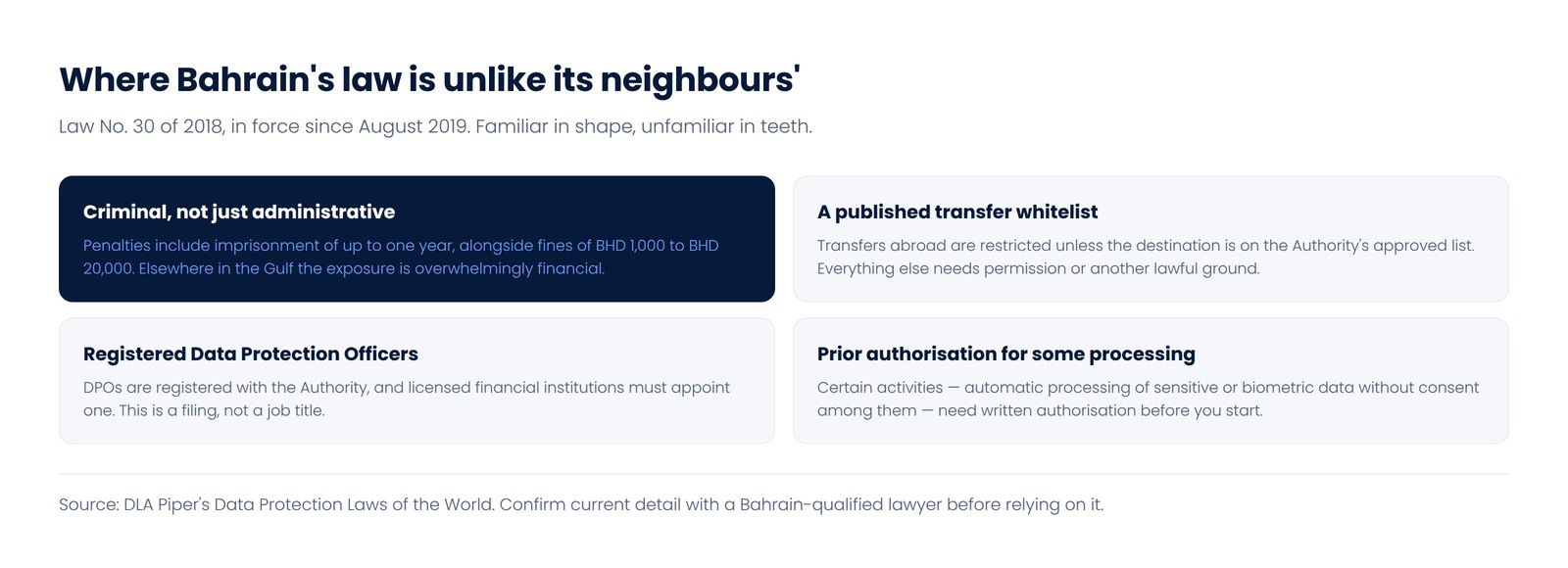
According to DLA Piper’s survey of the law, penalties run to imprisonment of up to one year and/or a fine between BHD 1,000 and BHD 20,000 for offences including unlawful processing of sensitive data, unauthorised transfers abroad, and failing to notify the Authority. Elsewhere in the Gulf, exposure is overwhelmingly financial.
Three other features matter operationally. Transfers abroad are restricted unless the destination sits on the Authority’s approved list — a published whitelist of countries — with everything else requiring authorisation or another lawful ground. Data protection officers are registered with the Authority rather than merely appointed internally, and licensed financial institutions must have one. And certain automatic processing — sensitive data without consent, biometric data, genetic data among them — needs prior written authorisation before you start, not after you are caught.
What criminal liability actually changes
The practical effect of criminal exposure is not that people go to prison. It is that the conversation moves.
A financial penalty is a line item. Someone in finance can model it, compare it to the cost of compliance, and quietly decide the risk is acceptable. I have sat in meetings where exactly that calculation was made out loud. Personal liability cannot be modelled that way, because the person signing off is the person exposed. Budget appears faster, and the request stops being a technical one.
The second effect is on documentation. Where liability is personal, the question shifts from whether you complied to whether you can show you complied — which means records of processing, retention schedules and a clear answer to where each category of data sits. That is administrative work, and it is the part most businesses have not done.
None of the above is legal advice, and I am not a lawyer. If you process Bahraini personal data at any scale, the money is well spent on a Bahrain-qualified adviser before you design around assumptions.
Four questions that decide where you host
Region choice is usually presented as an infrastructure decision. It is a compliance decision wearing an infrastructure costume, and it should be settled before anyone draws an architecture diagram.
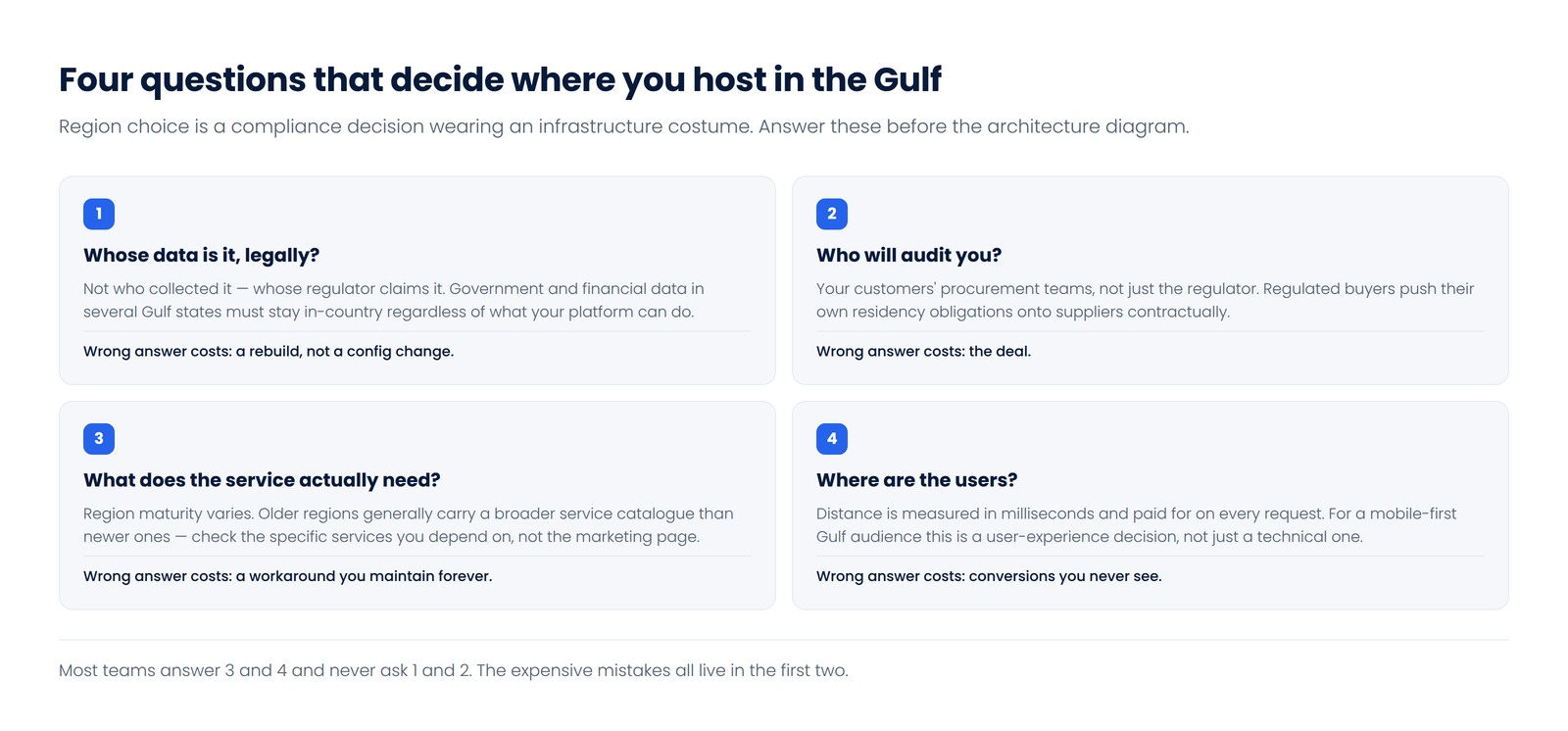
Whose data is it, legally? Not who collected it — whose regulator claims it. Government and financial data in several Gulf states must stay in-country regardless of what your platform is capable of. Getting this wrong costs a rebuild, not a configuration change.
Who will audit you? Your customers’ procurement teams, not only the regulator. Regulated buyers push their own residency obligations onto suppliers contractually, which means a hosting choice can lose you a deal without any regulator being involved.
What does the service actually need? Region maturity varies. Older regions generally carry a broader service catalogue than newer ones, so check the specific services you depend on rather than the marketing page. The cost of getting this wrong is a workaround you maintain forever.
Where are the users? Distance is measured in milliseconds and paid for on every request. For a mobile-first Gulf audience that is a user-experience decision, not only a technical one.
The mistake I see most often
A business picks a region for latency, launches, wins a regulated customer eighteen months later, and discovers during that customer’s security review that its data residency commitments cannot be met without moving. Moving a live system between regions is not a setting. It is a migration, with downtime, re-testing and a bill nobody budgeted for.
The cheap version of this problem is answered at design time by one conversation about who your customers will be in three years. The expensive version is answered by your CTO in a room with a client’s auditors. This is the kind of decision that senior technical oversight exists to catch early, and it is why I ask about customers before I ask about stack — the same instinct that governs how I approach any digital product.
What this means if you are in Kuwait
If your users and customers are Kuwaiti and your data is ordinary commercial data, the practical choice is usually between the Bahrain and UAE regions, and it is decided on latency, service catalogue and price. Bahrain is physically closer to Kuwait than the UAE, which for a latency-sensitive product is worth measuring rather than assuming.
If you hold data that a Kuwaiti regulator has an opinion about, or you sell to banks, government or healthcare, that opinion outranks every other consideration and should be established first. And if you process personal data of people in Bahrain specifically, the criminal exposure in their law is a reason to treat the transfer whitelist and prior-authorisation requirements as design constraints rather than paperwork.
The wider pattern is the one worth carrying into any project: regulation in this region is arriving faster than most technical roadmaps account for, and it is increasingly shaping how AI systems can be built here as much as where servers sit. The UAE’s 2027 deadlines are the same story in a different jurisdiction. Building as though the rules will hold still is how you end up rebuilding.
Dates move. I keep a tracker of every dated compliance obligation across the GCC, each one checked against the regulator’s own source.
Frequently asked questions
Does Bahrain’s law apply to us if we are based in Kuwait?
It can. Modern data protection laws in the region generally reach processing connected to people in the country, not only companies registered there. If you have Bahraini customers, users or employees, assume it is in scope until a Bahrain-qualified lawyer tells you otherwise — that is a cheaper order of operations than the reverse.
Is hosting in Bahrain automatically compliant?
No. Region choice and legal compliance are related but separate. Hosting in-country removes one category of problem — cross-border transfer — and leaves every other obligation untouched: lawful basis, retention, subject rights, breach notification, authorisations. A compliant deployment in the wrong region is a smaller problem than a non-compliant one in the right region.
Should we wait for the Saudi region before deciding?
Only if your requirement is specifically Saudi data residency and your timeline can absorb the wait. Announced regions have slipped before, and no architecture should depend on a launch date you do not control. Build for what exists, and design so that adding a region later is a deployment change rather than a rewrite.
How do we find out where our data actually is right now?
Ask three questions of every system: which provider, which region, and which third parties receive a copy. The third one catches most people — analytics, email, support tools and backups all move data somewhere, and they are rarely in the diagram. If nobody can answer within a day, that is the finding. If you want a second pair of eyes on it, tell me what you are running.
Is this worth doing before we have regulated customers?
The design-time version costs a conversation. The retrofit costs a migration. If regulated customers are plausible within a few years, decide now and document the decision — including why you rejected the alternatives, which is the part auditors actually want to read.