Introduction: Why LLMs Matter for Kuwait
In Kuwait, where e-commerce grows steadily and most users are mobile, Large Language Models (LLMs) like GPT-4 and Claude are transforming businesses. From Arabic chatbots to automated marketing, LLMs drive efficiency and engagement. This post dives into LLMs, their applications, and strategies for Kuwaiti e-commerce, retail, and community platforms. Ready to harness AI? Let’s dive in.
What Are Large Language Models (LLMs)?
Large Language Models (LLMs) are AI systems trained on vast datasets to understand and generate human-like text. Using transformer architectures, LLMs excel in natural language processing (NLP), enabling tasks like content creation, customer support, and data analysis.
Core Features
- Natural Language Understanding: Interprets Kuwaiti Arabic queries (e.g., “شلون أطلب؟”).
- Text Generation: Creates product descriptions, emails, or ad copy in Arabic.
- Context Awareness: Retains conversation history for personalized responses.
- Multitasking: Handles translation, summarization, and analytics simultaneously.
Popular LLMs
- GPT-4 (OpenAI): Powers chatbots and content tools, accessible via APIs.
- Claude (Anthropic): Focuses on safe, context-aware responses, ideal for Kuwaiti UX.
- Grok (xAI): Offers concise answers, available on grok.com with free quotas.
- LLaMA (Meta AI): Open-source, used by Kuwaiti startups for custom solutions.
Relevance to Kuwait
LLMs support Arabic NLP, critical for most Kuwaiti users who prefer Arabic content. They enable automation and personalization, aligning with Kuwait’s digital economy.
Opportunities for Kuwaiti Businesses
LLMs offer transformative opportunities for Kuwait:
- E-Commerce: Generate Arabic product descriptions and personalize offers, which lifts conversion when the Arabic actually reads naturally, and hurts it when it does not.
- Customer Support: Power chatbots on WhatsApp for 24/7 Arabic responses, cutting response times measurably.
- Marketing: Create targeted ad copy for Kuwaiti youth, which speeds up testing far more than it improves any single advert.
- Community Platforms: Analyze feedback on Kuwaiti Q&A forums, enhancing user engagement measurably.
- Analytics: Summarize sales data to predict trends like National Day spikes, which turns a weekly reporting chore into a short review.
Technical Breakdown: How LLMs Work
LLMs rely on advanced AI architectures and integrations. Here’s how they function for Kuwaiti businesses:
Architecture
- Transformers: Neural networks process text sequences, enabling context understanding (e.g., Kuwaiti dialect queries).
- Training Data: Billions of text samples, including Arabic corpora, ensure linguistic accuracy.
- Fine-Tuning: Models are customized for Kuwaiti use cases (e.g., e-commerce chatbots).
- APIs: Connect LLMs to Shopify, WhatsApp, or CRM systems for real-time tasks.
Workflow
- Input: User query (e.g., “وين طلبيتي؟”) or data (e.g., Shopify sales).
- Processing: LLM analyzes context using transformer layers.
- Output: Generates response (e.g., order status) or action (e.g., ad copy).
- Feedback: Learns from user interactions to improve accuracy.
Example: Kuwaiti Retail
A Kuwaiti fashion store uses an LLM:
- Input: Shopify API provides sales and Instagram data.
- Processing: AWS Bedrock’s Claude model predicts demand for abayas.
- Output: Generates Arabic product descriptions and WhatsApp ads.
- Feedback: Refines based on conversion rates.
Sample Code
Python snippet for LLM integration via AWS Bedrock:
python
import boto3 # Initialize Bedrock client bedrock = boto3.client('bedrock', region_name='us-east-1') # LLM request response = bedrock.invoke_model( modelId='anthropic.claude-v2', body={ 'prompt': 'Generate Arabic product description for Kuwaiti abaya', 'max_tokens': 200 } ) print(response['body'])This code is a starting point for Kuwaiti developers.
Tools
- AWS Bedrock: Hosts Claude and GPT models for Kuwaiti retailers.
- LangChain: Open-source framework for custom LLM apps.
- Hugging Face: Free Arabic NLP models for startups.
- Grok: Accessible via grok.com for testing.
Pros and Cons of LLMs in Kuwait
| Pros | Cons |
|---|---|
| Personalization : Boosts sales measurably with tailored offers. | Cost : An enterprise deployment carries real setup cost before it returns anything. |
| Efficiency : Removes a meaningful amount of repetitive content and support work each week. | Complexity : Requires AI skills, limited in Kuwait. |
| Arabic Support : Handles Kuwaiti dialects for most users. | Privacy : Data collection risks under Kuwaiti laws. |
| Scalability : Grows with Kuwait’s e-commerce boom. | Bias : May misinterpret dialects, needing native testing. |
Kuwaiti Strategies for LLM Implementation
- E-Commerce: Use LLMs for Arabic product descriptions and AI recommendations, targeting Kuwait’s market growth.
- Customer Support: Deploy LLM-powered chatbots on WhatsApp for 24/7 Arabic responses.
- Marketing: Generate ad copy for Instagram (much of Kuwaiti traffic), using Kuwaiti phrases like “زين”.
- Community Platforms: Analyze feedback on Q&A forums to enhance user engagement, rewarding active Kuwaiti users.
- Arabic UX: Ensure LLMs handle Kuwaiti dialects via native testing for accuracy.
Compliance
Align with Kuwait’s data protection laws by auditing LLM data flows with OneTrust.
Challenges and Ethical Considerations
- Cost: Enterprise deployments are expensive enough to be a real decision for a Kuwaiti SME. Solution: Use free tools like Hugging Face or Grok’s free quotas.
- Skills Gap: Very few people in Kuwait have shipped anything real with LLMs yet, which makes hiring hard. Solution: Train via Coursera or hire experts.
- Privacy: Kuwaiti laws require transparent data use. Solution: Use encrypted APIs and compliance tools.
- Bias: LLMs may misinterpret Kuwaiti dialects, offending users. Solution: Test with native speakers across a sample of real interactions.
- Job Impact: Automation may reduce support roles. Solution: Retrain staff for AI oversight.
Getting Started: Steps for Kuwaiti Businesses
- Identify Needs: Pinpoint tasks (e.g., support, content generation).
- Choose Tools: Start with AWS Bedrock, LangChain, or Grok (grok.com).
- Integrate: Connect LLMs to Shopify or WhatsApp via APIs.
- Train or Hire: Use AWS Skill Builder or partner with consultants (like me!).
- Pilot Project: Test LLM on one task (e.g., 100 chatbot queries).
- Scale Up: Expand based on ROI, tracked via Google Analytics.
Resources
- AWS Skill Builder: free training, and Bedrock if you want models running inside your own AWS account.
- Hugging Face: open models, including ones trained with real Arabic capability rather than Arabic as an afterthought.
- Grok: Free access via grok.com.
Where this usually goes wrong is sequencing: a business buys the model before deciding which process it is meant to improve. The piece on AI in operations sets out the order that works. If the use case is customer-facing, the deep dive on AI agents covers where autonomy helps and where it quietly creates liability, and the MCP explainer covers how to give a model controlled access to your own systems. For Arabic specifically, the failure mode is almost never the model — it is that the source content was translated rather than written, which the Arabic UX guide explains.
Conclusion: The Future of LLMs in Kuwait
LLMs are revolutionizing Kuwait’s e-commerce, support, and community platforms with Arabic personalization and automation. By adopting these tools, businesses can lead in 2025’s digital economy. Start small, optimize for Kuwaiti Arabic, and transform your operations.
Contact Me for AI Consulting
Ready to work out which parts of your business an LLM actually helps? That is the work described on the AI consulting page. With 25+ years in web consulting, I can design AI solutions for e-commerce, support, and more. Let’s drive growth. Contact me for a free AI consultation.
What to ask a vendor before you sign
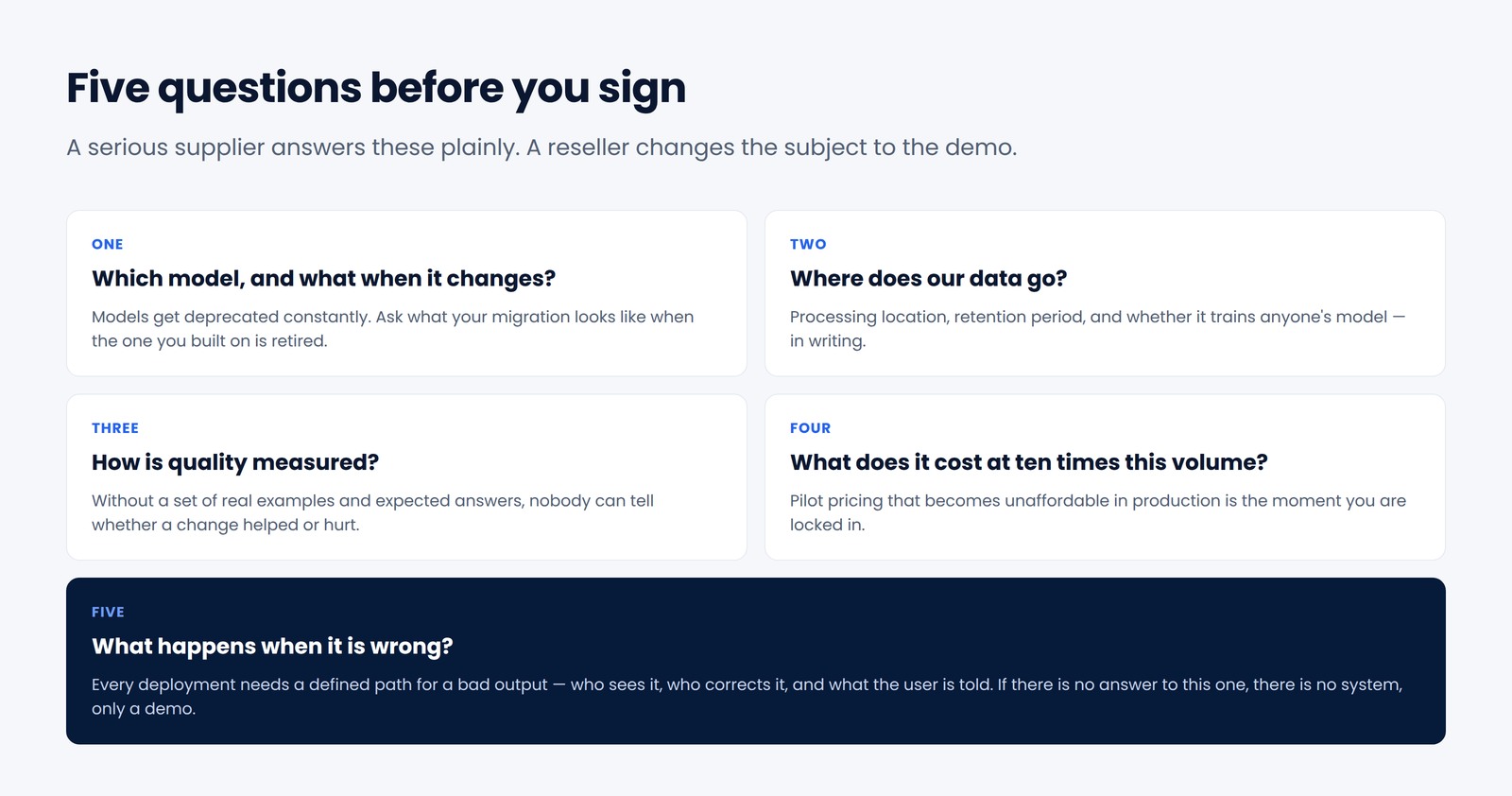
Most disappointing LLM projects were mis-scoped at the point of purchase rather than badly built. Scope the work around where an LLM earns its cost in operations rather than around the demo. Five questions separate a serious supplier from a reseller.
- Which model, and what happens when it changes? Models are deprecated and updated constantly. Ask what your migration path looks like when the one you built on is retired.
- Where does our data go, and is it used for training? Get the answer in writing, including retention periods and processing location.
- How is quality measured? If there is no evaluation set of real examples with expected answers, nobody can tell whether a change made things better or worse.
- What does it cost at ten times this volume? Pricing that works for a pilot can become unaffordable at production scale, and that is the moment you are locked in.
- What happens when it is wrong? Every deployment needs a defined path for a bad output — who sees it, who corrects it, and what the user is told.
A supplier who answers these clearly is worth paying. One who deflects to a demo is selling you a science project.
Frequently asked questions
Should we use a hosted model or run our own?
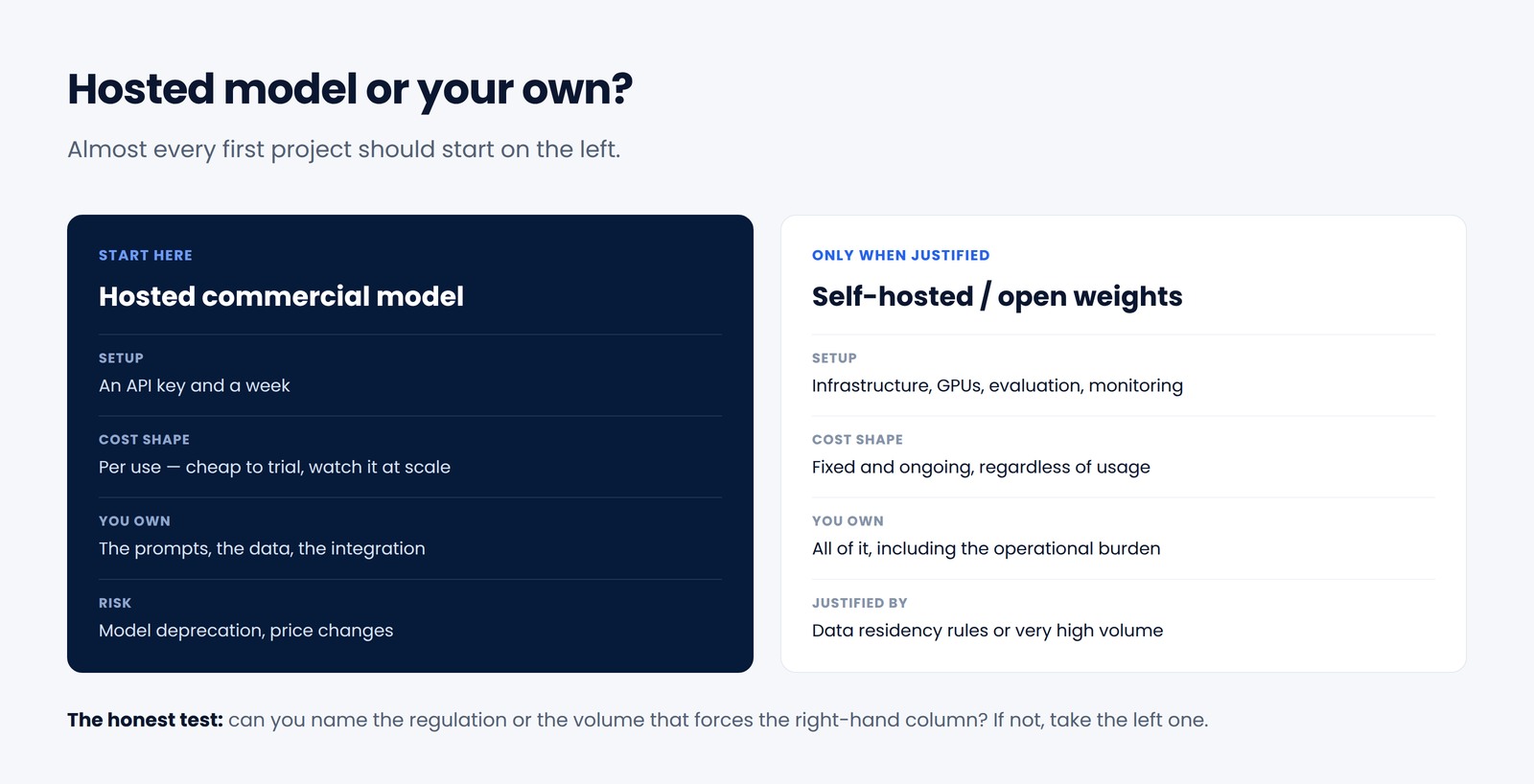
Start hosted. Running your own makes sense when data residency rules or volume economics demand it, and it brings real operational burden — infrastructure, updates, evaluation and security all become yours.
What does it cost to run in practice?
Less than most people expect for internal tools, and more than expected at consumer scale. Price a realistic monthly volume before designing anything, because the difference between an internal assistant and a public one is often two orders of magnitude.
How good is Arabic support today?
Usable and improving. Modern Standard Arabic is handled well, Gulf dialect less so, and text that mixes Arabic with English mid-sentence is the hardest case. Evaluate on your own documents rather than on a vendor demo.
What should we not use a language model for?
Anything where a confident wrong answer is expensive and nobody checks it — final financial figures, legal or medical advice, or irreversible actions taken without human review.