Speaking & Training

Social Media Summit, Kuwait

Participation in the 2013 Social Media Summit – Kuwait

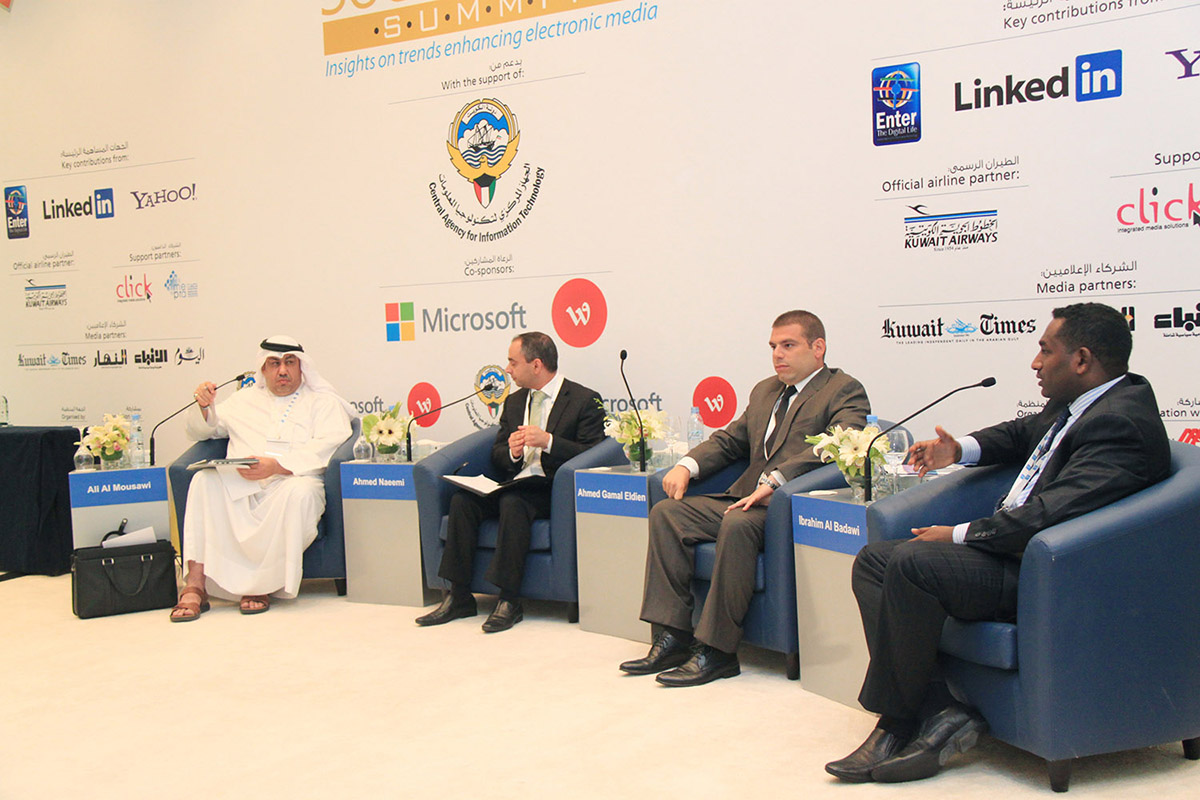
One of the most significant media events in Kuwait in 2013 was the Social Media Summit, where I had the honor of being invited as a panelist to discuss the impact of social media on the Kuwaiti market and the challenges faced by businesses and audiences alike.

The summit took place over two days at the JW Marriott Hotel in the Salhiyah district of Kuwait City. The event was supported by major corporate sponsors, including Yahoo, Kuwait Airways, Microsoft, LinkedIn, and several other leading organizations. Notably, the summit attracted participation from numerous government ministries, institutions, and military entities, reflecting the growing importance of social media across various sectors.

On the final day of the summit, I was privileged to be recognized by the event organizers and was presented with a trophy and certificate of honor in appreciation of my contributions.


Social Media Summit Kuwait Ali Almoosawi Social Media Summit Kuwait Ali Almoosawi Social Media Summit Kuwait Ali Almoosawi

What the summit actually signalled

Looking back, the guest list mattered more than the agenda. When Yahoo, Microsoft, LinkedIn and Kuwait Airways put their names on a two-day event, and ministries and military entities sent people to sit in the audience, it was a sign that social media had stopped being a marketing experiment in Kuwait and started being an institutional concern. Up to that point the conversation in most boardrooms here was whether to have a Twitter account at all. After that summit the question changed to who owns it, who answers it at two in the morning, and what happens when a complaint goes public before it reaches the call centre.

That is the part I still find worth writing about thirteen years later. Not the trophy, and not the panel — but the moment a channel crosses from novelty into infrastructure, because it happens again and again with every new technology, and the organisations that recognise it early behave very differently from the ones that do not. Kuwait is going through exactly the same crossing with artificial intelligence right now, and the pattern is uncomfortably familiar.

What Kuwait’s digital landscape looked like in 2013

It is easy to forget how different the ground was. Instagram was three years old and had no advertising platform. Snapchat was a curiosity. WhatsApp was a messaging app, not a storefront. Most Kuwaiti brands had a website built once and never touched again, and a Twitter account run by whoever in the office happened to be youngest. Arabic content was largely an afterthought — a translated version of the English page, pushed live without anyone checking how it read.

What Kuwait did have, and still has, is unusually high connectivity and an audience that adopts new platforms faster than the businesses serving it. The gap between how sophisticated the consumer was and how unprepared the brand was is the single defining feature of that period. Every practical problem I was asked to solve in 2013 — slow replies, no Arabic strategy, no measurement, no ownership — traced back to that gap. The annual DataReportal country profiles for Kuwait still show the same pattern: consumer adoption running ahead of institutional readiness.

What changed between 2013 and 2026

Thirteen years is long enough that almost every tactic from that era has expired. The underlying economics have not. Here is the honest comparison:

20132026
Organic reach was free and generousReach is bought, or it is earned through genuinely useful content
The website was the destinationThe website is a source that other surfaces quote from
Followers were the headline metricEnquiries, repeat purchase and retention are the headline metrics
Arabic was a translationArabic is a separate audience with its own intent and phrasing
Content was written for people scrollingContent is written for people, and parsed by machines that answer on their behalf
The competitor was the shop next doorThe competitor is a global platform shipping to Kuwait in three days

The last two rows are the ones that catch businesses out. A page today is read by a search engine, by an AI assistant summarising an answer, and by a person — and those three readers want different things from the same document. I wrote about that split in detail in the guide to SEO, AEO and GEO for Kuwait, because it is now the most common reason a site that used to rank quietly stops producing enquiries.

Five things from 2013 that still hold

Response time beats production value. In 2013 the brands that won on social in Kuwait were not the ones with the best photography. They were the ones that answered. That has not moved an inch. A business that replies in minutes will out-perform a business with a bigger budget and a slower inbox, and the same is now true of the automated layer — a chatbot that resolves the question is worth more than a beautiful one that deflects it.

Someone senior has to own it. The single most reliable predictor of whether a digital channel works in a Kuwaiti company is whether one named person is accountable for it and has authority to decide. Channels owned by committee die slowly. This is the same argument I make for technology decisions generally on the Fractional CTO page.

Publish what you actually know. The content that worked in 2013 was specific and local. The content that works in 2026 is specific and local. Generic advice was ignorable then and is now actively worthless, because a language model can generate an infinite amount of it for free. Google’s own helpful content guidance is basically a formalisation of the same instinct.

Arabic is not optional. It was a differentiator in 2013 and it is table stakes now, but most bilingual sites in Kuwait still handle it badly — right-to-left layout treated as a CSS afterthought, one URL serving two languages, hreflang missing entirely. The practical version of getting it right is in the guide to Arabic UX for the GCC.

Measure what you would act on. Follower counts were vanity in 2013 and dashboards full of unread charts are vanity now. If a number would not change a decision, it does not belong in the report.

Four things that stopped being true

Posting frequently is a strategy. It was, briefly, when feeds were chronological and reach was cheap. Now volume without a reason to exist simply trains the audience to scroll past you faster.

The website is where the journey ends. Increasingly the journey ends inside someone else’s interface — a search result that answers the question outright, an assistant that summarises three sources, a marketplace listing. Your site’s job has partly shifted from converting the visit to being the source that gets quoted accurately. I unpacked what that means commercially in the piece on generative AI rebuilding Kuwait’s digital economy.

You can run it with an intern. In 2013 the stakes were reputational. Today the same channels carry payments, customer data and regulatory exposure, and CITRA has a substantially larger footprint over how data is handled than anything that existed then.

Social is a separate department. It is now the customer service queue, the sales channel, the recruitment pipeline and the crisis line, all sharing one inbox. Treating it as marketing’s problem alone is how organisations end up with a complaint escalating publicly while three departments argue about who replies.

The shift nobody on that panel predicted

We spent two days in 2013 debating how businesses should talk to audiences on social platforms. Nobody in that room, myself included, predicted that the more consequential change would be machines talking to audiences about businesses. When someone asks an assistant which company in Kuwait can do a particular job, the answer is assembled from whatever the model can find and trust — your site, your reviews, your structured data, your consistency across sources. You are not in the conversation. You are the raw material for it.

That is a genuinely different discipline from social media marketing, and it rewards different behaviour: unambiguous facts about who you are, questions answered plainly on the page, clean machine-readable structure, and the same story told consistently everywhere. Google’s own product announcements for Search have moved steadily in that direction, and the assistants have moved faster.

What I would tell a Kuwaiti business starting today

Start with the boring layer. Make sure the business is described identically wherever it appears, that the site loads quickly on a phone on a mobile connection, that Arabic and English each have their own indexable pages, and that someone answers enquiries within the hour. That unglamorous foundation still decides more outcomes than any campaign, exactly as it did in 2013.

Then pick one thing to be genuinely good at publishing about — the thing you actually know that your competitors cannot copy from a template. Depth is the only durable advantage left, because everything shallow is now generated on demand.

Then, and only then, automate. The mistake I see most often is a business buying an AI layer to sit on top of processes that were never working. Automating a broken reply process produces broken replies faster. The sequencing that works is described in the piece on using AI in operations rather than in customer support alone.

Where this work sits now

The panels and workshops of that period — including the Second Social Media Forum, the Instagram marketing workshops and the early social media marketing classes — were about helping Kuwaiti organisations catch up with a channel their customers had already adopted. The work I do now, as an AI consultant in Kuwait and as a Fractional CTO, is the same job with a different technology in the middle of it.

The thing worth carrying forward from 2013 is not any particular tactic. It is the habit of asking, early and honestly, whether a new technology has crossed from novelty into infrastructure for your customers — and being willing to reorganise around the answer instead of appointing a committee to study it. The businesses that did that in 2013 spent the following decade ahead. The same window is open now, and it will close the same way.

Frequently asked questions

Do you still speak at conferences and events?

Yes — on AI adoption, digital products and search visibility, in Arabic or English. Tell me the audience and the theme and I will tell you honestly whether I am the right speaker for it.

Do you run training or workshops for teams?

Yes, built around the team’s actual tools and level rather than generic slides. These work best when the group has a real project in front of them, because the material can be applied the same week.

What do you work on now?

AI consulting and automation, Fractional CTO engagements, digital product and web development, and search and AI visibility, for businesses in Kuwait and across the GCC.

Have a project, problem or idea?

Let's discuss what you're trying to build, improve or grow — and whether I can help.

Discuss Your Project