Introduction: Why AI Agents Matter for the Middle East
Imagine a Kuwaiti e-commerce store that predicts customer needs, automates inventory, and personalizes marketing—all without human intervention. Or a Dubai logistics firm optimizing delivery routes in real-time, saving millions. This isn’t science fiction; it’s the power of AI agents, autonomous systems transforming businesses globally. In Kuwait, Dubai, Riyadh, and across the Middle East, where digital economies are booming (e.g., Saudi Arabia’s Vision 2030), AI agents offer a competitive edge. This post explores AI agents—how they work, their benefits, and why Middle Eastern businesses must adopt them now. Ready to unlock AI’s future? Let’s dive in.
What Are AI Agents? A Technical Overview
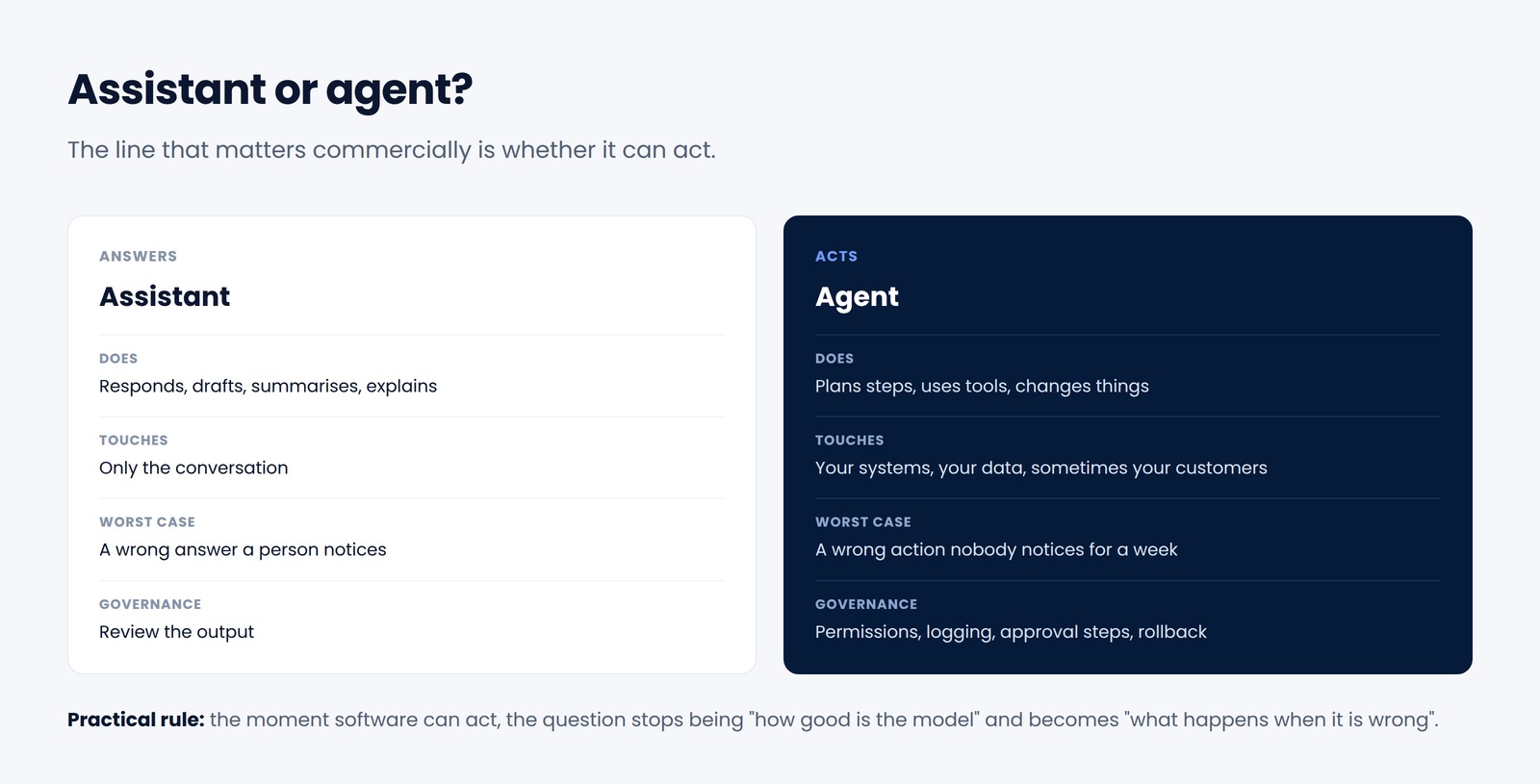
AI agents are autonomous software systems that perceive their environment, make decisions, and take actions to achieve specific goals. Unlike traditional AI (e.g., chatbots), AI agents combine large language models (LLMs), machine learning (ML), and decision-making algorithms to operate independently. Think of them as digital employees handling tasks like customer support, data analysis, or supply chain optimization.
Key Components of AI Agents
- Perception: Agents collect data from APIs, databases, or user inputs (e.g., a Kuwaiti retailer’s sales data).
- Reasoning: Using LLMs like GPT-4 or AWS Bedrock, agents analyze data and predict outcomes (e.g., forecasting demand in Dubai’s fashion market).
- Action: Agents execute tasks, such as sending emails, updating websites, or adjusting logistics routes in Riyadh.
- Learning: Agents improve over time via reinforcement learning, adapting to Middle Eastern market trends.
Why They’re Different
Unlike static AI tools, agents are proactive. For example, a chatbot answers queries; an AI agent might analyze customer behavior, suggest upsells, and update inventory—all in one workflow. In the GCC, where businesses face high operational costs, this autonomy is a game-changer.
The Business Case for AI Agents in Kuwait and the GCC
The Middle East’s digital economy is surging. Kuwait’s e-commerce market is projected to grow steadily, Dubai’s logistics sector handles 14 million tons of cargo yearly, and Saudi Arabia’s Vision 2030 aims for digital transactions by 2030. AI agents align perfectly with these trends, offering:
- Cost Efficiency: Automating repetitive tasks (e.g., customer service in Kuwaiti banks) reduces the volume of repetitive work reaching a person.
- Scalability: Dubai’s real estate firms can use agents to manage thousands of property listings, updating prices based on market data.
- Personalization: Riyadh retailers can deploy agents to tailor marketing campaigns, which helps when the underlying customer data is accurate and misleads when it is not.
- Speed: AI agents process data faster than humans, critical for time-sensitive sectors like logistics in the UAE.
No Kuwaiti or GCC blog explores these benefits in depth, leaving businesses unaware of AI agents’ potential. This post bridges that gap.
How AI Agents Work: Technology and Tools
AI agents rely on a stack of technologies, making them accessible to Middle Eastern businesses. Here’s a breakdown:
Core Technologies
- Large Language Models (LLMs): Power natural language understanding (e.g., Anthropic’s Claude, used for customer support agents).
- Model Context Protocol (MCP): A standardized framework for integrating LLMs with enterprise systems. MCP ensures agents communicate seamlessly with CRM tools like Salesforce, common in Dubai’s corporate sector.
- APIs and Data Pipelines: Agents pull data from platforms like Shopify (for Kuwaiti e-commerce) or SAP (for Riyadh manufacturers).
- Reinforcement Learning: Agents learn from feedback, refining decisions (e.g., optimizing ad spend for UAE startups).
Example Workflow
Consider a Kuwaiti online retailer:
- Data Input: The agent accesses sales data via Shopify’s API.
- Analysis: Using AWS Bedrock (an LLM platform), it predicts which products will sell out.
- Action: The agent updates inventory, emails suppliers, and launches a targeted Instagram ad for Kuwaiti customers.
- Learning: It tracks ad performance, refining future campaigns.
Tools for Middle Eastern Businesses
- AWS Bedrock: Offers pre-built AI agents for e-commerce and logistics, ideal for Kuwait and Dubai.
- Google Vertex AI: Supports custom agent development, popular in Saudi tech hubs.
- Microsoft Copilot: Integrates with Office 365, used by GCC enterprises.
- Open-Source Options: LangChain and AutoGPT allow cost-effective agent creation for startups in Amman or Beirut.
Sample Code Snippet
Here’s a Python snippet for a simple AI agent using LangChain to analyze sales data:
python
from langchain.agents import initialize_agent, Tool
from langchain.llms import OpenAI
# Define tools (e.g., access Shopify API)
tools = [Tool(name="Shopify", func=lambda x: get_sales_data(x), description="Fetch sales data")]
# Initialize LLM and agent
llm = OpenAI(api_key="your_key")
agent = initialize_agent(tools, llm, agent_type="zero-shot-react")
# Run agent
result = agent.run("Analyze last month’s sales and suggest restocking")
print(result)
This code is a starting point for Kuwaiti developers experimenting with AI agents.
Pros and Cons of AI Agents for Middle Eastern Businesses
| Pros | Cons |
|---|---|
| Automation : Frees staff for strategic tasks (e.g., Dubai marketers focusing on campaigns). | Cost : Initial setup (e.g., AWS Bedrock) is a real project with real cost. |
| 24/7 Operation : Agents handle inquiries anytime, crucial for Riyadh’s global trade. | Complexity : Requires technical expertise, scarce in smaller Kuwaiti firms. |
| Data-Driven Insights : Improves decision-making (e.g., UAE logistics optimizing routes). | Privacy Risks : Handling customer data raises compliance issues (e.g., GDPR, UAE laws). |
| Scalability : Grows with business needs, ideal for Saudi startups. | Job Displacement : May reduce entry-level jobs, a concern in Kuwait. |
Regional Applications: Kuwait, Dubai, Riyadh, and Beyond
AI agents are transforming key Middle Eastern sectors:
- Kuwait – E-Commerce: Agents automate inventory and personalize shopping . A fashion retailer might use a hosted model to drive recommendations and reorder points; the gain comes from the stock data being trustworthy, not from the model.
- Dubai – Logistics: Agents optimize routes and predict delays . Route optimisation and delay prediction are among the clearest wins, because the cost of being wrong is measurable.
- Riyadh – Finance: Saudi banks deploy agents for fraud detection and customer onboarding, aligning with Vision 2030’s digital goals.
- Broader Middle East: In Amman, startups use open-source agents like AutoGPT for marketing automation. In Beirut, NGOs leverage agents to analyze donor data.
Case Study: Kuwaiti Retail
To make this concrete, picture an electronics retailer running an agent against its own stock and supplier data. It would:
- Monitored stock levels in real-time.
- Predicted demand based on Instagram trends.
- Placed supplier orders automatically once stock crossed a threshold.
Challenges and Ethical Considerations
Adopting AI agents in the Middle East faces hurdles:
- Skill Gaps: Kuwait and Qatar lack enough AI developers, per LinkedIn data (only part of GCC tech workers specialize in AI).
- Cost: Small businesses in Amman or Kuwait may struggle with setup costs.
- Regulation: UAE’s Data Protection Law and Saudi’s Personal Data Protection Law require strict compliance.
- Ethics: Bias in LLMs (e.g., cultural insensitivity) could harm Arabic-speaking users.
Solutions
- Partner with platforms like AWS, offering training for Kuwaiti staff.
- Use open-source tools to reduce costs.
- Ensure agents comply with local laws via audits.
- Test LLMs for Arabic language accuracy, critical for GCC markets.
Getting Started with AI Agents in the Middle East
Ready to work out whether an agent is the right shape for the problem you have? That is the work described on the AI consulting page. Follow these steps:
- Identify Needs: Pinpoint tasks to automate (e.g., customer support for a Dubai hotel).
- Choose a Platform: Start with AWS Bedrock or LangChain for flexibility.
- Hire Experts: Work with AI consultants (like me!) or train staff via Coursera’s AI courses.
- Pilot a Project: start with one automated workflow — test a small agent (e.g., inventory management for a Kuwaiti store).
- Scale Up: Expand to other tasks once ROI is proven.
Resources
- AWS MENA: Offers workshops in Dubai and Riyadh.
- Coursera: AI courses with Arabic subtitles.
- GitHub: Repositories like LangChain for open-source agents.
The distinction that matters most in practice is between an assistant that answers and an agent that acts, because the second one carries liability the first does not. Before giving a model the ability to act on your systems, read the MCP explainer on how that access is actually granted and scoped, and the LLM guide on the model layer underneath. The sequencing argument — fix the process first, automate second — is in the piece on AI in operations.
Conclusion: The Future of AI Agents in the Region
AI agents are reshaping the Middle East’s digital landscape, from Kuwait’s e-commerce to Dubai’s logistics and Riyadh’s finance. By automating tasks, personalizing experiences, and scaling operations, they’re a must for businesses aiming to compete in 2025’s economy. As the region embraces digital transformation, early adopters will lead. Start small, experiment, and watch your business soar.
Contact Me for AI Consulting
Want to implement AI agents for your Kuwaiti, Dubai, or Riyadh business? With 30+ years in web experience, I can help you design, deploy, and optimize AI solutions tailored to the Middle East. From e-commerce to logistics, let’s unlock AI’s potential together. Contact me today for a free consultation.
Frequently asked questions
What is an AI agent, precisely?
Software that takes a goal, plans the steps, uses tools and acts — rather than only answering a question. The distinction that matters commercially is whether it can act on your systems or only produce text.
Are agents reliable enough for business use?
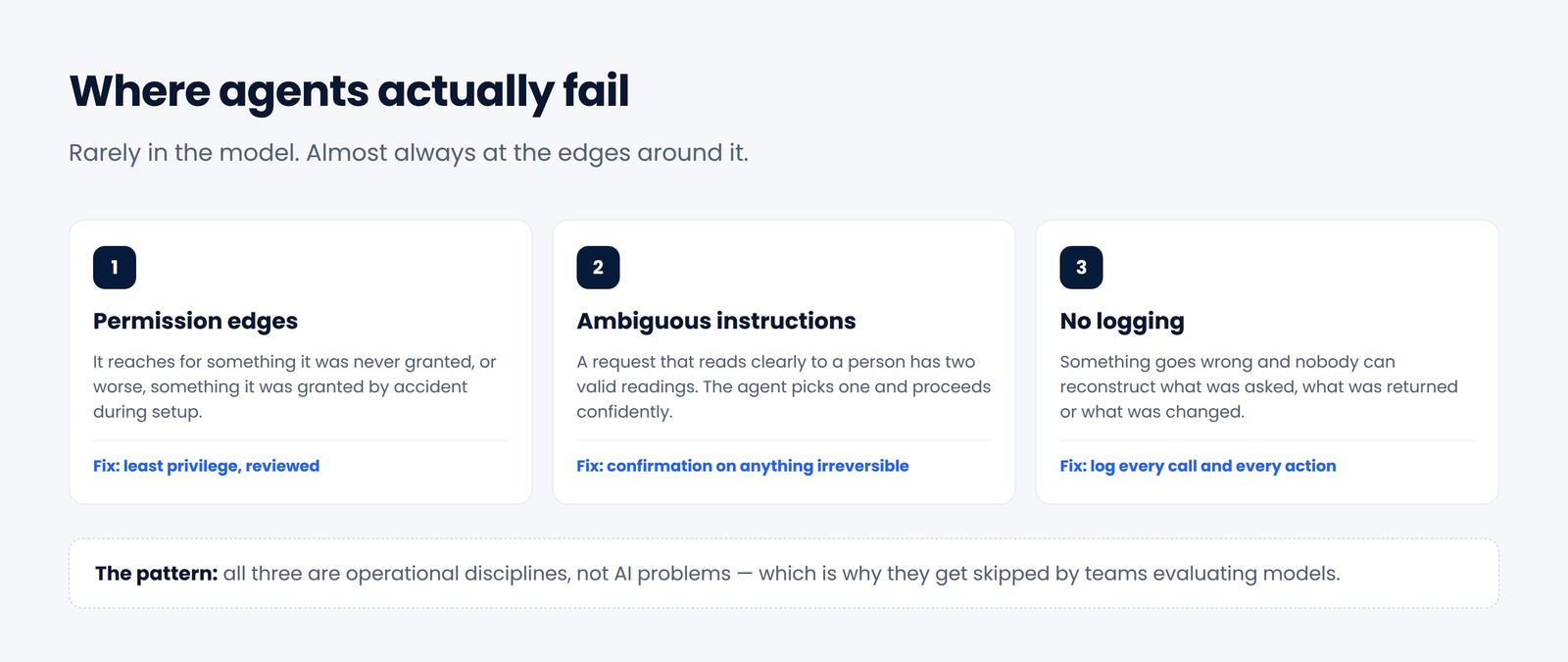
For bounded, reversible tasks with a person reviewing the result, yes. For open-ended workflows with irreversible consequences, not yet, and the gap between a convincing demo and a dependable system is wider here than anywhere else in AI.
Where do agents fail most often?
At the edges of their permissions and on ambiguous instructions. Without logging, nobody notices the failure until something downstream is visibly wrong, which is why observability matters more than model choice.
What makes a sensible first agent?
One that prepares work a person then approves — a drafted quote, a drafted reply, a reconciliation, a summary. You get the time saving without handing over the decision.