Every demo I have been shown of an AI customer-service agent was in English. Every one of them worked. Then someone on the client’s side types a real message from their own inbox — half Arabic, half English, a product name in Latin letters, a dialect word for “delivery” that does not appear in any textbook — and the room goes quiet.
That gap is not a detail to be fixed later. In Kuwait it is the project. This is what actually works, what actually fails, and how to find out which is which before you sign anything.
Start with what the benchmarks say
There is now decent published evidence rather than vendor claims. Researchers took three thousand questions, had them translated by hand into five Arabic dialects, and ran nineteen language models over the same material in English, Modern Standard Arabic and dialect.
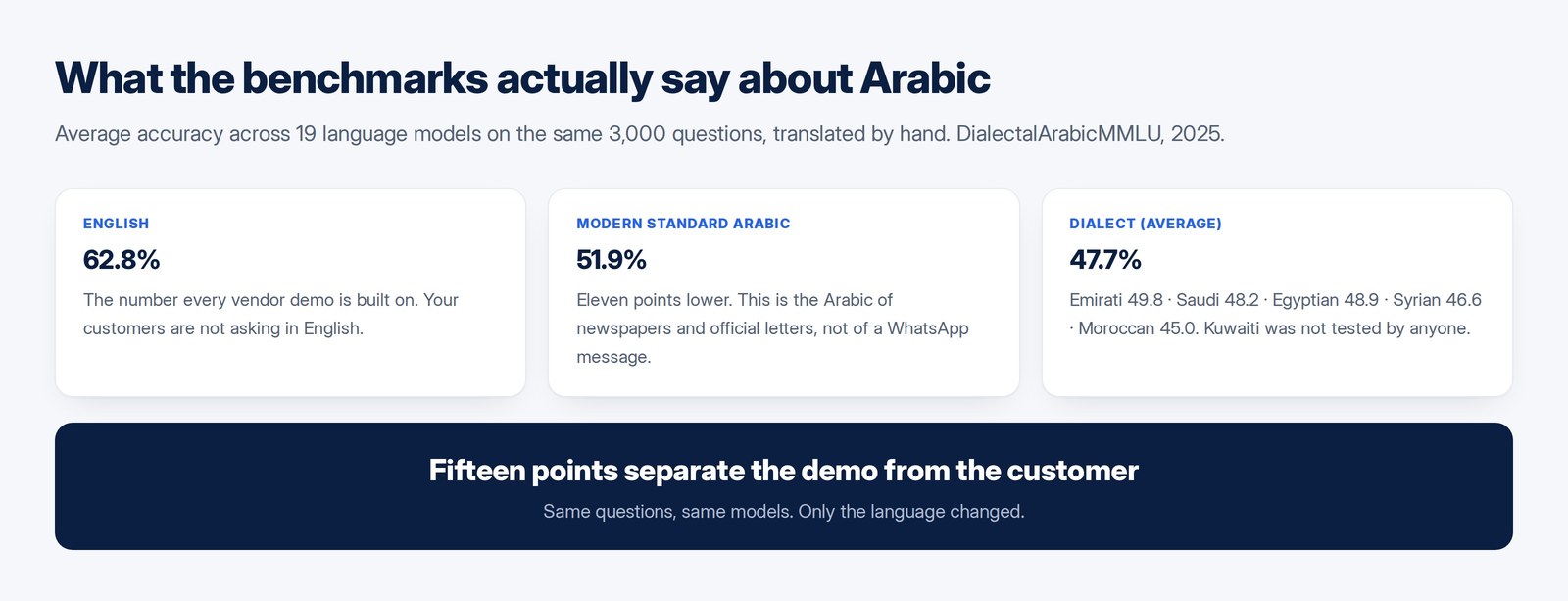
Eleven points from English to Modern Standard Arabic. Another four from Modern Standard Arabic to dialect. The DialectalArabicMMLU results put Emirati at 49.8 and Saudi at 48.2 — the two Gulf varieties tested, and the closest published proxy for Kuwaiti, because nobody has built a Kuwaiti-dialect benchmark at all. That absence is itself worth knowing: when a vendor tells you their system handles Kuwaiti Arabic, there is no public test they can be quoting.
None of this means the technology does not work here. It means the number you were shown in the demo is not the number you will get, and the gap is large enough to change what you should build.
Where it breaks, in the order it breaks
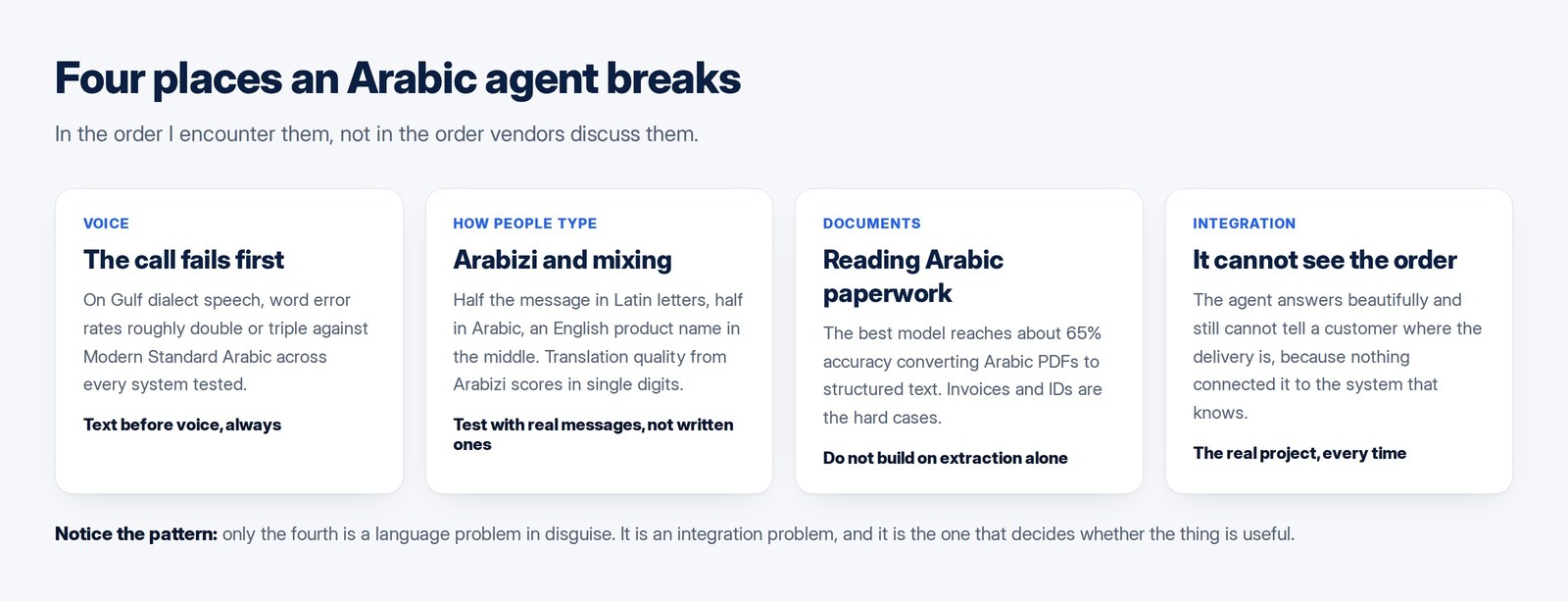
Voice fails first
If you are considering a voice agent on the phone line, look at speech recognition before anything else. On an open benchmark of Arabic speech systems, word error rates on Gulf dialect speech land between roughly 48% and 60% for the systems tested, against 19% to 28% on Modern Standard Arabic. The same models, on the same benchmark, degrade sharply the moment the speaker stops reading and starts talking.
A one-in-two word error rate is not a tuning problem. Build text first, and treat voice as a later project with its own business case.
Then the way people actually type
Your customers do not write in Modern Standard Arabic. They write in dialect, in Arabizi — Arabic in Latin letters with numbers standing in for sounds — or in both plus English in a single sentence. When researchers tested seven leading models on translation from Arabizi, translation quality scored in single digits on the standard measure, for every model and every dialect they covered.
An honest caveat: that study covered Lebanese, Egyptian and Algerian, not Gulf. I am not going to pretend a Gulf number exists when it does not. But the direction is unambiguous, and it matches what I see in real inboxes.
Then anything involving Arabic paperwork
Agents that read documents — a customer sends a photo of an invoice, a civil ID, a delivery note — inherit a harder problem. On a benchmark of Arabic document understanding, the best model reached about 65% accuracy converting Arabic PDFs into structured text, with tables and numerals among the worst cases. Design for a human to check the extraction, or do not build that feature yet.
And then the failure that has nothing to do with Arabic
The most common disappointment I am called in to look at is an agent that answers fluently and cannot tell a customer where their order is. It was never connected to the system that knows. It is a very expensive FAQ page with a chat bubble.
This is the same point I made about connecting AI to your own systems, and it is why building an assistant that reaches your systems is a different project from buying a chatbot. Conversation is the easy half.
What actually works in Kuwait right now
Four things, consistently, and all of them are unglamorous.
- Order and delivery status. High volume, low risk, one lookup, and the answer is a fact rather than a judgement. This is where nearly every successful deployment I have seen started.
- Opening hours, branches, stock in a specific branch. Same shape. Boring, constant, and a real share of your inbox.
- Triage and routing. The agent does not answer — it reads the message, works out what it is about and which language it is in, and puts it in front of the right person with the customer record already open. Most of the saving, almost none of the risk.
- Drafting the reply for a human to send. Your team stays in control, the customer gets a faster answer, and dialect mistakes are caught before they are sent rather than after.
Notice that two of the four never speak to the customer at all. That is not a compromise, it is where the arithmetic works — and it is the same logic as automating the repetitive middle of a process rather than the judgement at either end.
The escape hatch is not optional
In a survey of 3,566 customers conducted in February and March 2026, Gartner found that 87% said it is essential to be able to reach a human when a company uses generative AI for service. Not preferred. Essential.
In a market the size of Kuwait, where your reputation travels by word of mouth faster than any campaign, an agent that traps people is worse than no agent. Make the route to a person visible in the first message, not buried after three failed attempts.
The Kuwait-specific part nobody mentions
Most articles about deploying AI on customer data in the Gulf will tell you to check your data protection obligations. In Kuwait the position is less obvious than it looks, and it changed recently.
Kuwait has no single comprehensive data protection statute. CITRA’s Data Privacy Protection Regulation was narrowed by Decision No. 26 of 2024, and after that amendment it applies to CITRA-licensed telecom and internet providers rather than to businesses generally. If you are a retailer, a clinic or a restaurant group, you are quite possibly outside its scope entirely — which means most of the compliance advice written about Kuwait between 2021 and 2023 no longer describes your situation.
That is not permission to be careless. Your real constraints are contractual — what you promised customers and what your enterprise clients require of you — plus sector rules if you are regulated, plus the plain reputational cost of a leak. But it does mean the honest answer to “what does the law require of our chatbot” is narrower than a vendor selling compliance features will tell you. Verify your own position with a Kuwaiti lawyer rather than with a slide.
Worth knowing alongside it: Kuwaiti customer service is already digital-first. Central Bank figures reported for the first half of 2026 put online purchases at KD 8.5bn of KD 27.9bn in total consumer spending — roughly a third of the value, across 187 million transactions. The messages are already arriving. The question is only who answers them.
How I would test it in four weeks
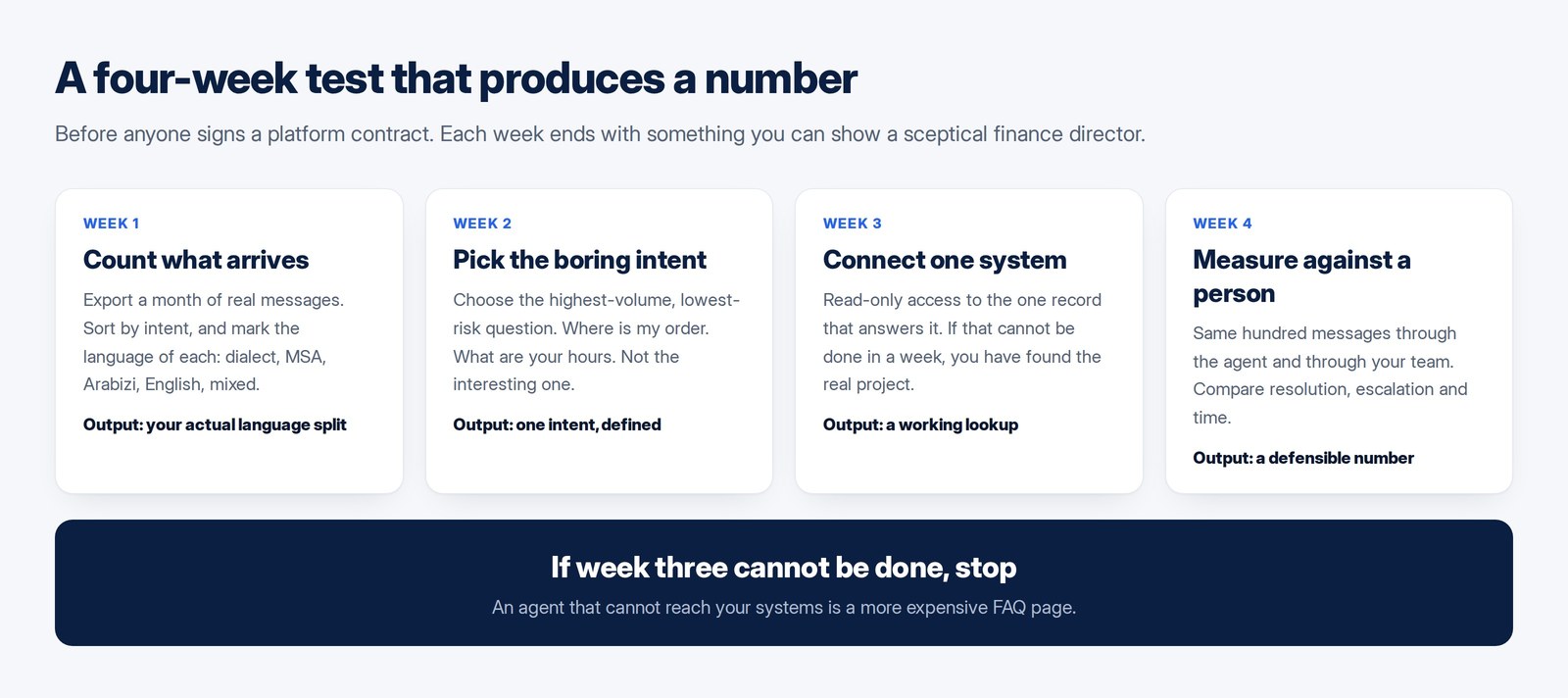
The first week is the one people skip and the one that pays. Export a month of real messages and label them by language: dialect, Modern Standard Arabic, Arabizi, English, mixed. Almost every client is surprised by their own split, and that split determines what is buildable.
Week three is the gate. If read-only access to the one record that answers your chosen question cannot be arranged inside a week, you have not found a chatbot project — you have found an integration project wearing a chatbot costume, and it should be scoped and priced as one. Gartner expects more than 40% of agentic AI projects to be cancelled by the end of 2027, citing unclear business value and cost. A four-week test is how you find out which side of that you are on for the price of a month.
If you want a second opinion before you commit to a platform, or you have a pilot that answers well and helps nobody, tell me what is arriving in your inbox. The way I work on AI starts with whether the thing is worth building at all.
Building one that clears these bars in Arabic is a specific job, and it is what my company does: custom AI assistants at Tothiq.
Frequently asked questions
Should the agent reply in dialect or in Modern Standard Arabic?
Reply in Modern Standard Arabic that is plain and warm rather than formal, and let it understand dialect. Generating convincing Kuwaiti dialect is where models are weakest and where a wrong word reads as mockery. Understanding dialect input is the easier half and the half that matters.
Is an Arabic-specific model better than a general one?
Sometimes, and it is worth testing rather than assuming. Arabic-centric models have performed well on Arabic benchmarks, but your traffic is a mix of dialect, Arabizi and English, and general frontier models are often stronger on that mix. Test both on your own messages — that is a two-day exercise, not a procurement decision.
What does this actually cost to run in Arabic?
More than the English equivalent, per message. Arabic script compresses into tokens far less efficiently than Latin script — published measurements put Arabic at about 1.28 characters per token against 2.61 for Latin — and most pricing is per token. Budget for it, and be sceptical of any estimate built from English test traffic.
Can we start on WhatsApp instead of the website?
Usually yes, and often you should, because that is where the messages already are. The channel is the easy part. The same integration question decides it: can the agent reach the record that answers the question, whichever window the customer is typing into.
How do we measure whether it worked?
Against your own people, on the same messages. Resolution without escalation, time to first useful answer, and how often a customer asked for a human anyway. Vendor containment rates are measured on their own definitions and their own markets — none of the published ones cover Arabic or the GCC, so they tell you nothing about your inbox.